How to Prevent Edge Wave with an NC Straightener Feeder?
Edge wave is one of the most frustrating defects in stamping: the strip looks acceptable at a glance, but along its edges it ripples like a ribbon, and the moment the die forms the part, that hidden waviness becomes distortion, misalignment, and scrap.
Edge wave comes from the coil itself, from the uneven stress locked into the strip when it was rolled and coiled, and it is the straightener's job to remove it before the material reaches the die.
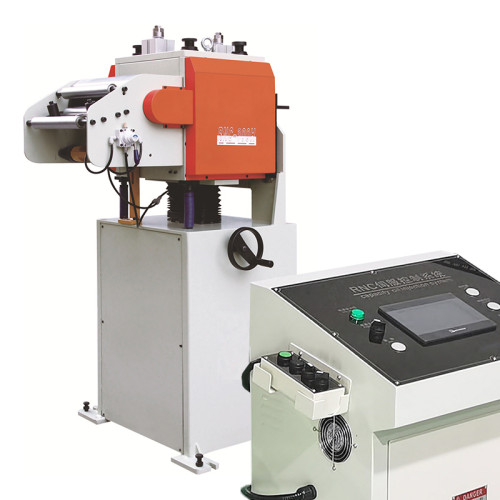
An NC straightener feeder combines flatness control with precise feeding in one machine, which makes it the most direct answer to edge wave on a stamping line.
This guide explains what edge wave is, why it survives in some lines and not others, and how to set and use an NC straightener feeder so the strip reaches the die flat, edge to edge.
What Edge Wave Is and Why It Happens
Edge wave is a waviness along the edges of a strip, usually on both edges or sometimes one, while the center of the strip remains comparatively flat. It is a flatness defect, not a thickness defect, and it comes from internal stress.
Edge wave matters in stamping because the die assumes flat material. If the strip has edge wave, the die may not close properly on the edges, parts come out with edge distortion, pilots struggle to locate the strip, and in progressive dies the strip can jam or tear at the edge.
The cost is rejects, die damage, and line stops. An NC straightener feeder is designed to address this by bending the strip through a series of staggered rolls, alternately over-bending each side to redistribute the internal stress until the strip comes out flat.
The number of rolls, the roll diameter, and the penetration depth all determine whether the straightener can actually remove the wave.
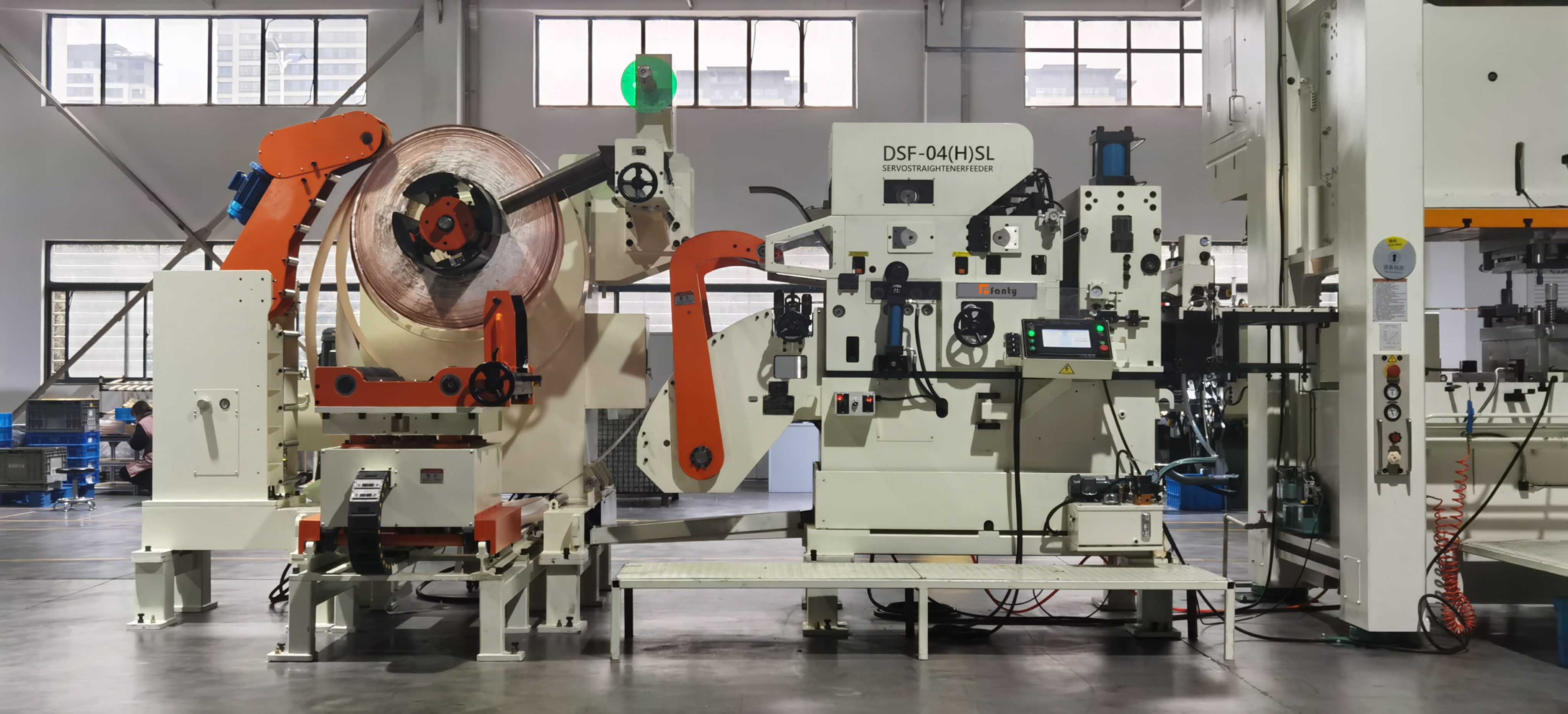
How the Straightening Rolls Remove Edge Wave
A straightener removes flatness defects by controlled over-bending. The strip passes between upper and lower rolls arranged in a staggered pattern, and each pass bends the strip around a roll, stretching the fibers on the outside of the bend.
By adjusting how deeply the rolls penetrate, the operator applies more or less bending to the strip. For edge wave, the key is that the bending must reach the edges of the strip, which is why roll width and roll alignment matter.
If the straightener is too narrow for the strip, the edges run outside the effective bending zone and the wave survives. If the roll penetration is too shallow, the strip is not worked enough to relieve the stress; if too deep, you create the opposite problem, center buckle.
An NC straightener feeder makes this adjustment practical because the roll gap is set precisely, usually with motorized or fine-thread adjustments, and the settings can be saved for each material grade.
Instead of the operator re-finding the sweet spot for every coil by trial and error, the machine recalls the straightening profile that worked for that material, thickness, and width. That repeatability is what turns edge wave removal from an art into a process.
On a FANTY NC straightener feeder, the roll gap, the number of working rolls, and the feed parameters are all stored in the controller, so the first strip of a new coil runs flat, not the third or fourth strip after several adjustments.
| Flatness Defect | Visible Symptom | Straightening Response |
|---|---|---|
| Edge wave | Ripples along one or both edges | Over-bend through full-width rolls, adjust penetration |
| Center buckle | Waviness in the strip center | Reduce center bending, balance roll pressure |
| Coil set | Strip curves along its length | Level the strip with the first straightening passes |
| Crossbow | Strip curves across its width | Balance upper and lower roll alignment |
| Twist | Strip rotates along its length | Check roll parallelism and guide alignment |
| Snaking | Strip wanders side to side | Center guides and verify line alignment |
Setting the Roll Penetration for Edge Wave
There is no single correct roll setting for every coil, but there is a reliable procedure. Start with the strip specifications: thickness, width, tensile strength, and the severity of the edge wave.
Set the roll gap so the strip is gripped but not over-stretched, then increase the penetration in small steps, running a short test strip after each step, until the wave disappears and the strip lies flat on a reference surface.
Watch for the signs of over-straightening: the center starts to buckle or the strip becomes work-hardened and brittle. The right setting is the minimum penetration that removes the wave, because unnecessary bending work-hardens the material and can hurt the forming process in the die.
Once you find the setting, save it. On an NC straightener feeder with recipe storage, the operator selects the material, and the machine sets the rolls and the feed parameters together.
This is where the machine earns its keep in mixed production: a shop running several materials and thicknesses can switch between jobs with consistent flatness, instead of relying on one operator's memory.
FANTY's straightening rolls are made of hardened alloy steel with a ground surface, so the rolls hold their profile through high production volumes, and the penetration adjustment stays accurate shift after shift.
Edge wave is only half the flatness story; the other half is what happens to the strip after it leaves the straightening rolls. A strip that is flat but fed unevenly will still produce distorted parts, because the die depends on both flatness and position. This is why the straightener and the feeder belong together.
In an NC straightener feeder, the straightening rolls and the servo-driven feed rolls are timed on the same controller, so the strip is leveled and then metered at a precise pitch without stopping between the two operations.
The servo feed part of the machine works the same way as a dedicated NC servo feeder: it holds ±0.05 mm feed accuracy and synchronizes to the press crank angle, so the flat strip arrives at the die at exactly the right moment, every stroke.
By combining the two functions, an integrated machine removes one more hand-off point where a flat strip could be turned into a bad part, and that is the difference between a line that occasionally produces good parts and a line that produces them consistently.
- Inspect the strip edges before straightening to identify the defect type.
- Set the roll gap so the full strip width is within the bending zone.
- Increase penetration in small steps and test after each adjustment.
- Stop at the minimum penetration that removes the wave to limit work hardening.
- Save the proven settings as a recipe for that material grade.
- Check roll surface condition monthly; worn rolls cannot produce flat strip.
Edge Wave FAQ
Can any straightener remove edge wave, or do I need a specific design?
The straightener must have enough working rolls, the right roll diameter for the material thickness, and rolls wide enough to cover the full strip. A machine that is too light or too narrow cannot reach the edges effectively. This is why straightener selection starts with your material range.
How do I know whether my edge wave is coming from the coil or the line?
Test a strip section directly after the straightener on a flat reference surface. If the strip is flat there but the parts still distort, the problem is downstream, likely feeding or die alignment. If the strip still waves, the straightener settings or capacity are the issue.
Is over-straightening harmful?
Yes. Over-bending work-hardens the material, reducing ductility and making the strip harder to form in the die. The correct setting is the minimum penetration that removes the defect. Recipe storage on an NC straightener feeder helps avoid re-discovering this balance for every coil.
Why choose an NC straightener feeder instead of separate straightener and feeder units?
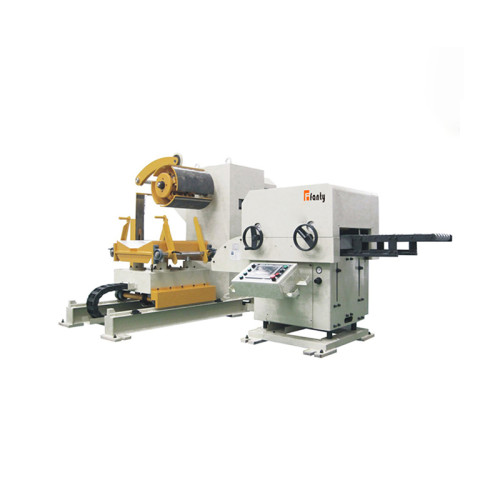
An integrated NC straightener feeder aligns the straightening rolls and the feeding rolls on one frame, so the strip is leveled and metered in one controlled pass with fewer hand-off points. It also saves floor space and simplifies the line, which is why many shops prefer the 3-in-1 decoiler straightener feeder configuration.
Related reading
- five-roll straightening up to 4 mm
- how leveling improves strip flatness
- how to hit a flatness spec on a coil line
Part of the 3-in-1 decoiler straightener feeder — the full library of coil handling, straightening and feeding guides from FANTY.
Run Flat Strip, Every Coil, Every Shift
Ask FANTY about an NC straightener feeder sized for your material range, built in our 45,000 m² factory.
Get a Recommendation