How Many Straightening Rolls Does Your Coil Line Need?
The number of straightening rolls in your decoiler-straightener is the single most important factor determining whether your strip comes out flat enough for precision stamping. Too few rolls and thin or high-strength material retains curl, causing feeding faults and scrapped parts. Too many rolls and you pay for capability - and maintenance - you may never use. Straightening machines typically carry 5 to 21 rolls, arranged in upper and lower banks with the upper bank adjustable to create the intermesh that bends the strip back and forth until it relaxes flat. This guide explains how roll count relates to material thickness and strength, how roll diameter and spacing affect flatness, and how FANTY sizes the roll configuration of a decoiler straightener for different stamping applications.
How Straightening Actually Works
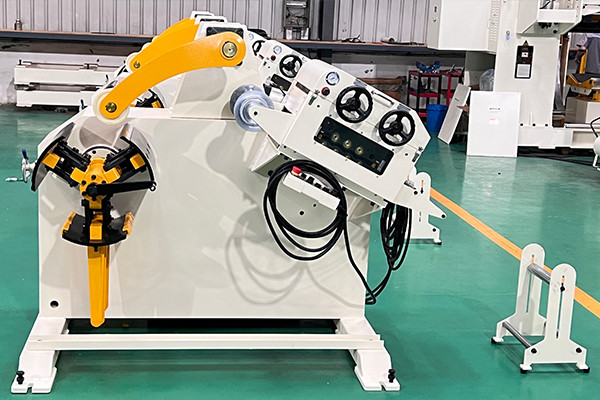
A coil is never flat when it comes off the mill or the slitting line. The strip carries residual curvature and internal stress from the coiling process, which shows up as coil set, crossbow, camber or edge wave. Straightening removes this by passing the strip between staggered upper and lower rolls. As the strip bends alternately up and down, the outer fibers yield in tension while the inner fibers yield in compression, and after enough reversals the residual stress evens out and the strip exits flat. The key variables are the number of bends, the depth of each bend (the intermesh), the roll diameter and the roll spacing. More bends, with the right depth, mean more complete stress relief - which is why roll count matters so much for demanding applications.
The intermesh is the depth the upper roll bank pushes into the strip, and it must be set according to material thickness, strength and the amount of coil set. For thick, heavy strip you need deeper intermesh and stronger construction to bend it; for thin, soft strip you need lighter pressure and precise adjustment to avoid work-hardening or scratching. Modern straighteners - including FANTY's NC servo straighteners - motorize the intermesh adjustment, which makes setup repeatable and lets the operator dial in the exact flatness required. Manual adjustment by turning screws by feel is the largest source of inconsistent flatness in older lines.
Roll Count Guidelines by Material and Application
There is no universal answer, but the industry has settled on practical ranges. For coil-fed stamping of common thicknesses, the table below summarizes typical straightening roll configurations and the applications they suit best.
| Roll Count | Typical Thickness | Best Application | Trade-off |
|---|---|---|---|
| 5–7 rolls | Over 6 mm | Heavy plate stamping, thick blanks | Simple and strong, limited flatness |
| 7–11 rolls | 2–6 mm | General stamping, structural parts | Good balance of strength and flatness |
| 11–17 rolls | 0.5–3 mm | Precision progressive die stamping | Excellent flatness, higher maintenance |
| 17–21 rolls | Under 1 mm | Thin strip, electronics and fine blanking | Maximum flatness, delicate setup |
The rule of thumb is simple: thinner material needs more rolls with smaller diameter, because thin strip requires more bending reversals to relieve stress, and small-diameter rolls create the sharp bends thin material needs. Thick material needs fewer but larger and sturdier rolls, because the machine must develop enough bending force to yield thick section without flexing the roll shafts. Roll diameter and spacing are just as important as count: for a given material thickness, the roll diameter determines how sharply each bend is, and a smaller pitch between rolls means more bends fit in a given length of strip. FANTY matches roll count, diameter, pitch and frame strength together so that the straightener is correctly engineered for the material range, not merely fitted with more rolls.
How to Decide the Right Configuration
Start by listing every material you will process: thickness range, tensile strength, coil width and the flatness requirement of the finished part. Flatness is not one standard - a heavy structural part tolerates more residual curvature than a precision electrical contact. For most precision progressive die stamping up to 3 mm, an 11- to 17-roll straightener with motorized intermesh gives the best balance. For mixed production spanning thin and thick material, choose a straightener whose roll configuration is optimized for the thin end, because thick strip can be handled by reducing intermesh while thin strip cannot be made flat by a coarse machine. FANTY engineers ask for your full material matrix before recommending a roll configuration; we rarely recommend maximum roll count unless the thin-material share justifies it.
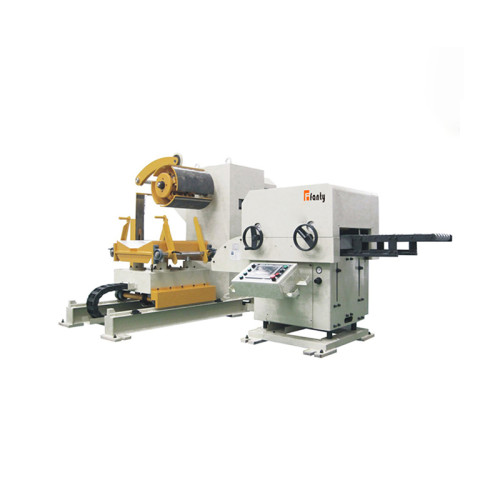
Consider also the feeding side. In a decoiler-straightener-feeder combination, the straightener works in tandem with the NC servo feeder, and the flatness of the strip leaving the straightener directly affects feeding accuracy. If the strip retains a visible curve, the feeder rollers cannot grip it uniformly, and the feeding pitch drifts. This is why high-speed lines pair a well-configured straightener with a servo feeder and why FANTY validates the combination - strip flatness, feeding accuracy within ±0.05 mm and speeds up to 200 SPM - as one system before delivery. The straightener is not an accessory; it is half of the precision story.
- List your full material matrix before choosing roll count, diameter and pitch.
- Optimize for the thinnest and highest-strength material in your range.
- Prefer motorized intermesh adjustment for repeatable, accurate setup.
- Check roll hardness and surface finish for your material's abrasive load.
- Verify frame rigidity: flexible frames cannot hold consistent intermesh.
Maintenance and Roll Life Considerations
More rolls mean more bearings, more shafts and more potential failure points, so maintenance discipline matters on high-roll-count machines. Roll surfaces wear with every meter of strip, especially when processing abrasive or pickled material, and worn rolls develop scoring that marks the strip surface. Inspect roll surfaces monthly for grooves, pitting and discoloration, and measure radial runout quarterly with a dial indicator; a roll that runs out more than a few hundredths of a millimeter leaves a periodic mark in the strip and causes flatness variation. Bearings should be checked for play and re-greased on schedule, and the frame should be checked for any flex under load, since frame movement changes the intermesh gap.
When rolls do wear out, replace them as a set with matched diameters, never one at a time, or the strip will develop periodic flatness defects. FANTY manufactures straightening rolls in-house with hardened, ground surfaces and supplies matched replacement sets with documented runout, so customers can restore original flatness after years of service. We also provide the intermesh setting table for each material, which shortens setup and protects the rolls from overloading. A straightener that is set correctly and maintained on schedule will run for many years; the machines FANTY has installed across 200+ lines in 60+ countries are proof that roll configuration, build quality and service discipline together determine real-world flatness.
Common Questions About Straightening Rolls
Does more straightening rolls always mean flatter strip?
Not automatically. Roll count must match the material: thin strip needs many small rolls, thick strip needs fewer large rolls. The intermesh depth, roll diameter, spacing and frame rigidity matter as much as the count. The right configuration for your material range is what makes strip flat.
What roll count do I need for 1 mm stainless steel strip?
For stainless around 1 mm, a straightener in the 11- to 17-roll class with motorized intermesh is typical. Stainless work-hardens easily, so roll surface quality and gentle, precise intermesh control are critical to avoid marking or stiffening the strip.
How often should straightening rolls be replaced?
Depends on material and hours: abrasive or thick material wears rolls faster, sometimes in 1 to 2 years of heavy duty; gentle thin-strip use can last 5 years or more. Inspect monthly, measure runout quarterly, and replace as matched sets when scoring or runout exceeds the tolerance in your manual.
Get the Right Straightener for Your Material
FANTY engineers will match roll configuration, drive and controls to your exact material matrix - backed by 12 years of experience, a 45,000 m² factory and 370 staff.
Get a Straightener Recommendation