How Does an NC Straightener Feeder Reduce Strip Stress?
Every coil carries residual stress, and if that stress survives until the die, it shows up as camber, twist, and parts that drift out of tolerance. The straightener inside an NC Straightener Feeder exists for one reason: to remove that stress from the strip before the press ever sees it.
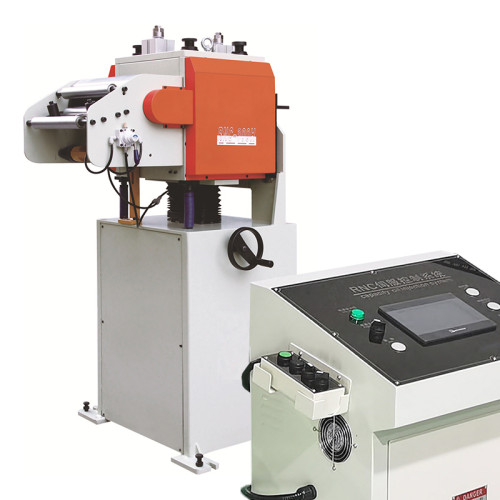
This guide explains the mechanics of strip stress, how straightening rolls cancel it out, and why a servo-driven straightener feeder produces flatter strip and more stable parts than any separate machine setup.
What Strip Stress Actually Is
When a coil is wound at the steel mill, the strip is bent plastically around the coil diameter, and that bending leaves a permanent pattern of residual stress across the strip width.
The problems start when that stressed strip enters the die. A progressive die pilots the strip at fixed positions, and the die assumes the strip is flat and straight.
If the strip carries curvature or camber, the pilots see a different material position on every stroke, part dimensions drift, pilots wear unevenly, and some parts fail inspection. Even when the defects are small, they steal accuracy from a line that could otherwise hold tight tolerances.
Removing the residual stress before the die is not a quality luxury; it is a prerequisite for consistent stamping, which is why the straightener is a mandatory station between the decoiler and the press in any serious coil feeding line.
How Straightening Rolls Cancel Residual Stress
The straightener works by bending the strip repeatedly in alternating directions as it passes between a row of rolls. Each roll bends the strip a little beyond its yield point, and every cycle of bending and straightening overwrites the previous stress pattern.
The number of rolls and the roll diameter matter enormously. More rolls with smaller diameters create more bending cycles and do a better job on thin material, while thick material needs larger diameter rolls with more penetration force.
This is why a one-size-fits-all straightener is a myth: the correct machine is sized for your material range, and the roll gap must be adjustable so the operator can tune the penetration for each grade.
FANTY straighteners are built with precision-ground rolls, rigid frames, and adjustable gaps, and our engineers size the roll configuration for the specific width and thickness range of each customer line, backed by more than 80 R&D engineers and twelve years of coil handling experience.
Stress Defects and How the Straightener Fixes Them
Residual stress shows up in three recognizable defects, and each one tells you something about the strip and the straightener setup. Coil set is the visible curvature that follows the original coil radius; it is the easiest defect to fix, and a correct roll gap removes it in the first pass.
Camber is a sideways bow where the strip forms an arc across its width, usually caused by asymmetric stress between the two edges; it requires either more roll penetration or a slight roll offset to correct.
Twist is a spiral deformation, common in narrow strip, and it needs rolls that grip the strip uniformly across the width.
The table below summarizes the three defects, their causes, and the straightener adjustments that fix them. Keep it at the machine, because recognizing which defect you are fighting saves hours of trial and error.
| Defect | Visible Sign | Root Cause | Straightener Fix |
|---|---|---|---|
| Coil set | Strip curls along its length | Original coil radius remains | Increase roll penetration depth |
| Camber | Strip bows sideways | Asymmetric edge stress | Adjust roll offset or entry alignment |
| Twist | Strip spirals across width | Non-uniform roll grip | Level the roll stack and guide pressure |
| Wavy edge | Ripples along one edge | Edge stress mismatch | Fine-tune gap per edge with segmented backup |
The last row deserves a note, because wavy edge is the defect that most operators misdiagnose. A wavy edge means one side of the strip is longer than the other after uncoiling, which is an edge stress mismatch from the mill.
The straightener can correct it, but only if the backup support behind the work rolls can be adjusted independently across the width, so the operator can add more penetration on the tight edge.
Machines without segmented backup rolls simply cannot fix wavy edge, which is why you should ask about roll support design before you buy any straightener.
Why the Straightener and Feeder Must Work as One
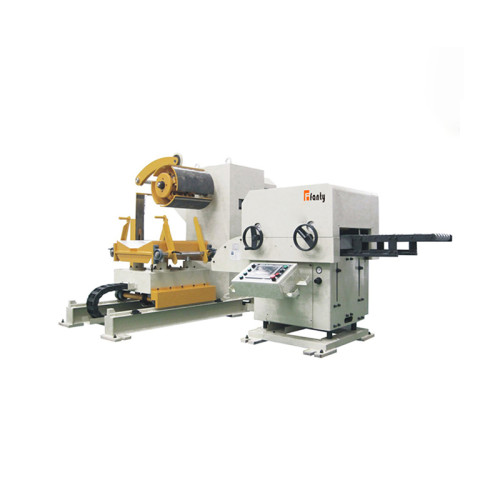
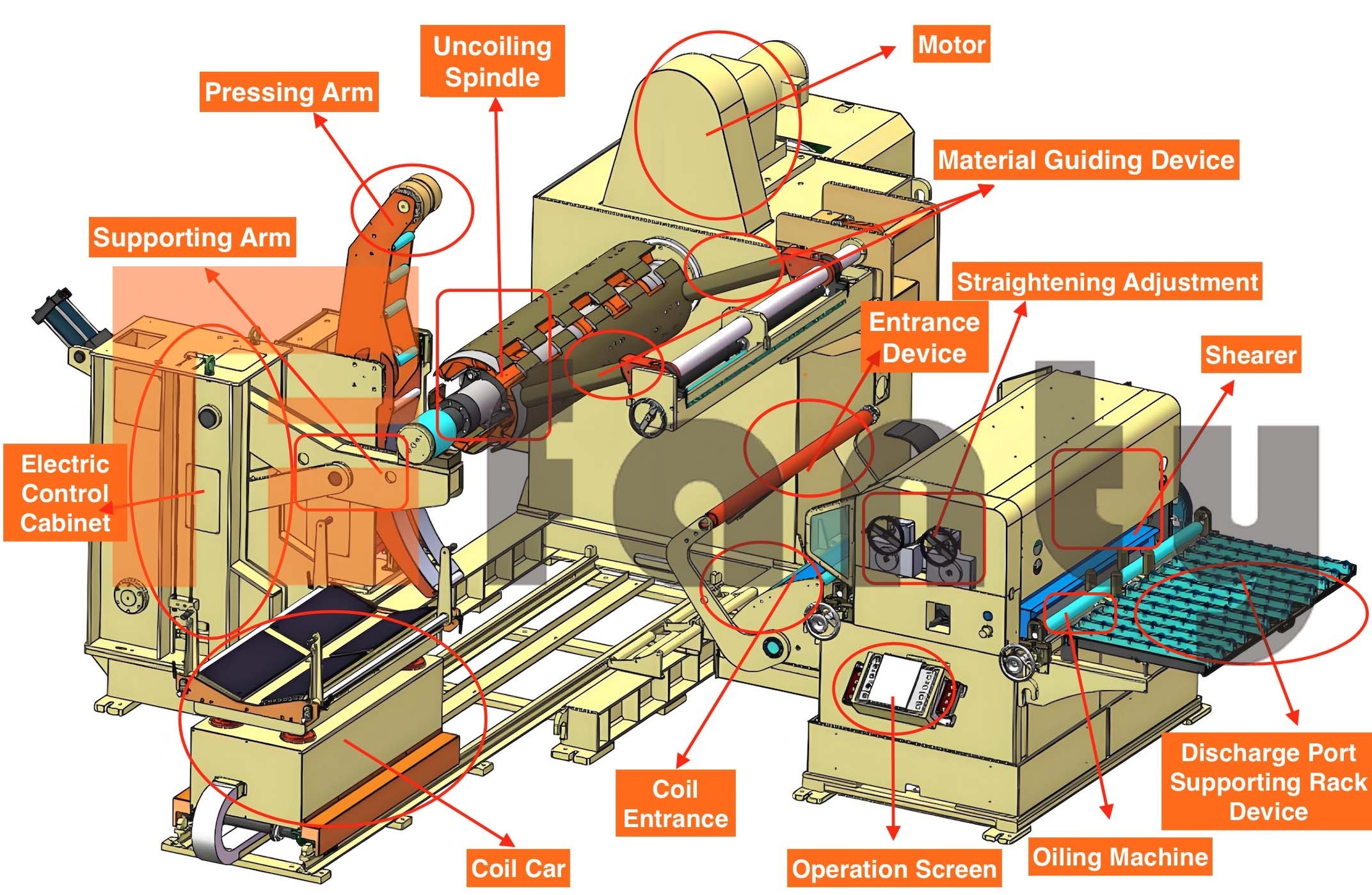
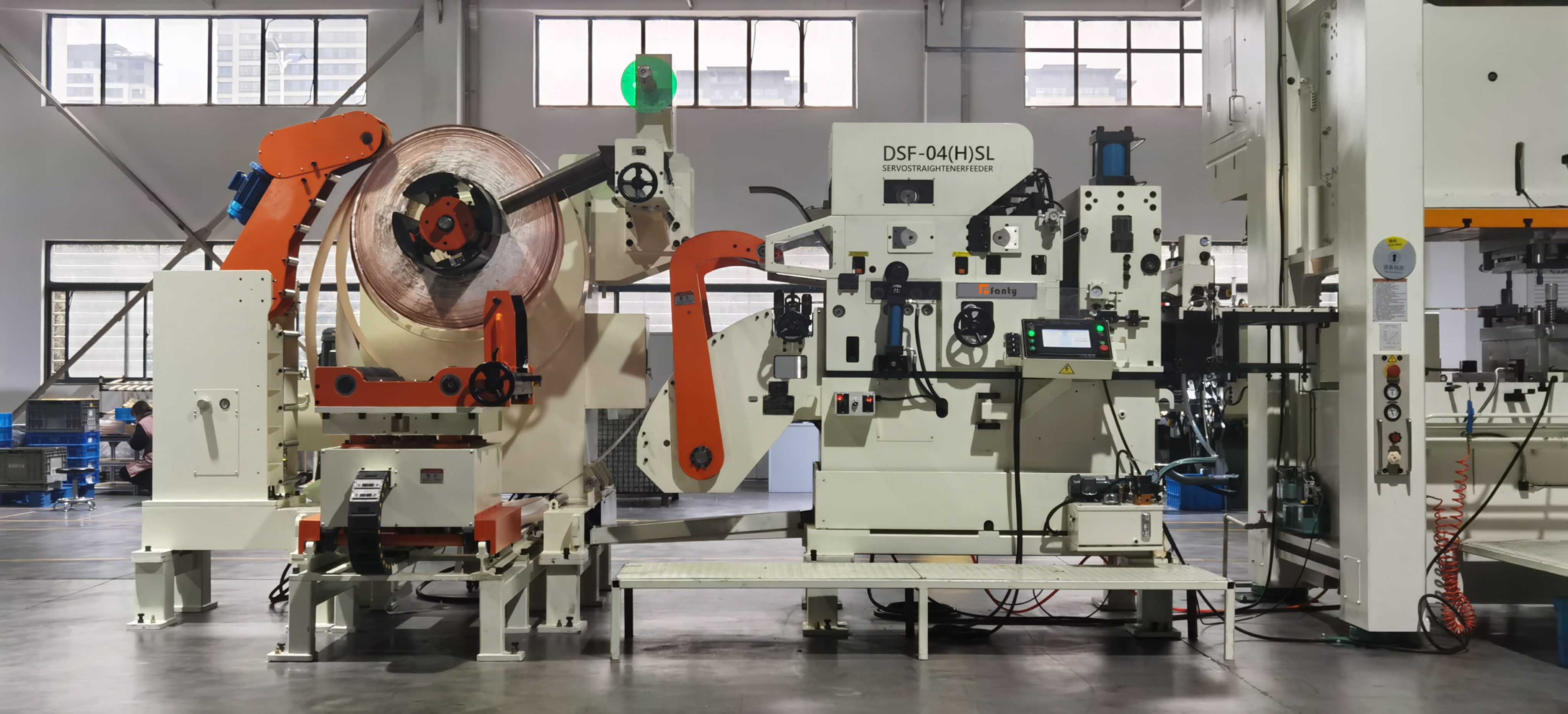
Strip stress is removed before the die, but the straightening process only delivers value if the strip enters the die flat, straight, and at the correct speed. That is where the integration of the 3-in-1 decoiler straightener feeder earns its keep.
In a separately assembled line, that coordination is fragile. Different frames settle at different rates, alignment shifts over time, and the straightener and feeder can end up pulling against each other, which reintroduces stress and destroys the very flatness the straightener created.
An integrated machine avoids all of that by design: the alignment is set at the factory, the frame is common, and the controls coordinate unwind tension, straightening, and feeding in real time.
FANTY machines are engineered this way, and the result is strip that reaches the die flat and stable, stroke after stroke, which is why our lines hold feeding accuracy at ±0.05 mm even on demanding progressive die work.
Operator Tips for Tuning the Straightener
Tuning a straightener is a skill, but it follows simple logic that any operator can learn in a day.
Two golden rules keep the tuning stable over time. First, change one adjustment at a time and give the strip a few meters to respond, because the effect of a roll change appears gradually.
Second, record the final settings for every material in a recipe, including the straightener gap and any roll offsets, so the machine returns to a proven setup instantly on the next run of that material.
FANTY controllers support complete recipes that include straightener settings, and our service engineers train operators on this exact workflow, which is one reason our machines are trusted in more than 60 countries.
- Check the strip exit flatness visually before starting full-speed production
- Adjust one roll or guide at a time and let the strip settle before judging
- Watch for wavy edges on high-tensile material; they need segmented backup rolls
- Clean and inspect work rolls weekly; scratches transfer directly to the strip
- Save verified straightener settings as named recipes per material
- Escalate recurring camber or twist to the supplier with coil samples
Stress Reduction Also Protects Your Die and Your Safety
Removing strip stress does more than improve part accuracy; it protects the most expensive asset in the line, the die. A flat strip enters the die at a consistent position, so the pilots guide it cleanly and the punches cut at the intended location. A stressed strip drags sideways against the pilot bushes and guide plates, wearing them out months ahead of schedule, and every die service is downtime plus tooling cost. Die protection is the quiet return on a good straightener, and it compounds every shift.
There is a safety dimension as well. A strip that suddenly releases stored stress can whip, curl up, or jump out of the guides, and that behavior at high speed is dangerous for the operator and damaging for the machine.
A proper straightener with correct tuning removes that stored energy gradually and predictably, so the strip moves through the line calmly.
FANTY builds CE-certified straightener feeders in a 45,000 square meter factory with 370 employees, and safety is designed into the guarding, the controls, and the material path, so your operators work with a line that behaves predictably even on difficult material.
Frequently Asked Questions About Strip Stress
Can a straightener remove all residual stress from a coil?
No machine removes all stress, and that is not the goal. The straightener removes the coil set and the gross stress pattern that causes camber, twist, and wavy edges, leaving the strip flat enough for the die to work accurately. The remaining uniform stress is harmless to the stamping process.
Why does my strip still have camber even with the straightener?
Camber usually means the roll penetration is not deep enough for that material, or the strip is entering the roll stack at a slight angle. Check the entry alignment first, then increase penetration gradually on the opposite side of the bow. If camber persists, the coil itself may have a serious edge stress mismatch.
How many straightening rolls do I need?
Thin material benefits from more rolls with smaller diameters because it needs many gentle bending cycles, while thick material needs fewer, larger rolls with more force. A typical NC Straightener Feeder uses 5 to 11 work rolls depending on the thickness range, and the right configuration is determined by your specific material envelope.
Does the straightener affect feed accuracy?
Yes, indirectly but importantly. A curved strip feeds differently at the start and end of each feed cycle, which adds error to the pitch. Once the straightener produces a flat, stable strip, the servo feeder sees consistent material behavior, and that is part of how an integrated machine holds ±0.05 mm accuracy.
Related reading
- five-roll straightening up to 4 mm
- how leveling improves strip flatness
- how to hit a flatness spec on a coil line
Part of the 3-in-1 decoiler straightener feeder — the full library of coil handling, straightening and feeding guides from FANTY.
Get Flat Strip and Stable Parts with the Right Straightener Feeder
Send us your material range and press details, and FANTY engineers will size the straightening rolls and feed system for your line. CE certified, built in a 45,000 m2 factory, trusted in 60+ countries.
Talk to Our Stamping Engineers