Which Coil Line Layout Serves Two Presses From One Coil?
Two presses, one coil, one NC straightener feeder. It reads like an obvious saving on paper and it creates a specific set of problems on the floor.
The question is not whether the presses can share a coil. They can. The question is where the strip splits, and that single decision sets the cost, the changeover and the scrap rate.
Three layouts do most of the work in real plants. Two of them are usually wrong for a given shop, and the reasons are arithmetic rather than preference.
One Coil, Two Presses: What the Layout Has to Solve
A shared coil line has to deliver strip to two dies that will not consume it at the same rate, at the same moment, or with the same feed length.
If both presses run the same part at the same speed, the problem is trivial. In practice they rarely do, and the layout has to absorb the difference.
Three things break first when a shared line is laid out badly. The loop collapses on one side while the other side runs long. Feed length drifts on the press furthest from the straightener.
And scrap climbs because the second press starts on strip the first press has already marked.
Each of those is a layout symptom, not a control symptom, and no amount of tuning in the servo drive will fix a strip path that was drawn wrong.
So the first decision is not the machine. It is the geometry of the split.
Three Layouts That Actually Work
Every shared-coil arrangement we have commissioned comes down to one of three architectures, and each one carries a different cost structure.
| Layout | What It Gives the Run | Where It Costs You |
|---|---|---|
| Split after the straightener, two feed units | Each press gets its own feed length and its own timing; both run independent jobs | Two feed units, two sets of rolls to maintain, and a longer strip path |
| Split at the decoiler, two complete lines | Total independence; a stop on one press does not touch the other | Two decoilers, two straightener heads, and roughly double the floor space |
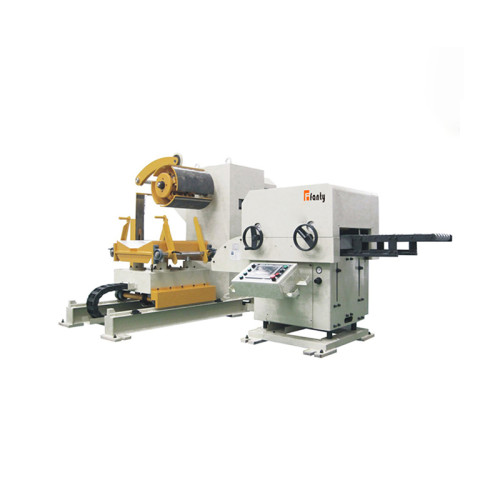
| Split after one 3-in-1, one feed unit, diverter | Lowest capital cost and the smallest footprint of the three | The two presses must share a feed length and a takt, and can never run different parts |
The third row is the one buyers ask for and the one that disappoints most often. It works, but only inside a narrow set of conditions.
A diverter after a single feed unit means both presses receive strip on the same cycle. If one die needs 60 mm of feed and the other needs 45 mm, that layout cannot serve them.
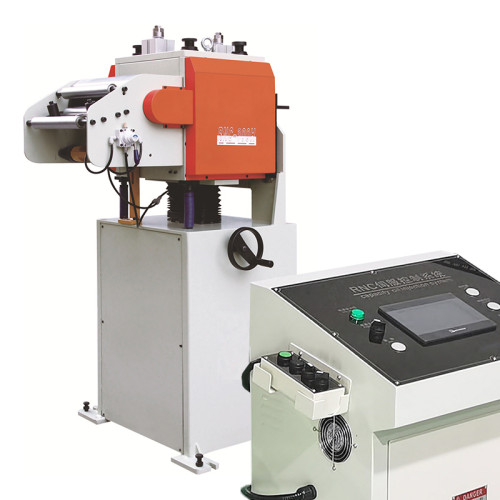
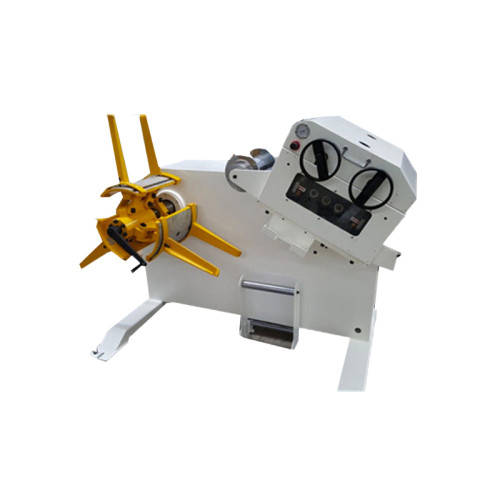
The first row is the compromise most plants settle on. One decoiler and one straightener head, then a split with an independent feed unit for each press.
It costs more than a diverter and less than two complete lines, and it keeps the expensive part — the straightener head and the decoiler — shared.

Where the Split Happens Decides Everything
The split point is the only decision that cannot be changed later without rebuilding the line, so it deserves the most thought.
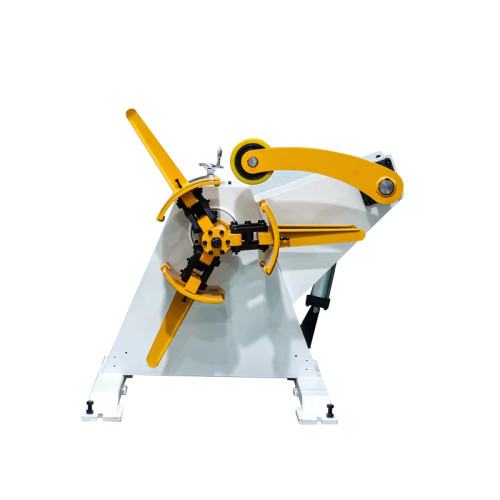
Split before the straightener. Each press gets its own straightener head and feed unit. Strip quality is independent, which matters when the two dies run different thicknesses.
Split after the straightener. Both presses get identically straightened strip. Feed length is independent, flatness is not, and that is usually the right trade.
Split after the feed unit. Both presses see the same feed length and the same flatness. It is the cheapest layout and the least flexible by a wide margin.
A loop pit or a dancer between the split and each feed unit is not optional. Without slack storage, a stop on one press instantly starves the other.
The loop also absorbs the difference in cycle time. A 45 SPM press and a 60 SPM press can share a coil line only if the slower press has enough accumulated strip to keep feeding while the faster one runs.
Size the loop for the slower press's takt, not the average. On a 60 SPM press running a 45 mm feed, a 15-second stop consumes roughly 4.5 metres of strip.
Any line with a shared feed unit also shares an error budget, and that budget is worth reading before the layout is fixed.
The full chain, from decoiler to die, is set out in the coil line guide library.
Cost and Floor Space, Side by Side
Price alone does not separate the three layouts. Floor length, changeover time and scrap do the rest of the work.
| Layout | Relative Capital Cost | Line Length for a 1,300 mm Coil | Where It Hurts You Later |
|---|---|---|---|
| Two complete lines | Highest | About 14 metres total | Two of everything to maintain, and two operators if the presses run together |
| Shared decoiler and straightener, two feed units | Middle | About 9 metres total | Feed length tuning is per press and has to be redone after every roll change |
| One 3-in-1 with a diverter | Lowest | About 6 metres total | No independent feed length and no independent timing, ever |
Look at the second and third rows together. The diverter layout saves roughly 3 metres of line and one feed unit, and gives up all scheduling independence.
Whether that trade is worth it depends on how the plant plans production. Two presses running the same part on the same shift suit a diverter. Two presses running different parts do not.
Scrap is the cost line most comparisons miss. On a shared feed unit, a misfeed stops both presses, and the strip in the loop at that moment is scrapped from both sides.
Which Layout Fits Which Shop
Four questions settle the choice in most plants, and the answers usually point in the same direction.
- Do the two presses ever run different feed lengths? If yes, the diverter layout is out immediately
- Do the two dies run the same material thickness? If not, the split has to happen before the straightener
- Is there 9 metres of clear floor length? Under that, two complete lines are not physically possible
- How often does one press stop while the other runs? Frequent single-press running forces independent loops
The third question is often the one that decides it. A plant with 7 metres of bay length has one option, not three.
Layout questions come up in every shared-coil project we quote, and the same four come back most often.
How many metres of strip does a shared loop need for a 15-second stop?
Size it for a 15-second stop on the slower press. At 45 SPM and a 45 mm feed that is about 4.5 metres of accumulated strip.
Can one 3-in-1 line feed two presses running different parts?
Only if both dies use the same feed length and the same takt. In practice that means the same part, or two parts designed together.
How much floor space does a shared line save on a 1,300 mm coil?
Around 5 metres on a 1,300 mm coil line — roughly 9 metres instead of 14. That saving is usually the reason the project exists.
Does a shared decoiler limit coil weight above 6 tonnes?
No, but it doubles the coil changes on the decoiler. At 6-tonne coils and three coils per shift, the changeover time becomes the line's real constraint.
Where a Shared Coil Line Is the Wrong Answer
Sharing a coil line is a saving on paper and a liability in four situations, all of them predictable before the order is placed.
When the two presses are never scheduled together. If they run on different shifts, you have paid for a shared decoiler and still need two strip paths with their own loops.
When one die is a bottleneck part. A shared line means a stop on the low-volume press can idle the high-volume one, and that lost output is never on the quotation.
When thickness differs by more than about 0.8 mm. One straightener head cannot hold flatness on 0.6 mm and 2.5 mm strip in the same setup without a full re-set between jobs.
When the strip is coated or pre-painted. Every extra roll and every extra metre of strip path is another place to mark the surface, and a shared line doubles the path length.
None of that argues against sharing the decoiler. It argues for sharing the decoiler and the straightener head while keeping the feed units separate, which is where most of the savings actually sit.
More than 200 of these combined lines are in the field, and the pattern holds: the plants that kept independence at the feed unit are the ones that still run the layout unchanged five years later.
What to Specify Before You Choose
Four numbers on the enquiry sheet turn this from a preference into a calculation.
Give the feed length and takt for both dies. Give the thickness range the line must cover. Give the maximum coil weight and outside diameter. Give the available bay length.
With those four, the layout falls out of the arithmetic. Without them, every supplier will quote the layout that suits their catalogue best.
CE-certified and shipped into more than 60 countries, these lines are specified against the two dies that will actually run on them, not against a generic press pair.
Where to go next
Layout, loop sizing and feed accuracy form one cluster in our coil line knowledge base. This article sits under it, one layer below the specification overview.
The Coil Line Guide Library