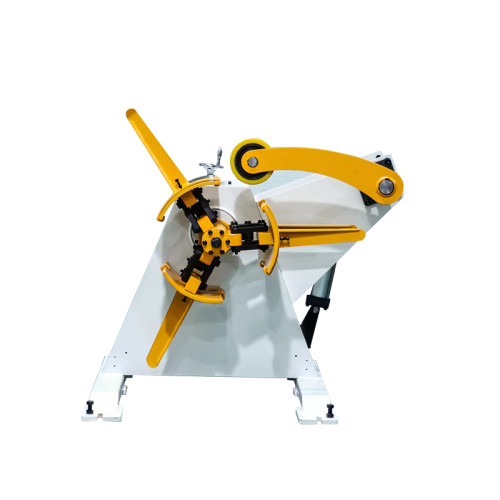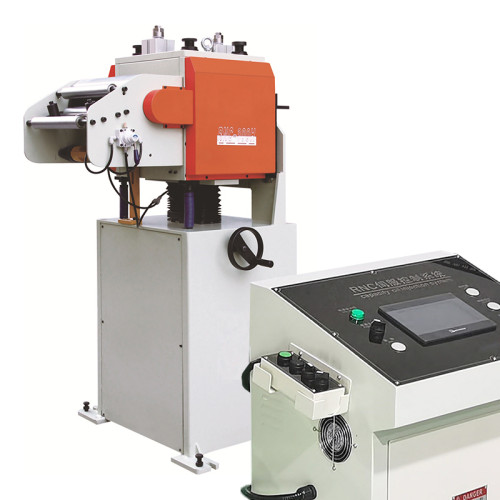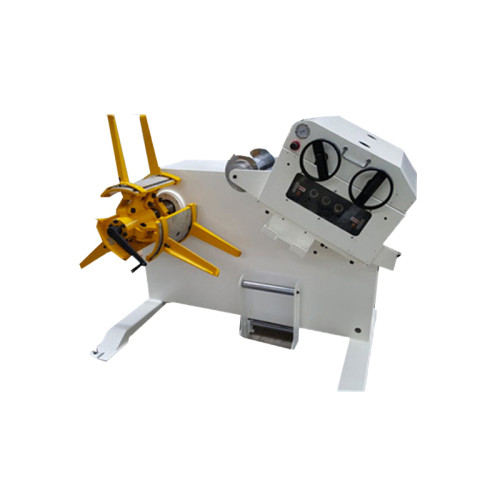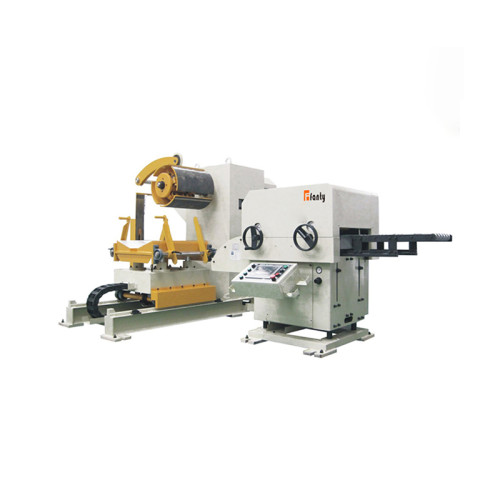
Which Brake Holds Back-Tension on a Heavy Duty Uncoiler?
A 1,250 mm heavy duty uncoiler paying off 2 mm CR at 25 m/min needs about 15 kNm of holding torque at full coil, and roughly a third of that on a bare mandrel.
Pick a brake that only meets the full-coil figure and the coil will run away as it empties. Pick one sized for the bare mandrel and it will not hold the first two metres.
This is how the number is built, and which of the three common brake arrangements survives it.
How Much Torque the Brake Has to Hold
Back tension is a force applied to the strip, and the brake sees it as torque through the coil radius. Torque equals tension multiplied by the radius the strip leaves from.
On the line above, 1,250 by 2.0 mm CR at 8 MPa of strip tension works out to 20 kN of pull.
At a 1,500 mm coil outside diameter the strip leaves at about 0.75 m, so the brake has to hold 15 kNm.
That is the figure that goes on the datasheet, and it is the only figure most buyers compare.
The brake also has to absorb power, not just hold torque. Twenty kilonewtons at 0.42 m/s is 8.4 kW of continuous heat, and that is what decides whether a friction disc survives a shift.
Torque tells you whether the coil will hold. Power tells you whether the brake will still be there in six months.

Three Ways to Hold It, and What Each Costs
Three arrangements cover almost every line built today. They differ less in peak torque than in what they do with heat.
| Brake arrangement | What it holds well | Heat it can absorb | Where it costs you |
|---|---|---|---|
| Pneumatic band or disc on the mandrel shaft | Static holding and light tension up to about 4 kNm | 2 to 4 kW continuous before fade | Pad wear, and torque that drops as the disc heats through a shift |
| Hydraulic caliper with proportional pressure | 10 to 25 kNm, stable at low speed | 15 to 30 kW with an oil cooler | A power unit, a cooler, and a pressure curve that must follow coil diameter |
| Regenerative drive on a motorized decoiler | Any torque the motor can produce, in both directions | Continuous, into a resistor or back to the supply | Highest capital cost, and a drive that must be tuned to the loop |
The pneumatic brake is the default on light lines because it is cheap and simple. On the 15 kNm example it is out of its range before the first coil is half empty.
The caliper is the usual answer for heavy duty work. It holds torque cold and hot, and the proportional valve lets tension stay flat as the radius falls.
The regenerative arrangement is what a motorized decoiler becomes when the drive is asked to hold back rather than pull. It costs the most and behaves the best.
Why the Number Changes From Full Coil to Bare Mandrel
Tension stays constant through the pay-off. Radius does not, so torque has to fall with it, and the brake has to follow.
At 1,500 mm outside diameter the requirement is 15 kNm. At 800 mm it is 8 kNm. At a 500 mm mandrel with a remnant coil it is 5 kNm.
A brake set to one pressure holds 15 kNm all the way down, which means the strip is pulled at three times the intended tension once the coil is small.
That shows up as stretched strip, a coil that tightens on the mandrel, and eventually a mandrel that will not release.
The fix is either a pressure curve tied to diameter, or a dancer or loop sensor that trims the brake in real time.
Without one of those two, the tension figure on the quote is only true for the first thirty seconds of each coil.
The coil line guide library covers how capacity, mandrel and control are specified together, which is where this radius problem gets solved.

What 40 Coils a Day Does to a Friction Disc
Run the numbers on throughput and the thermal question stops being theoretical.
Forty coils of 6 tonnes each at 305 m per coil is 12,200 m of strip a day. At 25 m/min that is a little over eight hours of paying off.
The brake dissipates 8.4 kW for most of that time, so the disc absorbs roughly 68 kWh in a shift.
A 400 mm ventilated disc will shed that, but only with airflow and only if the pads are the right compound.
A sealed or unventilated disc will not. It fades, the operator adds pressure, and the pads wear at twice the rate until someone changes them every six weeks.
Ask for the continuous thermal rating in kW, not the peak torque. Peak torque is a catalogue number that survives about ninety seconds.
How Brake Behaviour Reaches the Strip
Back tension is not a braking function that happens to sit near the strip. It is a process variable, and its errors land in the part.
Tension that rises as the coil empties pulls the strip tighter against the rolls downstream, which changes the effective gap and shows up as a thickness or flatness drift.
Tension that drops lets the coil loosen on the mandrel. The wrap goes slack, the strip walks sideways, and the edge guide starts correcting a problem that began two metres upstream.
Both faults look like a problem in the machine behind the uncoiler, which is why so many of them get diagnosed in the wrong place.
The tell is timing. Tension-driven errors appear gradually across a coil, while guide-driven errors appear within a few strokes.
Watch the ammeter or the brake pressure gauge through one full coil. If either moves by more than 10 percent from full to empty, the tension control is the fault, not the downstream settings.
Where a Brake Cannot Help You
It cannot create tension the strip will not take. On 0.4 mm soft aluminium, 8 MPa of back tension is enough to stretch the coil permanently.
The brake has to run near zero, and flatness then depends entirely on the rolls downstream.
It cannot fix a coil wound with edge damage. A telescoped or bruised coil will walk regardless of how steady the tension is.
It cannot respond faster than the loop. If the line stops and starts every few seconds, a caliper with a proportional valve will lag, and a dancer is the better answer.
And it cannot hold a coil that is heavier than the mandrel was built for. A brake rated for 15 kNm on a shaft designed for 10 tonnes does not add capacity. It adds a bent shaft.
Those four boundaries are worth writing into the specification, because each one changes which brake is correct.
What to Check on a Used Uncoiler
Most heavy duty uncoilers change hands second-hand, and the brake is where the money hides.
Measure disc thickness at four points. A disc worn from 25 mm to 21 mm has lost a sixth of its heat capacity, and a replacement may be obsolete.
Check the mandrel for axial play with the coil off. More than 0.3 mm of end float means the bearing or the wedge is worn, and no brake adjustment will hold tension on a moving mandrel.
Ask for the last pressure curve or drive parameter file. An uncoiler without one is a machine you will tune from scratch.
Price the disc and pads before you agree a price for the machine. On a heavy duty unit the disc alone can be 40 percent of the second-hand value.
A decoiler and a plain uncoiler are sized by the same torque arithmetic, so the calculation above applies to either one before you bid.
Which Lines Belong on the Order
Five items turn a brake from a catalogue part into a specified system.
- Holding torque at the maximum coil diameter, stated in kNm rather than as a model number.
- Continuous thermal rating in kW, at the ambient temperature of your building in August.
- Tension range with the control method named: pressure curve, dancer, or drive torque.
- Mandrel capacity in tonnes, with the coil weight your supplier actually delivers.
- Pad or disc part numbers and a stated wear limit, so replacement is a purchase rather than a redesign.
Each of those is checkable at commissioning with a gauge and a stopwatch, which is the only reason to write them down.
The coil handling product index lists mandrel capacities and brake options by model, and the torque figures there can be read against the arithmetic above.
How much torque does a 1,250 mm uncoiler need at 1,500 mm coil diameter?
About 15 kNm at 8 MPa of strip tension on 2 mm CR. On a 500 mm mandrel the same tension needs 5 kNm, so the brake must modulate across a 3 to 1 range.
At what throughput does a pneumatic brake stop being enough?
Above roughly 4 kW of continuous dissipation, which on this line arrives at about 15 m/min or 20 coils a day. Past that, pad fade becomes a daily adjustment.
Does a 2 percent tension error matter on a 1,250 mm strip?
Yes, once flatness is specified below 8 I-units. A 2 percent tension swing changes the roll gap by roughly 0.01 mm on a 2 mm strip, which is enough to move the reading.
Where to go next
Brake sizing is one line in the specification chain that runs from coil weight through mandrel, drive and control. The cluster's specification pillar walks that chain in order.
Read the decoiler specification pillar