What Load Does a Heavy Duty Uncoiler Put on Its Floor?
A 10-tonne heavy duty uncoiler arrived at a plant in Alabama with a 60-page manual and a one-page foundation drawing. The drawing showed a 200 mm slab and eight M20 anchors, and the contractor poured exactly that.
Fourteen months later the rear anchors had lifted 3 mm, the frame had tilted 0.4 mm out of level, and the mandrel was running a visible wobble at full coil weight.
The machine was not defective. The foundation had been sized for the machine's own weight and not for the coil hanging off the end of a cantilever.
The load calculation takes an hour and needs four numbers. This is how it runs.
Three Loads, Not One
A coil decoiler loads its floor in three separate ways, and they do not peak at the same time. Design for the wrong one and the pad looks adequate on paper while moving in service.
Bearing load is the easy one: machine weight plus coil weight, spread over the base area. On a 10-tonne uncoiler machine with a full coil, that is about 13 tonnes on roughly 2 m², or 65 kPa.
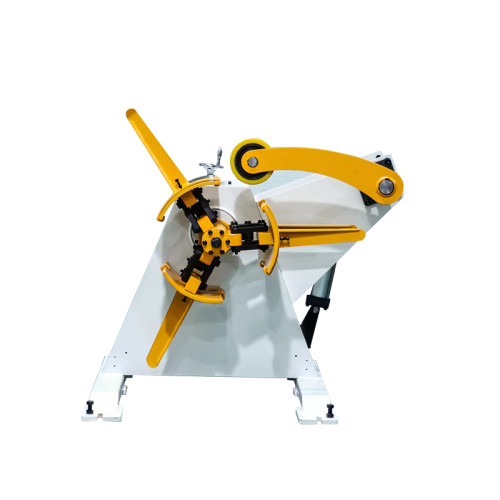
Overturning moment is the one that gets missed. The coil sits on a mandrel that cantilevers 800 to 900 mm in front of the frame, so its weight acts at a lever arm from the anchor line.
Dynamic reaction comes from braking and from emergency stops. It is smaller than most people expect, and it is the least likely of the three to govern the design.
Sort them in that order: bearing, then moment, then dynamics. The middle one decides the anchor size.
Working the Numbers for a 10-Tonne Coil
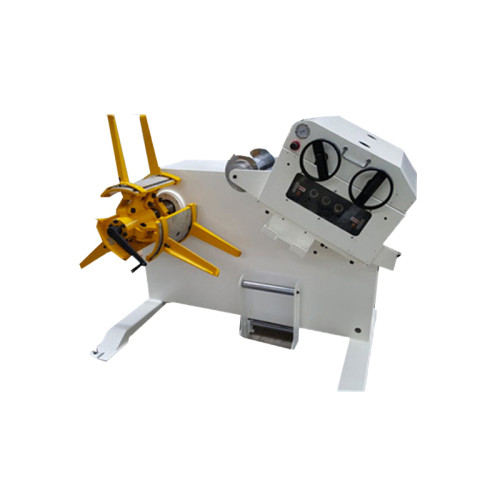
Take a motorized decoiler with a 3.2-tonne frame, a 1,500 mm coil width, a 1,700 mm mandrel cantilever and a 10-tonne maximum coil. Strip runs at 30 m/min.
Bearing: 13.2 tonnes over a base of 2.0 m by 1.5 m gives 4.4 t/m², or 43 kPa. A 150 kPa soil bearing capacity carries that with a factor of four in hand.
Moment: the coil centre of gravity sits 850 mm in front of the frame face, so 10 tonnes at 0.85 m produces 8.5 t·m, or 83 kN·m, about the anchor line.
Dynamic: the coil's mass moment of inertia at 1.5 m diameter is roughly 2,800 kg·m². Stopping from 0.5 m/s of strip speed in 1.5 seconds needs about 1.2 kN·m of brake torque.
The dynamic term is 1.5 percent of the static moment. That is why an uncoiler that creeps or shakes is almost never a brake problem — it is a foundation or anchor problem showing up as motion.
What the Anchor Bolts Actually See
Combine the vertical load and the moment at the pad surface and the pressure distribution stops being uniform. The front edge carries more, and the rear edge can go into tension.
With a 2.0 m by 1.5 m pad, the section modulus about the moment axis is 1.0 m³. Vertical load gives 43 kPa; the moment adds and subtracts 83 kPa.
Front edge: 126 kPa. Rear edge: minus 40 kPa, which is uplift. Concrete does not take tension, so the rear anchors do, and they carry it as a couple over the 1.3 m bolt spacing.
That works out to roughly 6.5 tonnes of total anchor tension, split across the rear bolt pair, about 3.3 tonnes per side.
An M20 cast-in anchor in 25 MPa concrete is good for 4 to 5 tonnes of tension, so the original eight bolts were marginal and had no margin for a loose one.
| Load case | Magnitude | What it stresses | Where it costs you |
|---|---|---|---|
| Machine and full coil | 129 kN | Slab bearing, soil | Rarely governs; 200 mm is enough |
| Mandrel overhang moment | 83 kN·m | Rear anchors, pad thickness | Governs the design and the bolt grade |
| Brake and e-stop reaction | 1.2 kN·m | Frame joints | Negligible at the pad |
| Coil car rail load | 60 kN per wheel pair | Local slab punching | Forces a separate pad or a thicker slab |

Slab Thickness, Joints and the Coil Car Rails
Thickness is set by punching shear at the anchors and by the coil car, not by bearing pressure. A 200 mm pad at 25 MPa with an 8 mm mesh handles the uncoiler alone.
Add a coil car running to within 300 mm of the base and the local load changes. Car wheels put 25 to 30 kN on a small contact area, and a thin slab cracks between the rails within a year.
Isolate the car rails. A separate 250 mm pad tied to the main pad with dowels keeps wheel loads out of the anchor zone without doubling the concrete volume.
Control joints belong outside the anchor footprint. A joint running under the base lets the two halves move independently, and the anchors then see differential settlement as tension.
Grout the base with a 30 to 50 mm non-shrink layer and check level across the mandrel face, not across the frame feet. The mandrel is what the coil sees.
Checking the Pad Five Years After the Pour
A foundation does not fail suddenly. It moves a fraction of a millimetre at a time, and the machine absorbs the movement until it cannot.
Anchor torque is the first check. Re-torque the rear anchors to the drawing value once a year and record what it takes to move them. An anchor that turns at half torque has already lost preload.
Level across the mandrel face with a machinist's level, not across the frame feet. A 0.2 mm per metre change from the commissioning record is the point to investigate.
Crack width at the pad edge tells you whether the concrete is working or has cracked through. Anything above 0.3 mm on a pad of this size needs an engineer, not a patch.
The symptoms show up on the coil before they show up on the pad. Strip that wanders 1 to 2 mm at the line entry, or a coil that walks on the mandrel, is usually the foundation talking.

When the Calculation Is Not the Constraint
Four situations override the arithmetic above, and in each of them a bigger pad is the wrong answer.
An existing post-tensioned slab. Drilling anchors into a tensioned slab is not allowed without an engineer's approval, and the approval usually costs more than a new isolated pad.
An upper floor. A 10-tonne coil on a mezzanine is a vibration problem before it is a strength problem. The machine will work and the building will hum.
Variable soil. A 150 kPa assumption on fill or on clay is a guess. One borehole to 4 m costs less than a repour.
Seismic zones. The horizontal case can exceed the static moment at 0.3 g, and then the anchor group needs a ductile design rather than a bigger diameter.
What to Hand the Civil Engineer
Most foundation errors start with a drawing that shows a footprint and a weight. Give the engineer the load cases and the drawing stops being a guess.
- Machine mass and maximum coil mass, separately. A single combined figure hides the ratio, and the ratio is what produces the uplift.
- Mandrel cantilever and coil centre of gravity. Measured from the anchor line, not from the frame face.
- Anchor positions and the bolt grade. Cast-in anchors with a defined tension capacity, not a site-drilled substitute chosen on the day.
- Coil car rail layout and wheel loads. The rails are part of the foundation scope whether or not they appear on the machine drawing.
The Alabama plant cut the rear anchors out, poured a 300 mm isolated pad with M24 cast-in anchors at 1,500 mm spacing, and re-grouted. Wobble at full coil disappeared, and the mandrel runout came back to 0.05 mm.
Total cost $9,800 including the downtime. The original pad had cost $3,400, which is the cheapest part of that story.
Base dimensions, anchor sets and coil car rail options for each machine size are listed in the coil handling equipment range, and they are what the civil drawing should be built from.
The rest of the specification chain, from capacity through mandrel type to control, is set out in the coil line guide library.
How thick should a concrete pad be for a 10-tonne uncoiler?
200 mm at 25 MPa for the machine alone, 250 to 300 mm where a coil car shares the pad or the anchors are close to an edge.
What anchor size holds a 10-tonne coil on a 1,700 mm cantilever?
M24 cast-in anchors at 1,500 mm spacing give about 8 tonnes of tension capacity per anchor, against roughly 3.3 tonnes of calculated uplift per side.
Does brake torque affect the foundation design?
Barely. On a 10-tonne coil at 30 m/min, brake reaction is about 1.2 kN·m against a static overturning moment of 83 kN·m, or 1.5 percent.
Can an existing 150 mm slab carry a 5-tonne decoiler machine?
Only with an engineer's check on punching shear at the anchors. The bearing pressure passes easily at 43 kPa; the anchor zone is what fails.
How much does an isolated pad cost compared with a shared slab?
$6,000 to $10,000 for a 300 mm isolated pad with cast-in anchors, against $2,500 to $4,000 for a nominal slab that may need replacing within two years.
What torque should the rear anchors be re-checked at each year?
The drawing value, typically 300 to 400 N·m on M24. Record the torque it takes to move each nut; anything turning at half value has lost preload.
Where to go next
This sits in the coil handling cluster, where capacity, mandrel, drive and foundation are specified as one decision rather than four.
If your anchors have already lifted, the specification guide explains which part of the machine the foundation was sized against.
Read the decoiler specification guide