What Changes When a Coil Line Feeds a Transfer Press?
A coil feeding line in front of a transfer press looks like the same machine you would put in front of a progressive die. It is not, and the difference shows up as gripper faults rather than feed errors.
This is the story of a 2.0 mm HSLA 340 job that produced six bad parts per thousand for three weeks before anyone blamed the coil.
Why the Gripper Faults Started After a Coil Change
The line ran clean for four months on 1,600 mm wide coil. Production switched to a 1,250 mm width from a different mill and the transfer started dropping parts at station three.
Nobody suspected the coil. The die was untouched, the feed length was unchanged at 385 mm, and the feed accuracy still measured inside ±0.05 mm at the roll exit.
What changed was the blank itself. Blanks cut from the narrower coil carried a 0.4 mm taper across the 380 mm length, and the grippers closed on that taper rather than on a square edge.
The taper came from camber in the strip, three millimetres over two metres. On a progressive die the pilot pins absorb that error. A transfer press has no pilot pins to absorb anything.
The maintenance log showed the earlier coil came from a service centre that edge-trimmed and re-cut the strip. The new coil arrived straight from a mill slitter.
Slitting introduces camber when knife clearance is uneven, and a coil can leave the slitter inside its tolerance and still be unusable on a transfer press.
Ask the service centre for the camber figure on the coil certificate, and measure it yourself on a two-metre length before the coil goes on the mandrel.
Two metres of strip on a floor, a straight edge and a tape measure settle the argument in five minutes. Nothing on the machine will tell you this.

Feed Length Is Not the Number That Matters Here
On a progressive die the feed length sets the pitch and the strip carries the part from station to station. Get it wrong and the pilot pins tell you immediately.
On a transfer press the coil line only has to deliver a blank of the right length and squareness. The transfer system handles everything after station one.
That shifts the critical number from feed length to blank geometry. Length tolerance can be loose and the job still runs; edge squareness cannot.
A 380 mm blank that measures 380.2 mm is fine.
The same blank with a 0.4 mm diagonal difference will fight the grippers through the whole transfer.
Set acceptance on diagonal, not on length. It is the number that predicts whether the part will transfer at all.
A useful rule from the trial: measure the diagonal of ten consecutive blanks. If the spread exceeds 0.3 mm, the coil is steering the part, not the grippers.
Camber Turns Into Taper Before It Turns Into Scrap
Camber is a measurement you can take at the coil before the line ever runs. Convert it into blank taper and the argument about whose fault it is ends quickly.
| Camber over 2 m | What the 380 mm blank does | Where it costs you |
|---|---|---|
| 1 mm | 0.13 mm taper, absorbed by gripper clearance | Nothing measurable |
| 2 mm | 0.26 mm taper, marginal on a 4-station transfer | Occasional gripper re-grip at station two |
| 3 mm | 0.40 mm taper, outside jaw clearance | Six rejects per thousand, jaw marks on good parts |
| 5 mm | 0.66 mm taper, blank runs out of square | Station three misloads and the press stops |
The arithmetic is simple and worth doing before the coil goes on the mandrel. Taper equals camber multiplied by blank length divided by the measurement length.
A 3 mm camber over 2,000 mm on a 380 mm blank gives 0.57 mm by that formula, and the measured 0.4 mm was close enough to confirm the mechanism.
Reject the coil at goods-in, or straighten it, or accept the taper and widen the jaw clearance. Those are the only three options and two of them cost money.
Lubrication Now Has Two Customers
A progressive die wants oil at the die face. A transfer press also wants dry, grippable blanks, because the jaws hold by friction on the blank edge.
When the plant increased oil flow to stop galling at station two, the gripper faults doubled within a shift. The blanks were sliding 0.2 mm in the jaws during transfer.
The fix was not less oil overall. It was a narrower applicator that put oil on the die face and left the outer 30 mm of each blank edge dry.
Check the blank edge after the shear. If you can see a continuous oil film across the full width, expect jaw slip on the next speed increase.
Cycle Time Moves to the Blanking Station
Transfer presses on this class of work run 18 to 25 strokes per minute, and the coil line has far more capacity than that. The constraint moves upstream to the shear.
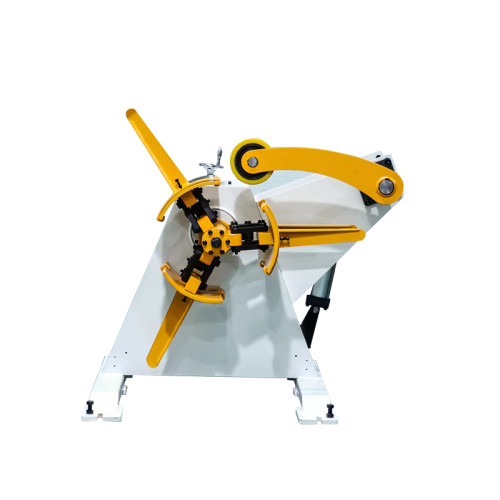
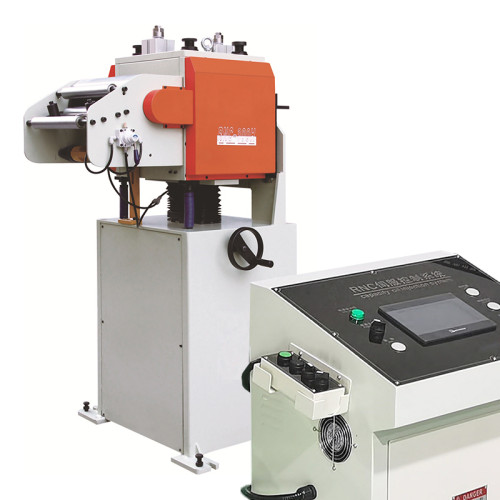
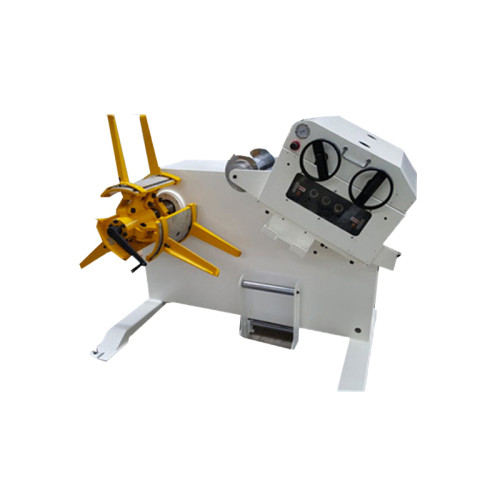
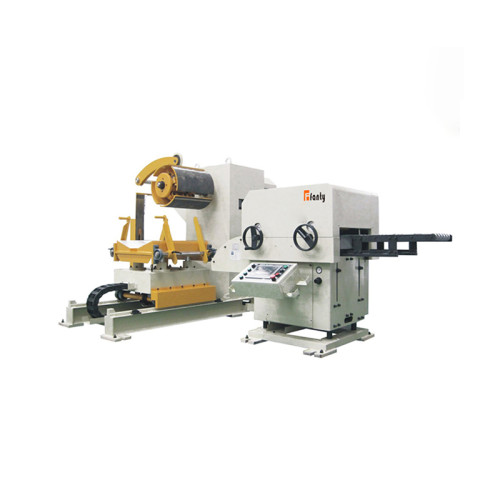
At 22 SPM with a 385 mm feed the line averages 8.5 m/min, well inside the capability of a 3-in-1 decoiler straightener feeder sized for this width.
That margin is why coil change time, not line speed, usually limits output. A 5-tonne coil at 2.0 mm and 1,250 mm yields roughly 250 metres, or about 650 blanks.
At 22 SPM those 650 blanks run out in half an hour. Two people and a coil car decide the shift, not the machine rating.
Count the coil changes per shift before quoting a rate.
A job that needs six changes in eight hours loses more time at the mandrel than at the press.
What does bite is the shock of blanking 2.0 mm HSLA 340 in station one. Strip buckling behind the shear, slug pulling and a 0.1 mm pass-line dip after each stroke all appear at low speed where nobody looks for them.
Watch the strip between the feed rolls and the shear for two minutes at production speed. A visible ripple that settles before the next stroke is normal; a ripple that persists is a pass-line problem.
When a Transfer Press Should Not Be Coil Fed
Coil feeding a transfer press pays when the blank is simple, the volume is high and the part needs four to six forming stations. Outside that envelope the economics reverse.
If the blank needs a curved or notched outline before forming, a blanking line plus a destacker is usually cheaper than a coil line with a complex first station.
If the part runs below about 8,000 pieces a month, the coil change time eats the advantage. A stack of pre-cut blanks costs more per piece and less per month.
Also be honest about camber tolerance. Mills supply camber within a standard, not within your gripper clearance, and no straightener removes camber completely.
Where the machine earns its place is repeat work with a stable coil source, a single blank geometry and a die that can shear in station one without shock damage.
The Trial That Settles the Argument
Run the trial on the widest and the narrowest coil you intend to buy, not on the one the mill sent for the demo. Camber behaves differently at each width.
- Two coil widths, one die. The narrow coil is where camber shows up, so it has to be in the trial even if the order is mostly wide material.
- Twenty blanks, not five. Camber varies along a coil, and five consecutive blanks can all come from a good section.
- 200 strokes at speed. Gripper faults often appear only after the tooling is warm and the transfer is running at production rate.
Measure twenty blanks, not five. Record length, diagonal and edge squareness, then run the transfer at production speed for at least 200 strokes.
Count gripper faults separately from die faults. Mixing the two is how three weeks get lost, which is exactly what happened on this job.
The feed accuracy budget that sits behind all of this, from coil to die, is set out in our coil line knowledge base.
If the job is still being compared against a blanking route, this comparison of blanking and coil-fed work covers the crossover point.
Four questions come back from every transfer press enquiry of this shape.
Standard coil line configurations and their footprints are listed in the line range.
How much camber can a 4-station transfer press tolerate?
Around 1 mm over 2 m on a 380 mm blank, which produces roughly 0.13 mm of taper. At 3 mm the taper reaches 0.4 mm and the jaws start losing the part.
Why did feed accuracy stay at ±0.05 mm while parts failed?
Because feed accuracy measures strip position at the rolls. The blank taper happened after the shear, so the number stayed good while the part went bad.
At what volume does coil feeding beat pre-cut blanks?
Roughly 8,000 pieces a month on a 2.0 mm part. Below that, coil change time and scrap skeleton handling usually outweigh the material saving.
Does a straightener remove camber?
It reduces coil set and crossbow, not camber. Camber is a length-direction curve and a roll straightener has no lateral reference to correct it.
Where to go next
Transfer press feeding is one branch of the wider question: how much error the whole line adds between coil and die. The error budget that breaks it down by station is in our coil line knowledge base.
The Coil Line Guide Library