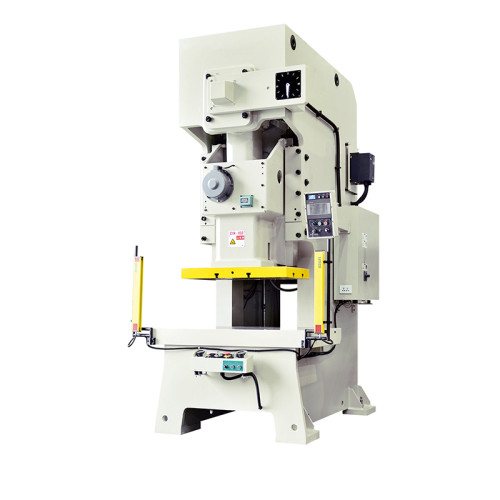
What Accuracy Can an NC Straightener Feeder Achieve?
Accuracy is the number every buyer asks about first, and with good reason: an NC Straightener Feeder that cannot hold its claimed tolerance will cost you scrap, die damage, and rework for the life of the line.
This article explains what accuracy an NC Straightener Feeder can realistically achieve, what the specification numbers actually mean, and which factors determine whether your line reaches that level in practice.
We will look at the machine specification, the physics that limit it, and the practical conditions in your stamping shop that decide the real-world result. By the end, you will know what to expect from a high-quality 3-in-1 decoiler straightener feeder and how to verify it on your own floor.
The Accuracy Specification Explained
When a manufacturer states that an NC Straightener Feeder achieves ±0.05 mm feeding accuracy, the figure refers to the repeatable positioning band of the strip feed under defined conditions. In simple terms, if you program a 100 mm feed, the strip will stop between 99.95 mm and 100.05 mm, cycle after cycle.
That band is the industry benchmark for servo-driven feeding equipment in precision stamping.
The spec is achieved through the core design of the machine. A servo motor drives precision feed rolls directly, and a high-resolution encoder measures the roll rotation to determine strip travel.
Because the encoder reads motor position thousands of times per revolution, the control system can correct the feed in real time and stop at the programmed position with minimal overshoot.
It is important to understand that ±0.05 mm is a machine capability, not a guarantee for every material and speed. The figure assumes proper strip guidance, correct roll pressure, good straightening quality, and a stable press interface. Understanding this distinction separates realistic expectations from disappointment after installation.
What Determines the Accuracy of an NC Straightener Feeder
Five factors combine to decide the accuracy you actually measure on the shop floor. The first is the servo drive and control system.
The second factor is mechanical rigidity. The feed rolls, frame, and bearings must hold the strip firmly and deflect as little as possible under load. A frame that flexes at high speed introduces error that no control system can fully correct.
Third is roll pressure: if the feed rolls cannot grip the strip without slip, the encoder measures roll travel but the strip travels less, creating an error that grows with feed length.
Fourth is straightening quality. If the strip enters the feeder with coil set, camber, or waves, the strip will not sit flat between the feed rolls and the effective travel will vary. This is why the straightener section of the NC Straightener Feeder is not an optional extra — it is a precondition for accuracy.
Fifth is the press interface: a reliable cam signal at the correct point of the stroke keeps the feed synchronized and repeatable.
Accuracy Benchmarks by Machine Type
| Machine Type | Typical Feed Accuracy | Best Application |
|---|---|---|
| Pneumatic gripper feeder | ±0.3 to ±0.5 mm | Simple low-speed feeding, low cost |
| Mechanical cam feeder | ±0.1 to ±0.3 mm | Fixed-pitch high-speed runs |
| Standard servo feeder | ±0.05 to ±0.1 mm | General progressive die stamping |
| NC Straightener Feeder (servo) | ±0.05 mm | Precision progressive stamping with strip shaping |
| 3-in-1 decoiler straightener feeder | ±0.05 mm integrated | Space-saving automated coil feeding lines |
The table puts the NC Straightener Feeder in context. The step from a pneumatic feeder to a servo-driven unit is the biggest accuracy jump available, and the difference shows directly in die life and scrap rates. For precision progressive dies, the ±0.05 mm band is effectively the entry requirement; below that, pilots and guides in the die carry too much of the positioning burden.
How Straightening Quality Affects Feeding Accuracy
Strip shape is the hidden variable in accuracy. Coil strip is wound under tension, and when it uncoils it carries residual curvature called coil set.
Cambers and edge waves are the second shape problem. A strip with camber curves sideways; one with edge waves ripples along the edges. Both make the strip unstable between the feed rolls and cause the effective feed length to vary.
A properly set straightener corrects these shape defects before the strip reaches the feed rolls, which is why the straightening section must be matched to the material range you run.
In practice, the accuracy you measure is the combined result of feeding and straightening. A machine that straightens poorly will never reach its feed accuracy spec, however good the servo is.
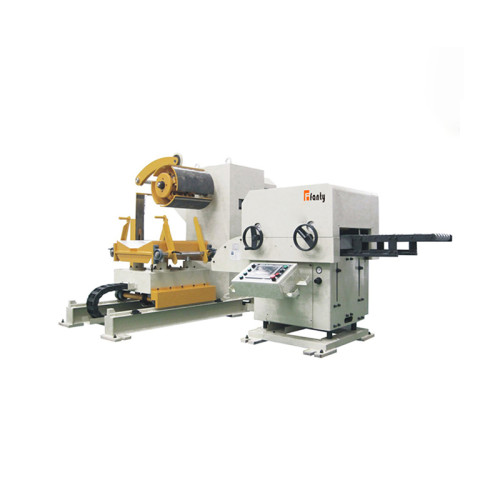
This is the argument for buying an integrated NC Straightener Feeder or 3-in-1 decoiler straightener feeder where the straightener and feeder are engineered and tuned as one system, rather than matching components from different suppliers.
How to Maintain Long-Term Accuracy
Accuracy is not a one-time setting; it degrades gradually as the machine wears. The feed rolls are the first item to monitor. Their surface finish and diameter determine the effective feed length, so keep them clean and free of contamination, and check for glazing.
Bearing condition is the second item. Worn bearings introduce play into the roll support, and play directly becomes feed error. Check for lateral movement of the rolls during a periodic maintenance window and replace bearings at the first sign of play.
Third, keep the straightener rolls correctly gapped for the current material thickness; a straightener set for 2 mm material will not straighten 1 mm strip effectively.
Finally, re-run the accuracy test at regular intervals and compare the results with the commissioning baseline. If the repeatability band drifts, the test tells you early — while the cause is still minor. FANTY recommends testing every six months for single-shift operation and every three months for multi-shift high-speed lines.
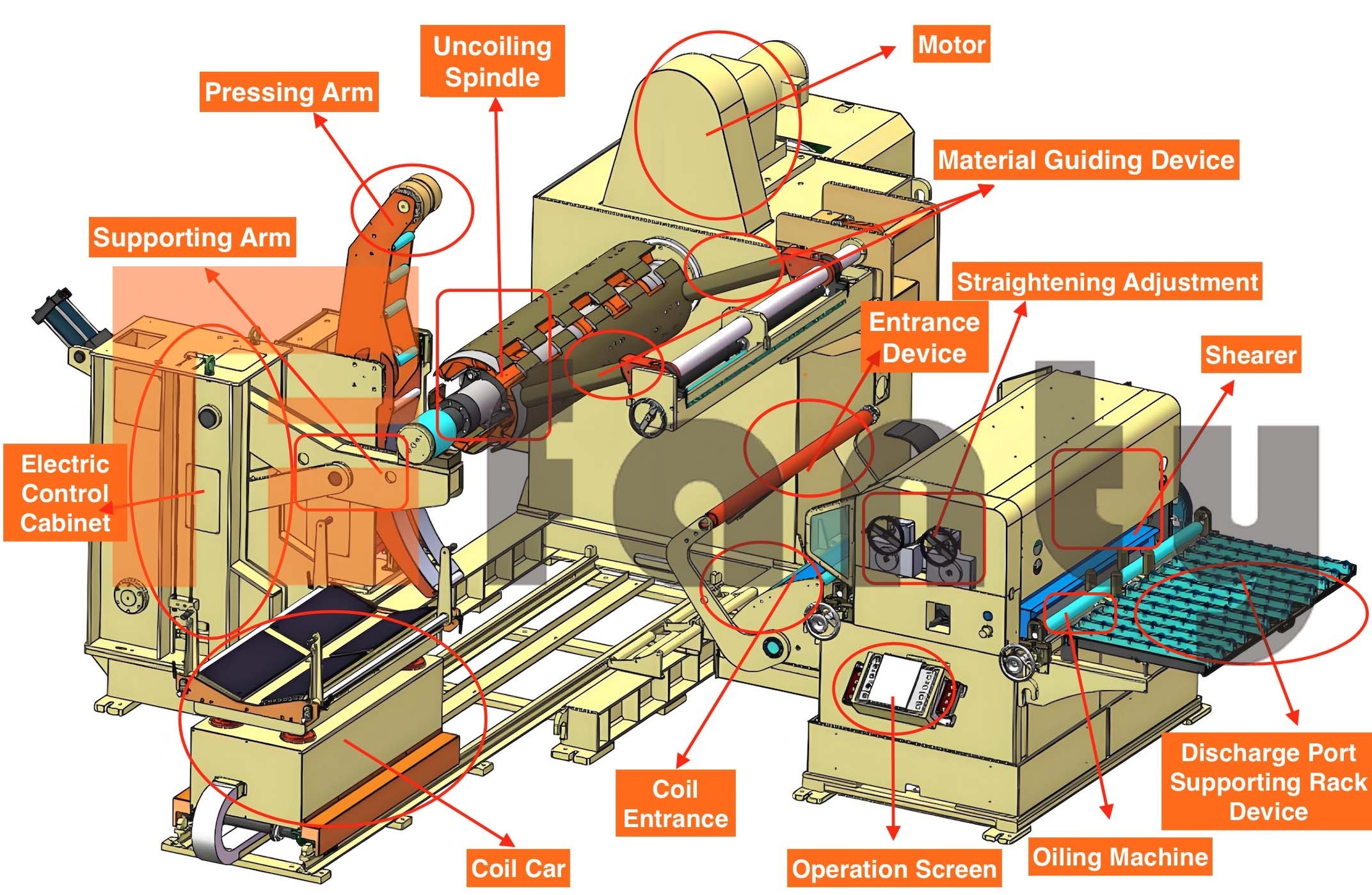
FANTY's Accuracy Engineering
FANTY has spent 12 years refining the engineering that delivers ±0.05 mm accuracy. The 45,000 m² factory houses 370 staff and more than 80 R&D engineers who design the servo systems, straightening geometry, and frame structures in-house.
The company's experience spans thin precision strip and heavy-gauge material, low-speed and 200 SPM applications, which is why FANTY engineers tune each machine to the customer's material rather than relying on a default setup.
Whether you choose a standalone NC Straightener Feeder or an integrated 3-in-1 decoiler straightener feeder, the accuracy specification is a starting point — the commissioning process is where that number becomes your production reality.
Frequently Asked Questions
Is ±0.05 mm accuracy realistic for every material?
It is realistic for well-behaved strip in the machine's rated range. Soft, thin, or irregularly shaped strip may require adjusted expectations. The spec assumes correct roll pressure, good straightening, and a stable press signal.
What is the difference between positioning accuracy and repeatability?
Positioning accuracy is how close the fed length comes to the programmed value; repeatability is how consistent it is across cycles. Repeatability matters more for die protection, because a consistent error can be compensated in the program.
Can an NC Straightener Feeder hold accuracy at 200 SPM?
FANTY's NC Straightener Feeder supports high-speed operation while maintaining the ±0.05 mm band, provided the material, straightening, and press interface meet the application conditions. Verify with an accuracy test at full speed during commissioning.
Why is straightening included in the accuracy calculation?
Because strip shape directly changes the effective feed length. Coil set, camber, and edge waves shift the strip between the feed rolls, so accurate feeding depends on the strip being flat and stable first.
How do I verify my machine is still within spec?
Run the ten-feed accuracy test at two speeds and compare the repeatability band with the commissioning baseline. Any drift beyond the band points to roll wear, bearing play, straightener settings, or servo tuning changes.
Related reading
- how back tension affects straightening
- why pass line height matters
- how to hit a flatness spec on a coil line
Part of the 3-in-1 decoiler straightener feeder — the full library of coil handling, straightening and feeding guides from FANTY.
Demand ±0.05 mm Accuracy from Your NC Straightener Feeder
Send us your material details and press parameters — we will confirm the achievable accuracy and send the full specification with factory test report.
Send Inquiry to FANTY