How Does Back Tension Affect an NC Straightener Feeder?
Back tension is the resistance the decoiler applies to the strip as the feeder pulls material forward. It is the least discussed setting on a coil line and one of the most consequential, because it sits at the boundary between the two machines and it changes what happens inside the straightener without any change to the straightener's own settings.
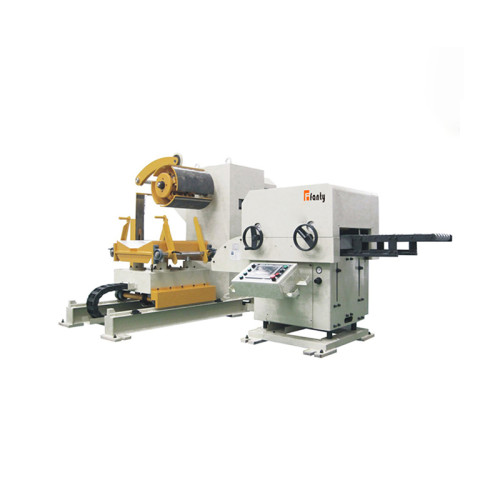
On a 3-in-1 decoiler straightener feeder, back tension is set once during commissioning on many lines and then left alone for years. That is usually a mistake. Strip gauge changes, coil weight changes and material grade changes all move the optimum point, and a setting that was correct for 2.0 mm mild steel can be well outside the useful range for 0.8 mm aluminium. Here is what back tension actually does, measured on a running line.
Back Tension in One Sentence
Back tension keeps the strip taut between the decoiler and the straightener so the strip enters the leveling rolls under control rather than arriving with a slack loop, and it does this by resisting the pull of the feed rolls.
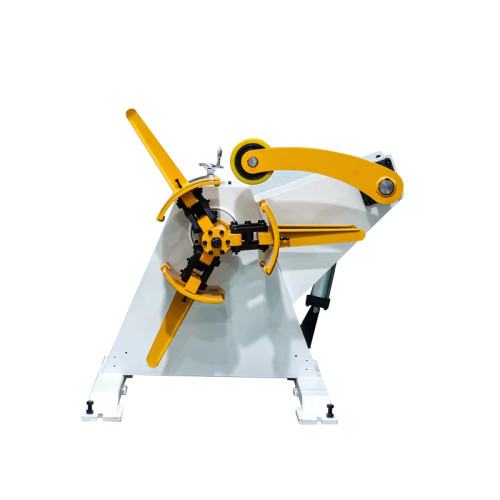
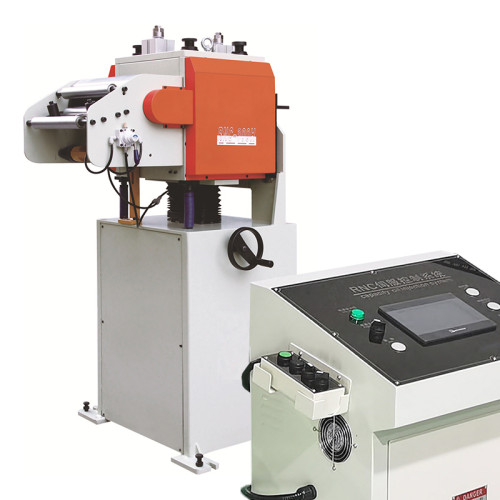
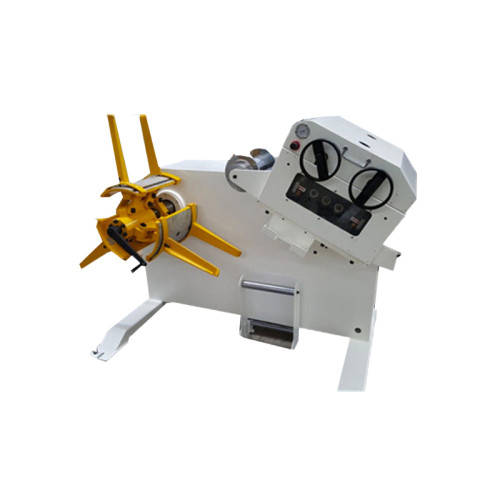
Everything else follows from that. If the tension is too low, the strip arrives loose, the loop oscillates and the straightener receives material at an inconsistent entry angle. If the tension is too high, the feeder has to pull harder than the strip can comfortably tolerate, and the strip stretches slightly, the coating or surface suffers, and the coil itself may be pulled into the mandrel segments. Both conditions are easier to avoid on a machine where the decoiler brake and the feeder share one control platform, as they do across our coil handling equipment range.
What Back Tension Does Inside the Straightening Section
The straightener removes longitudinal curvature by bending the strip alternately in opposite directions across a set of rolls. The amount of curvature it removes depends on how much bending moment it applies, and the bending moment depends partly on the strip's own resistance to being bent.
Back tension changes that resistance. A strip under tension is already partly straightened, which means it needs less bending at the rolls to reach flat. This is why adding tension can make a marginal setup produce acceptable flatness, and why removing tension can make a previously acceptable setup fail. The straightener has not changed. The material arriving at it has.
There is a limit. Once the tension is high enough to yield the strip in tension alone, the flatness stops improving and the strip starts to narrow and thin. The practical range sits below that point, and the width of the useful band depends heavily on gauge.
Three Zones of Back Tension
Measured on a 1,250 mm wide line running 2.0 mm cold-rolled steel at 180 SPM, the relationship falls into three distinct zones. The numbers below are specific to that setup, but the shape of the curve holds across most coil lines.
| Zone | Strip tension | What you observe | Flatness result |
|---|---|---|---|
| Slack | Below 4 MPa | Loop oscillates, entry angle wanders, occasional roll slip | Inconsistent, 0.4-0.9 mm per metre variation |
| Working | 6-14 MPa | Stable loop, steady entry angle, no slip at full takt | Consistent, under 0.2 mm per metre |
| Over-tensioned | Above 18 MPa | Strip narrows slightly, feeder current rises, edge wave appears | Degrades again, plus a new defect |
The useful observation is that the working zone is narrow relative to the total range, and it moves when the material changes. Thin strip tolerates less absolute tension before it stretches. High-strength steel tolerates more before it yields. Aluminium sits far lower than steel at the same gauge.
Too Little Tension: Loops, Snaking and Roll Slip
Insufficient back tension produces problems that are usually blamed on the feeder, because that is where they become visible.
A slack loop oscillates vertically in the pit, and each oscillation changes the entry angle of the strip into the first straightening roll. The straightener then removes a varying amount of curvature, so flatness varies along the coil even though every setting on the machine is constant. Operators often respond by increasing roll penetration to flatten the worst sections, which over-straightens the better ones and creates a new problem.
Roll slip is the second symptom. With a loose loop, the strip can decelerate slightly between feed strokes, and the next acceleration stroke finds the feed rolls momentarily in contact with a strip that is not moving at the same speed. The encoder reports a correct roll position while the strip lags, which produces a short part. This is the mechanism that makes operators suspect encoder drift when the real fault is at the decoiler brake.
Too Much Tension: Stretch, Marking and Coil Damage
Excessive back tension is less common than insufficient tension, but it does more damage per event. Watch for these four effects.
- Permanent strip stretch. Once tension exceeds the yield point the strip does not return. Measured across a 1,250 mm width, a 0.3 percent stretch on a 2.0 mm strip means 6 microns of thickness lost, which is enough to move a tight-tolerance part out of specification.
- Edge wave. Higher tension in the centre of the strip than at the edges produces a characteristic wavy edge. It is often mistaken for a straightener fault when the cause is upstream.
- Surface marking. Higher tension requires higher feed roll pressure to maintain grip, and that pressure is applied directly to the strip surface at every roll contact.
- Coil collapse on the mandrel. On a partly consumed coil with thin gauge, excessive pull can collapse the inner wraps and pull them against the mandrel segments, which then marks the strip for the rest of the coil.
Setting Tension on a Real Line
Do not set back tension by feel. There are three measurements that define it, and each takes a few minutes.
First, calculate the target tension from strip width and thickness. For 2.0 mm steel at 1,250 mm wide, a working tension of 10 MPa corresponds to roughly 25 kN of pull. Your decoiler brake or drive should be capable of holding that and no more than about twice it, so you have adjustment range on both sides of the set point.
Second, verify with a loop height measurement. With the line at production takt, the free loop should sit within a band of about 150 mm of vertical travel. A loop that swings more than that is under-tensioned; a loop that is pulled tight against the guide roller is over-tensioned.
Third, check the feeder motor current at production takt and record it. Current tracks tension directly, and a rising current trend over weeks is the earliest warning that tension has crept up through brake wear or a changed setting.
Measuring the Effect in One Shift
Here is a test that settles the question on your own line in a single shift.
Run one coil at the current setting and sample twenty parts, recording length deviation. Then reduce the decoiler brake setting by roughly a third and run another coil, sampling twenty parts. Then increase above the original setting by a third and run a third coil. Plot the three means against the three tension settings.
On most lines the curve is flat in the middle and steep at both ends, which tells you how much margin you actually have. If the middle is not flat, the problem is not back tension at all and you should look at roll condition, entry guide alignment or pass line height instead.
The machines we build hold feed length within plus or minus 0.05 mm at 200 SPM, and that number is only achievable when the strip arrives at the straightener under controlled tension. The straightener can remove curvature. It cannot remove variation that enters the machine from upstream.
Back tension questions from the shop floor
How do I know if my back tension is too high?
Three signals: feeder motor current above the recorded baseline, a loop pulled tight against the guide roller instead of floating, and a slight narrowing or edge wave on the strip. Any one of them is worth a measurement.
Should back tension change when I change material?
Yes, and it is one of the most commonly missed changeover steps. Thin gauge tolerates less tension before it stretches, aluminium sits far below steel at the same thickness, and high-strength grades tolerate more. Record a tension value per material on the setup sheet.
Can back tension replace straightener roll penetration?
Partly, on light gauge where a small amount of tension flattens the strip before it reaches the rolls. It is not a substitute on heavy gauge or high-strength material, where the bending moment has to come from the rolls.
Why does my loop oscillate even at a steady line speed?
Usually the loop control response is slower than the brake or drive can react, so the loop overshoots and corrects. A loop swinging more than about 150 mm vertically is under-tensioned and the controller is fighting the slack.
Does back tension affect the decoiler itself?
It sets the load the decoiler brake or drive has to hold, so it directly affects brake wear and heat. A line running at the high end of the tension range will consume brake pads noticeably faster than one in the middle of the working zone.
Trying to dial in strip tension?
Send us your strip width, gauge, material grade and target takt. We will give you a starting tension value, the loop height to expect, and the feeder current band to record for your maintenance log.
Request tension settingsFanty · 3-in-1 Compact Line
Decoiler, Straightener and Feeder on a Single Frame
Fewer foundations, one control cabinet, faster commissioning. Share your strip spec and target output and our engineers size the combined unit against your cycle.
Get a Free QuoteFANTY Machinery · 13 years on stamping automation · 2,000+ coil lines installed · engineers reply within 24 hours