Is a Hydraulic Decoiler Worth the Price Premium?
A hydraulic decoiler on a 5 t coil costs two to four times a manual one, and the difference is not in the steel. It is in the twenty minutes a coil change takes and the tension the strip sees afterwards.
This compares the three common loading arrangements on the same job, puts a number on the time each one saves, and names the shops where the cheap unit is the correct purchase.
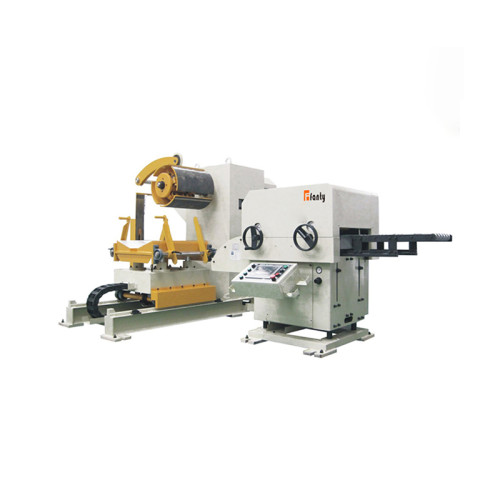
All of it applies to a standalone decoiler machine or uncoiler, because the choice of expansion and drive is independent of whatever runs downstream.
Separate the Three Functions You Are Buying
The price list mixes three separate functions, and buyers compare totals instead of the parts that matter.
The first is mandrel expansion: hand-cranked screw, motorised, or hydraulic cylinder. This decides how long the coil takes to grip and release.
The second is rotation: free-running with a friction brake, motorised with a VFD, or motorised with closed-loop tension control.
The third is coil presentation: floor loading with a forklift, a coil car, or a coil lift that places the coil on centre.
A manual unit is cheap because it has none of the three automated. A hydraulic unit is expensive because it automates the first and usually the second.
Our own decoiler and uncoiler range is quoted line by line for exactly that reason, so the three functions can be compared across suppliers.
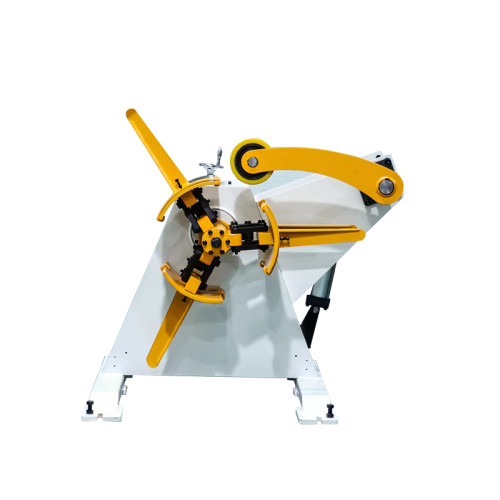
Ask which of the three the quotation actually includes. A "hydraulic decoiler" with a hand-cranked expansion and a pneumatic brake is a different machine from the one in the brochure photograph.

The Loading Arithmetic That Pays the Difference
Loading time is the number that decides the purchase, and it is measurable in any shop with a stopwatch and a week of production.
A manual decoiler with a forklift and a hand crank takes 15-25 minutes per coil, and most of that is waiting for the forklift and cranking the expansion.
A hydraulic unit with a coil car takes 5-8 minutes, because the car positions the coil and the cylinder does the gripping in one movement.
At two coils per shift the difference is 20-34 minutes per shift, or roughly 170 hours a year on a two-shift pattern.
At a loaded labour rate of 45-60 USD an hour that is 7,600-10,200 USD a year, before counting the press time the coil change was holding.
Count the press time separately. A 200 t press stopped for 20 minutes costs more than the labour standing next to it.
That is the figure that usually settles the argument in a plant where the line runs one die all week.
| Loading arrangement | What it gives the run | Where it costs you |
|---|---|---|
| Manual, forklift loaded | 15-25 min per coil, no power needed | Press idle during the change, two people on the coil |
| Motorised expansion, forklift | 10-15 min per coil, one operator | Still needs a forklift and clear floor space |
| Hydraulic with coil car | 5-8 min per coil, repeatable centring | Coil car costs 4,000-9,000 USD on its own |
| Hydraulic, twin mandrel | Coil change without stopping the line | Twice the footprint and a second coil in stock |
Put the coil car in the same quotation as the decoiler. Bought separately it is a second freight bill and a second commissioning visit.
Brake and Tension: Where Hydraulic Earns Its Keep
Loading time is easy to justify. Tension control is the reason experienced buyers pay for hydraulics on a line that runs thin stock.
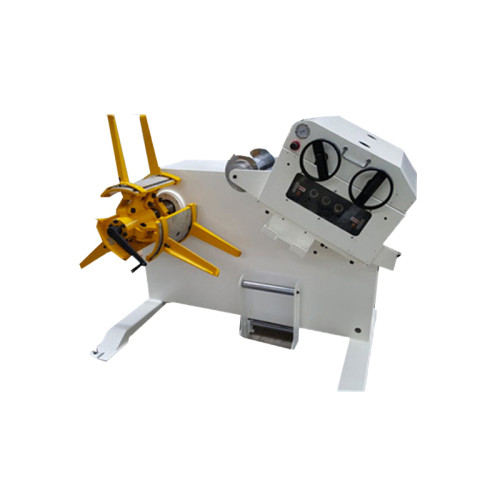
A manual uncoiler usually carries a friction brake adjusted by a hand wheel. As the coil unwinds from 1,500 mm to 400 mm, the lever arm halves and the tension doubles.
Hydraulic and pneumatic brakes hold tension by pressure, so back tension stays within 5-10% across the coil instead of drifting 60-80%.
That drift is what produces loose loops at the start of a coil and tight strip at the end, and the operator chases it with the loop arm all shift.
On 0.5-1.0 mm stock the symptom is a strip that runs slack and then snatches. On heavier gauge the brake is less critical and the loading time dominates the decision.
Ask for the tension range in kilograms, not in bar. A brake rated "up to 8 bar" tells you nothing about what it does at 0.4 bar, which is where light coils run.
Check the brake on the coil you will actually run, not the coil in the demonstration. A 1,200 kg coil and a 4,500 kg coil behave like different machines.
If the strip needs 40-80 kg of back tension, a friction brake can hold it at the start of the coil and cannot hold it at the end.
When a Manual Decoiler Still Wins
Three situations make the manual unit the better purchase, and none of them is about budget alone.
The first is low coil consumption. A shop running four coils a week cannot recover 8,000 USD of hydraulics in any reasonable period, whatever the labour rate.
The second is a job shop with no fixed coil position. A manual uncoiler that a forklift can nudge into place is more flexible than a hydraulic unit bolted to a foundation.
The third is dirty or intermittent power. A hydraulic unit with a 2.2 kW power pack and a PLC is not happy on a supply that sags 15% at shift start.
- Fewer than six coils a week: manual pays for itself by not being bought.
- Coil position moves between jobs: a portable uncoiler beats a fixed one.
- Heavy gauge only, 3 mm and up: tension drift matters far less.
There is a fourth case worth naming. A manual decoiler is repairable by the maintenance team with a hand tool, on a Sunday, without a hydraulic hose crimper.
That matters more than it sounds. A plant with one maintenance fitter and no hydraulic spares keeps a manual uncoiler running through a weekend.
What the Price List Leaves Out
The quotation price is the purchase, not the cost. A hydraulic unit carries four running costs that a manual one does not.
Hydraulic oil and filter changes every 2,000 running hours cost 150-300 USD in parts, plus the labour and the disposal.
Seal kits run every three to five years at 300-600 USD, and a leaking cylinder on a mandrel is a two-day stop, not an afternoon.
The power pack draws 1.5-3 kW continuously while the line runs, which on a two-shift year is 4,000-8,000 kWh.
None of those numbers changes the decision on a busy line. On a line running four coils a week they can consume the entire saving.
| Running cost | Manual decoiler | Hydraulic decoiler | Where it bites |
|---|---|---|---|
| Oil and filter | None | 150-300 USD per 2,000 h | Disposal and downtime, not the parts |
| Seal kit | None | 300-600 USD every 3-5 years | A leaking mandrel cylinder stops the line |
| Power draw | Zero | 1.5-3 kW while running | 4,000-8,000 kWh on two shifts |
| Repair skill | Hand tools | Hose crimper and gauges | Weekend failures wait for Monday |
The capacity, type and mandrel sequence behind this comparison is set out in the coil line guide library, which starts from coil weight rather than from drive type.
Four Cases That Break the Comparison
The arithmetic assumes the coil change is the constraint. In a shop where the die change takes 90 minutes, saving 15 minutes on the coil changes nothing.
It also assumes the operator is paid either way. In a plant where the coil is loaded by the forklift driver during a scheduled break, the manual loading time costs nothing.
Footprint is the third blind spot. A hydraulic unit with a coil car needs 4-6 m of clear floor in front of the mandrel, and many bays do not have it.
The fourth is headroom for maintenance. A mandrel that expands hydraulically cannot be stripped in place; the cylinder has to come out, and that needs clearance above the machine.

Finally, none of these numbers price the risk of a hydraulic failure on a Sunday. A manual brake fails visibly and slowly, and that is worth something on a one-shift plant.
The practical answer: buy hydraulic when coil changes are frequent enough to matter and the strip is light enough to need tension control. Otherwise buy simple.
Does a hydraulic decoiler cost 2-4 times a manual one?
Typically two to four times, or 8,000-18,000 USD against 2,000-5,000 USD for a 5 t unit. A coil car adds 4,000-9,000 USD.
How many coils a week justify the hydraulic premium?
Six or more, on a two-shift pattern. Below that the labour saving is under 4,000 USD a year and the payback runs past five years.
Can a manual uncoiler hold back tension on 0.8 mm strip?
Only with a friction brake and constant attention. Tension typically drifts 60-80% across a coil as the diameter falls from 1,500 to 400 mm.
What does a 2,000-hour hydraulic service cost?
An oil and filter change every 2,000 running hours, a seal inspection annually, and a hose check every six months. Budget 400-700 USD a year in parts.
Does a coil car work with a manual decoiler?
It can, but the combination rarely pays. The car saves 10 minutes of positioning and the hand crank gives most of it back.
Where to go next
Drive type is one branch of the capacity, mandrel and control decision. The full sequence, starting from the coil you actually buy, is in our coil line knowledge base.
The Coil Line Guide Library