How to Switch a Coil Line From Steel to Aluminium
The last steel part clears the die at 14:20. The first aluminium part is scheduled for 18:00, and the material is already on the coil car.
Nothing about the machine has changed. The strip has: a third of the stiffness, a third of the density, and a surface that marks at a contact pressure steel shrugs off.
Switching a coil feeding line from steel to aluminium is a short list of adjustments and one long list of habits. The list is worth writing down once.
This walkthrough covers the seven steps, the four settings that actually move, and the jobs where a steel-set line should not be asked to follow.
Line capacity, gauge range and coil weight for each model are set out in the machinery specification index.
The Strip Changes Before the Settings Do
Aluminium at 1.2 mm is not a lighter version of steel at 1.2 mm. It is a different material with a different modulus, and every setting downstream inherits that difference.
Young's modulus for 5182 is about 69 GPa against 210 GPa for mild steel. The strip is a third as stiff, so it springs back roughly three times as far for the same bend.
Density is 2.7 against 7.85, which means a 5 tonne coil of 1.2 mm aluminium holds about 1,570 m of 1,250 mm strip. The same weight of SPCC holds about 540 m.
That single number changes the shift pattern. Fewer coil changes, longer runs, and a much lighter strip hanging in the loop at any moment.
Surface hardness is the third difference. Aluminium runs around 95 HB against 120 for mild steel, and it transfers to a rough roll rather than wearing it down.
Seven Steps From the Last Steel Part to the First Aluminium One
- Empty the line and sweep the loop pit; steel grit under aluminium becomes a corrosion cell within a week
- Wipe every roll face with a lint-free cloth and solvent, then inspect for embedded particles under a light
- Drop clamp pressure to the aluminium value and re-check it with a strip pull, not by feel
- Reduce back tension by 50 to 60 percent, then confirm the strip is not walking sideways
- Change lubricant to an aluminium-compatible grade; EP additives formulated for steel stain and can etch
- Segregate scrap bins before the first stroke, not after the first mixed bin
- Run a 10 part qualification batch and measure it before releasing the run to production
Step two is the one crews skip. A single 0.2 mm steel chip pressed into a roll face leaves a mark every roll revolution for the rest of the shift, and the mark is 0.03 mm deep on aluminium.
Step three is the one that costs parts. Operators used to steel reach for the same clamp pressure, and 1.2 mm aluminium at steel pressure comes out with a visible roll track on the top face.
What the Rolls See Differently on 5182
| What changes | 1.2 mm SPCC | 1.2 mm 5182 | Where it costs you |
|---|---|---|---|
| Strip stiffness | 210 GPa | 69 GPa | Springback triples, so penetration has to come down and the die radius has to grow |
| Length per 5 tonne coil | About 540 m at 1,250 mm | About 1,570 m | Fewer coil changes, but the loop holds a softer strip that kinks if it is pulled tight |
| Back tension | 8 to 12 kN on a 400 mm width | 3 to 5 kN | Steel-level tension thins the centre of the strip and shows as a buckle, not a break |
| Surface hardness | Around 120 HB | Around 95 HB | Roll marks appear at pressures that left steel untouched, and they do not polish out |
| Scrap value | 350 to 420 USD per tonne | 1,500 to 1,900 USD per tonne | One mixed bin downgrades both materials and the loss is charged to the job |
The second row explains a scheduling effect that surprises planners. A run that took six coils on steel takes two on aluminium, so the line spends less time threading and more time running.
It also means the coil car cycle matters less and the die change matters more. On a mixed-material week, the bottleneck moves to the tool room.
Galling, Pick-Up and the Roll Surface
Aluminium does not wear a roll. It welds to it. A micro-weld forms at the contact point, tears away a fragment of strip, and leaves a raised lump that marks everything after it.
The first sign is a dull grey smear on the roll face after 200 to 400 parts. By the time it is visible to the eye, the mark depth is already past 0.02 mm.
Roll finish matters more than roll hardness here. A 0.4 µm Ra finish on a chrome-plated roll carries aluminium far longer than a 0.8 µm ground finish on the same base material.
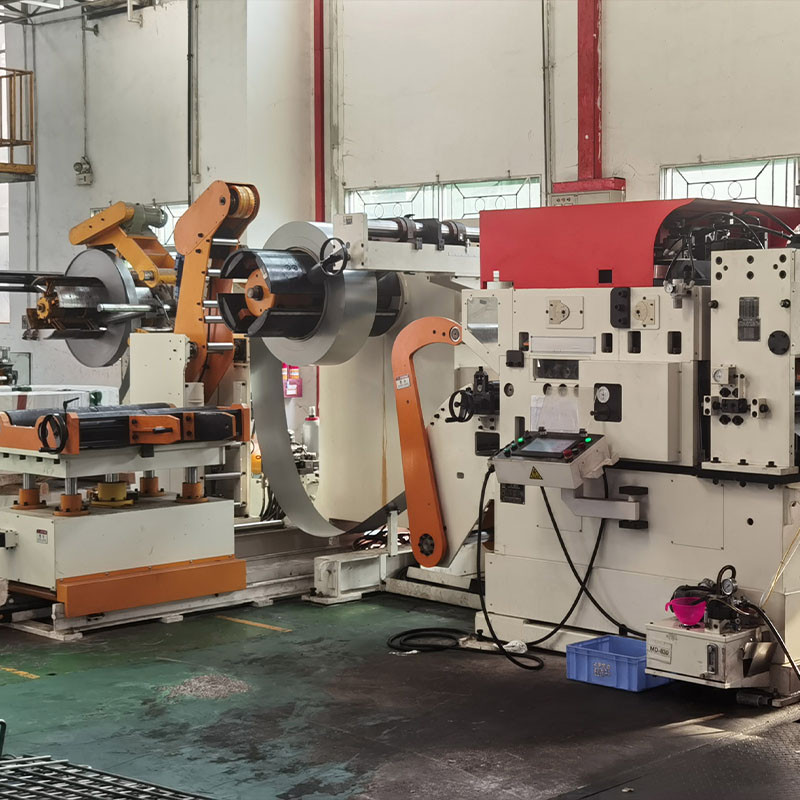
Lubricant is the second lever. A drawing oil built for steel relies on EP additives that react with aluminium and leave stains that only appear after the part is washed.
A lower-viscosity aluminium grade at 8 to 12 cSt carries the heat away and keeps the film intact at 200 SPM. Heavier oil simply gets pushed aside at the contact line.
Wipers are the third. Felt or polymer wipers that hold the film in place on a steel line tend to scrape aluminium dry at the entry roll, which is where pick-up starts.
Where a Steel-Set Line Cannot Follow
Roll diameter is sized against strip thickness. A head with 90 mm rolls built for 1.5 to 4 mm steel cannot impose enough curvature on 0.8 mm aluminium, whatever the gap and penetration say.
The arithmetic is the D/t ratio. Below roughly 30:1 the roll is too large relative to the strip to reach the fibre strain the material needs, and the strip leaves the head with its coil set intact.
Die springback is the second wall. A die cut for steel at 8 percent clearance produces a different bend allowance on aluminium, and no amount of feed correction changes the punch radius.
Third is the loop. A line with a short loop and a tight dancer is tuned to hold tension on heavy strip. On a strip a third as stiff, the same dancer over-corrects and the strip flaps between the rolls.
Fourth is contamination. A shared lubricant tank and a shared chip tray will put steel particles into aluminium, and the corrosion shows up as pitting three weeks after the parts ship.
Checking the First 50 Parts
Ten parts prove the line threads. Fifty parts prove the settings hold, and the difference between those two numbers is where most changeovers fail.
Measure the first five, the tenth and the fiftieth. If blank length moves more than 0.08 mm across that set, the clamp is slipping and the pressure needs another look.
Check the top face under a raking light at the fiftieth part. A roll mark that appears by then will be a reject by the five hundredth.
Measure the springback angle on a formed feature, not just the blank. The angle is the number that tells you whether the die can run this material at all.
Record the four numbers on the job card: clamp pressure, back tension, blank length, springback angle. The next changeover then starts from a measurement instead of a memory.
Where the same line runs both materials weekly, the honest answer is two setting cards and a cleaning routine, not one compromise setting.
A single setting tuned between the two materials produces parts that fail both specifications, and the failure shows up as a burr on one job and a mark on the other.
The accuracy side of the changeover is covered in the coil line guide library, including how much of the error budget belongs to the feed and how much to the die.
How much back tension does 1.2 mm 5182 need against 1.2 mm SPCC?
About half to 60 percent less. Where steel wants 8 to 12 kN on a 400 mm width, aluminium wants 3 to 5 kN, and more than that buckles the centre of the strip.
How many metres of strip does a 5 tonne aluminium coil hold?
About 1,570 m at 1,250 mm by 1.2 mm, against about 540 m for the same weight of SPCC. Plan coil changes around two per shift, not six.
Does a 1.2 mm aluminium blank need different die clearance?
Yes. Aluminium runs best at 5 to 7 percent per side against 8 to 11 percent for mild steel, and the burr height tells you within the first 20 parts if it is wrong.
Can the same rolls run steel and aluminium on one shift?
Only with a full clean between materials. Steel particles left on the roll face embed in aluminium and start pitting, and the damage appears weeks after the parts ship.
Why does aluminium mark at regular intervals?
The interval is the roll circumference. A mark every 283 mm on a 90 mm roll is pick-up on one spot of that roll, not a feed problem.
What happens to mixed steel and aluminium scrap?
Both drop to mixed grade, which trades at 180 to 260 USD per tonne. Segregated aluminium brings 1,500 to 1,900 USD, so one mixed bin can cost more than a shift of scrap.
Where to go next
Material changeover is the short version of a wider question: which settings belong to the machine and which belong to the job.
Read the coil line guide library