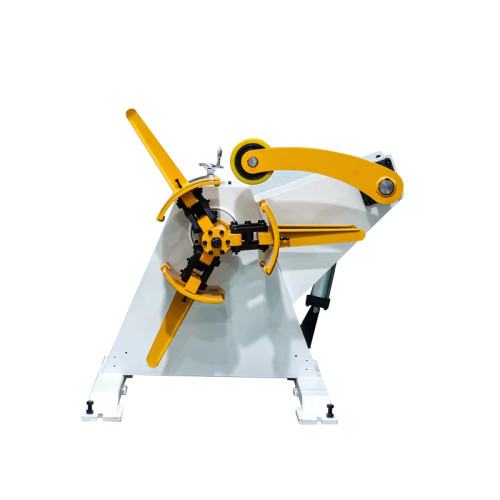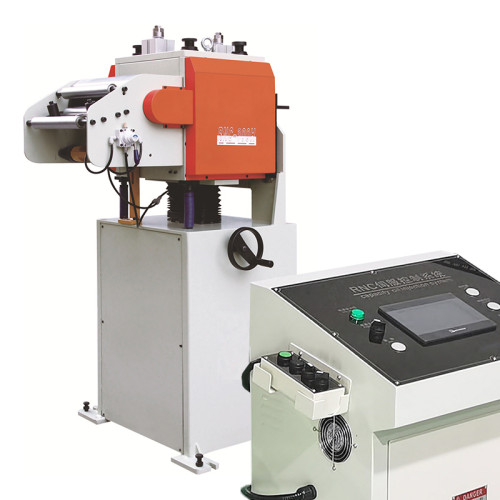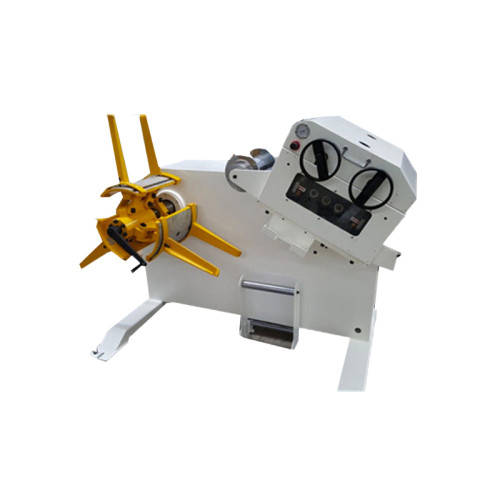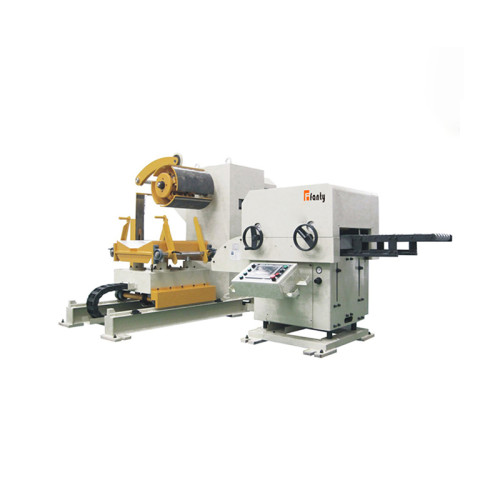
How to Prevent Coil Over-Run with a Motorized Decoiler?
Coil over-run is one of those problems that shows up suddenly and costs real money. The strip continues paying off the coil after the press stops, the loose loop grows, the material snags on the next feed, and before anyone reacts the edge is damaged or the coil has collapsed.
On a line with a motorized decoiler, over-run is almost always a control problem: the decoiler keeps delivering strip because braking, sensing, or the drive settings are not tuned to the machine that follows.
This guide explains why over-run happens, how to tune a motorized decoiler so the strip stops exactly when it should, and how to protect thin and thick coils alike. The same principles apply whether the decoiler feeds a standalone press or a complete decoiler straightener feeder line from FANTY.
Why Coil Over-Run Happens
Over-run happens when the rotational momentum of the coil and the decoiler drum carries the strip forward after the demand stops. A heavy coil spinning at speed stores a lot of kinetic energy, and if the drive or brake cannot absorb that energy quickly, the strip keeps moving.
The second cause is signal delay in the loop sensor. Most lines use a loop arm, photocell, or proximity switch between the decoiler and the downstream machine. If the sensor is mounted too far from the press, or the loop arm has excessive travel, the decoiler keeps feeding until the loop is already too large.
By the time the sensor triggers, the strip has paid off an extra length, and the loose material then buckles or snags on the next feed.
The third cause is operator tuning. A motorized decoiler has acceleration and deceleration parameters, a maximum feed speed, and sometimes an over-run compensation setting.
If these are left at factory defaults while the line speed is changed, the decoiler can deliver strip faster than the press consumes it, and the excess accumulates as an uncontrolled loop. Over-run is rarely a mechanical failure; it is a tuning and control issue, which is good news because tuning is free to fix.
Tune the Drive and Brake Response
Start with the deceleration ramp. On a motorized decoiler, the drive should decelerate in a controlled ramp rather than cutting power instantly, because an instant stop on a heavy coil can slip the material or damage the coil edge.
Next, match the decoiler feed speed to the downstream machine. The decoiler should run slightly faster than the average strip demand so it can top up the loop, but not so fast that it overshoots between sensor triggers.
On lines with a servo feeder that demands strip in bursts, the decoiler accelerates during the feed and stops between feeds, so the acceleration and deceleration settings matter more than the top speed.
A good starting point is a feed speed about 10 to 15 percent above the average line speed, with a deceleration ramp tuned so the strip stops within the loop tolerance.
For thin or soft materials, reduce the roll pressure and check the coil brake tension if the decoiler has one. Excessive brake drag makes the strip feed jerky, which increases the risk of over-run when the press stops suddenly. The goal is a decoiler that delivers strip smoothly, stops predictably, and never lets the loop collapse or balloon.
Position and Adjust the Loop Sensor
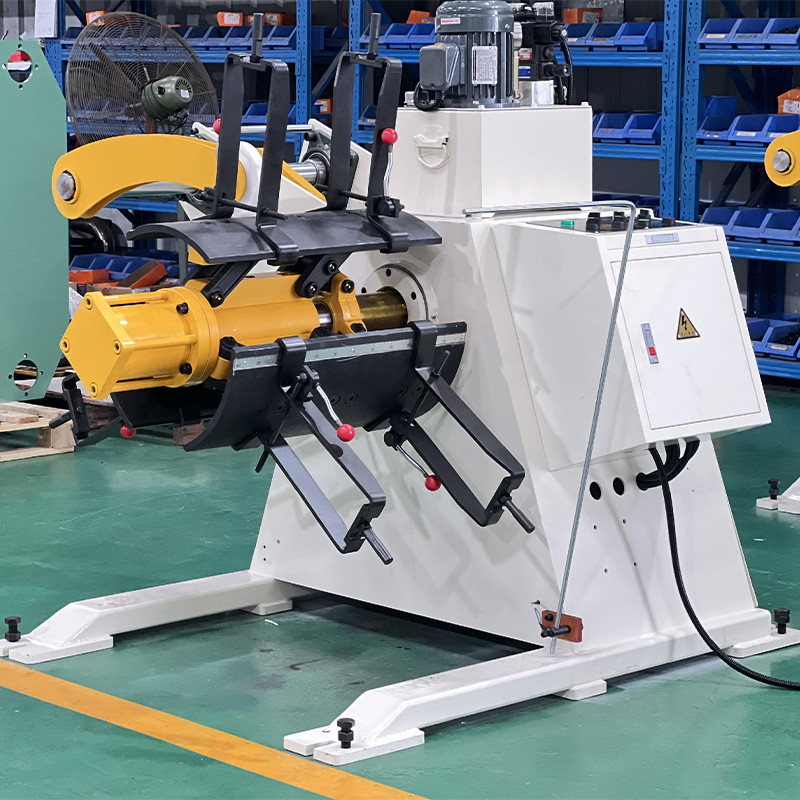
The loop sensor is the brain of over-run prevention. On a typical motorized decoiler setup, a loop arm or photocell sits between the decoiler and the press, and its job is to tell the drive when the strip is running short or long.
Calibrate the sensor positions so that the stop point is reached while the loop is still comfortably large enough to feed the next strip demand. Test the system at the actual production speed, not at jog speed, because a loop that looks fine at slow speed can balloon at high speed.
Watch the loop during a full-speed run and adjust the sensor stop position until the strip consistently settles at the same loop size.
Some modern decoiler controllers include an over-run compensation setting that deliberately anticipates the stop by braking slightly early.
If your machine has this feature, enable it and tune the anticipation distance by trial: start with a small value, run the line, and increase it until the loop stops exactly on target. This is the single most effective adjustment for eliminating over-run on motorized machines.
Braking and Control Options Compared
Different decoiler designs handle the stop differently. The table below compares the common control approaches so you can see which one your machine uses and where the over-run risk sits.
| Control Type | How It Stops the Strip | Over-Run Risk |
|---|---|---|
| Manual brake decoiler | Operator sets brake drag; strip tension controls pay-off | High at speed; no automatic response |
| Motorized with limit switch | Switch cuts drive when loop arm reaches stop position | Medium; depends on arm travel and speed |
| Motorized with photocell | Photocell signal stops drive; fast response | Low when correctly positioned |
| Motorized with over-run compensation | Controller anticipates stop and brakes early | Very low; best for high speed |
If your motorized decoiler relies on a simple limit switch and you run thin material or high speeds, upgrading to a photocell or enabling over-run compensation is the most cost-effective improvement you can make. The payback is fast because a single over-run incident that damages a coil edge can cost more than the sensor upgrade itself.
Daily Checks That Prevent Over-Run
- Verify the loop sensor is clean and correctly positioned before every shift, and wipe photocells that face dust or oil mist.
- Test the emergency stop and the decoiler stop response at the start of each shift with the coil at normal speed.
- Watch the loop size during the first full-speed run after any change of coil width or material grade.
- Check the drum and mandrel for wear that lets the coil creep, which makes the strip pay off unevenly.
- Record the tuned deceleration and over-run compensation values so they can be restored after maintenance.
Coil over-run is fully preventable once the control loop is understood and tuned. FANTY has 12 years of experience building coil handling equipment in a 45,000 m² factory with 370 staff and more than 80 R&D engineers, and its motorized decoiler range is CE certified and installed on more than 200 lines in over 60 countries. If over-run is a recurring problem on your line, check the sensor position and drive ramp first; in most cases the fix is a matter of tuning, not hardware.
Frequently Asked Questions
Why does my coil keep over-running even after I adjusted the brake?
If the decoiler is motorized, the brake is not the primary control; the drive stop command is. Check the loop sensor position and the deceleration ramp first, then enable over-run compensation if the controller supports it. A manual brake on a motorized machine only adds drag and does not stop the drive.
How much loop should there be between the decoiler and the press?
A working loop of 150 to 300 mm is typical for most stamping lines. The loop should be large enough to supply the next feed without pulling the strip tight, but small enough that the sensor reacts quickly. Too large a loop range gives the decoiler time to build excess speed.
Can over-run damage the coil or the strip?
Yes. When the strip pays off beyond the controlled loop, it can snag, buckle, or scrape against the decoiler structure, damaging the coil edge and sometimes collapsing a loosely wound coil. Thin materials are the most vulnerable, which is why tuned control matters most on light-gauge lines.
Do I need to change the decoiler to fix over-run?
Usually not. Most over-run problems are solved by repositioning the sensor, shortening the loop range, tuning the deceleration ramp, and enabling over-run compensation. A machine change is only needed if the drive cannot decelerate fast enough for your line speed, which is rare on properly sized equipment.
Related reading
- how much coil weight a decoiler handles
- how much floor space a coil line needs
- how to specify a decoiler for a coil line
Part of the the coil line guide library — the full library of coil handling, straightening and feeding guides from FANTY.
Stop coil over-run before it costs you a coil
Get a free review of your decoiler control setup from FANTY's coil line specialists.
Send Your Inquiry