How to Choose a Coil Car for Your Decoiler Line?
A coil car is the piece of equipment that moves the coil from the floor, the rack, or the crane to the decoiler head, and on a busy line it works harder than almost anything else in the coil-handling area. The wrong coil car slows every coil change, strains the operator, and can damage both the coil and the decoiler.
The right one makes loading a one-person, two-minute operation that protects the strip and the machine. Choosing a coil car is mostly a matter of matching five numbers to your actual coils and your floor layout, and this guide walks through each of them with the sizing logic that equipment builders use.
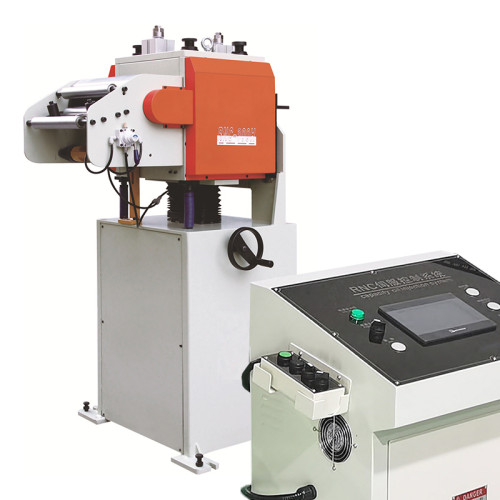
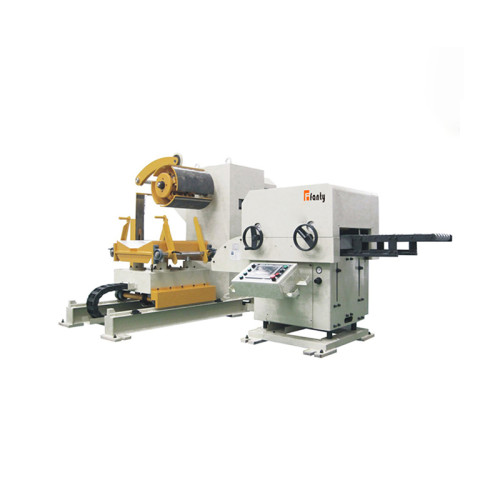
Coil cars are a standard companion to the NC straightener feeder combinations and motorized decoilers that FANTY builds for progressive die lines. The advice below applies whether you are buying a complete new line or adding a coil car to speed up an existing one.
What a Coil Car Does
A coil car is a motorized trolley with a lifting platform that travels along tracks between the coil storage area and the decoiler.
Without a coil car, the same job needs a crane and at least two people: one to guide the coil and one to operate the crane. The crane must lower the coil accurately onto the head, which is slow and risky, because a swinging coil can strike the decoiler or the operator.
A coil car replaces that entire dance with a controlled, repeatable motion that a single operator runs from a pendant.
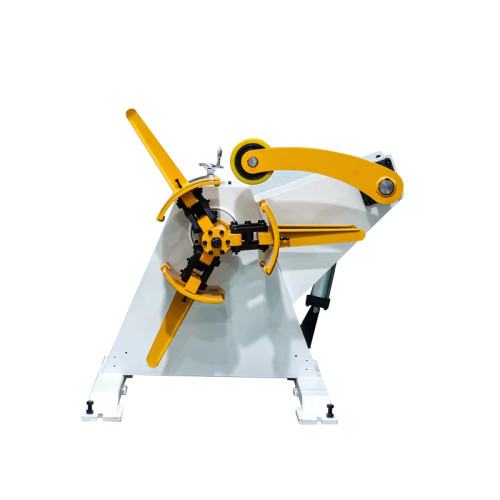
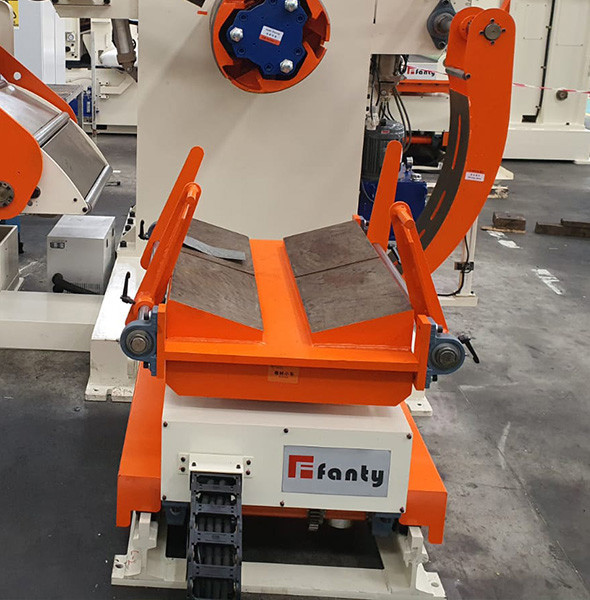 A coil car carrying a coil into position at the decoiler.
The Five Numbers That Size a Coil Car
Every coil car specification reduces to five numbers, and each one must be checked against your worst case, not your average coil.
| Specification | What it controls | How to set it |
|---|---|---|
| Load capacity | The heaviest coil the car can lift | Your heaviest coil plus 20% margin |
| Platform width | Whether the coil sits stably | Wider than your widest coil's diameter |
| Lift stroke | How high the coil can be raised | From the lowest storage level to above the decoiler center height |
| Travel distance | How far the car must run | From the storage position to the decoiler head plus margin |
| Speed | How fast the cycle completes | Balance speed against control; fast is not always productive |
Load capacity deserves special attention because the margin protects the machine, not just the motor. A car rated for exactly your heaviest coil runs at its limit every time, wears faster, and has no reserve for the coil that arrives slightly over the declared weight.
Builders rate coil cars with a safety factor, but you should still choose a model a step above your actual maximum.
Lift Mechanism: Hydraulic, Screw, or Mechanical
The lifting mechanism determines the car's cost, smoothness, and maintenance profile. Three designs dominate the market.
- Hydraulic lift. Smooth and powerful, ideal for heavy coils, but it adds a power unit and hydraulic maintenance.
- Screw or ball-screw lift. Precise vertical positioning and clean operation, well suited to medium loads and frequent use.
- Scissor or mechanical lift. Simple and robust, a practical choice for lighter coils and less demanding cycles.
For coils under about three tons, a screw or scissor lift is often the most economical and cleanest option.
Track Layout and Travel Design
A coil car runs on tracks, and the track layout is a floor-plan decision that you make once and live with for decades. Straight track between the storage area and one decoiler is the simplest and most reliable layout. If one car must serve two decoilers, you need a transfer arrangement or a turntable, which adds cost and complexity.
Three practical layout points matter. First, the storage area should hold coils so their bores face the travel direction, letting the car approach and lift without rotating the coil. Second, the track must be long enough for the car to clear the decoiler completely when loading the next coil.
Third, the floor must be level and strong enough for the loaded car, because a settling track misaligns the car with the decoiler head and turns every loading cycle into a struggle. A concrete slab designed for the loaded weight is not optional.
Safety Features That Are Not Optional
A coil car moves several tons of steel near people, so safety equipment is a specification, not an extra.
- End stops and bumpers. Mechanical stops at both ends of the track prevent the car from running off the rails.
- Proximity sensors. Detect the decoiler position so the car stops accurately every cycle without operator judgment.
- Anti-drop valves. Hold the platform if a hydraulic hose fails, preventing the coil from crashing down.
- V-guides on the platform. Keep the coil centered on the platform so it cannot roll off during travel.
- E-stop and audible warning. A pendant emergency stop and a travel alarm protect anyone near the car's path.
Ask the builder which of these are standard and which are options, and put the full list in the quotation.
Sizing Examples for Common Coil Ranges
The table below shows typical coil car selections for common coil weight ranges on stamping lines. Use it as a starting point and confirm the final selection with the builder using your actual coil data.
| Max coil weight | Typical coil OD x width | Suggested car capacity | Typical lift type |
|---|---|---|---|
| 3 tons | 1,200 mm x 200 mm | 3.6 - 4 tons | Screw or scissor |
| 5 tons | 1,300 mm x 300 mm | 6 tons | Screw or hydraulic |
| 8 tons | 1,400 mm x 400 mm | 10 tons | Hydraulic |
| 10 tons | 1,500 mm x 500 mm | 12 tons | Hydraulic |
| 15 tons | 1,600 mm x 600 mm | 18 tons | Hydraulic heavy-duty |
These figures assume a standard coil car with a V-platform and a lift stroke around 500 to 700 millimeters. If your coils are stored on pallets or in a pit, the stroke and platform design change, so always send the builder your storage layout before they quote.
Frequently Asked Questions
Can a coil car replace a crane completely?
For the loading cycle, yes: the car lifts, travels, and positions the coil without a crane. You still need a crane or forklift to place coils into the car's storage position if they arrive on a truck, but the car handles the precision part of the job.
Can one coil car serve more than one decoiler?
Yes, if the track layout allows it, usually with a longer track and a transfer section. Serving two machines with one car saves cost but means the car can become a bottleneck if both lines change coils at the same time.
How fast should a coil car travel?
Typical travel speeds are 10 to 20 meters per minute. Speed beyond that adds little because the lift and alignment take most of the cycle; a controlled, accurate motion is more valuable than a fast one that needs constant correction.
Does a coil car work with an auto-centering decoiler?
Very well. The car presents the coil to the head at the correct height, and the auto-centering head expands to grip the bore evenly. The two systems together make coil loading a fully repeatable, one-operator operation.
What maintenance does a coil car need?
Regular checks cover the travel wheels, the lift mechanism, hydraulic fluid level and hoses if fitted, and the limit switches. Following the builder's schedule keeps the car accurate, and most wear items are simple to replace before they cause a failure.
Related reading
- how much coil weight a decoiler handles
- how much floor space a coil line needs
- how to specify a decoiler for a coil line
Part of the the coil line guide library — the full library of coil handling, straightening and feeding guides from FANTY.
Get a Coil Car Sized for Your Actual Coils
Send FANTY your coil weights, diameters, storage layout, and decoiler model, and we will specify a coil car with the right capacity, lift, and track plan. Every coil-loading package we quote includes the safety features and the floor requirements in writing.
Request a Coil Car SpecificationFanty · Coil Handling Equipment
From 1 to 20 Ton Coils, We Build the Decoiler to Fit
Share your coil spec sheet and we confirm hydraulic versus mechanical, single versus double head, and the expansion range that keeps changeover under five minutes.
Get a Free QuoteFANTY Machinery · 13 years on stamping automation · 2,000+ coil lines installed · engineers reply within 24 hours