How Much Brake Torque Does a Motorized Decoiler Need?
A roll forming mill does not pull strip off a coil the way a press does. It pulls steadily, at a fixed surface speed, and the coil has to resist that pull without going slack or dragging.
That resistance is brake torque, and it changes by a factor of three as the coil empties. Sizing a motorized decoiler on one number is where most of the trouble starts.
Start With the Pull, Not the Machine
Back tension is what keeps the strip flat and taut between the coil and the first forming stand. Without it the strip bows, the roll gap wanders and the profile drifts.
For cold-rolled strip on a roll forming line, a useful working range is 5 MPa to 10 MPa of strip cross-section. Heavy sections sit at the low end and thin strip at the high end.
Take a 300 mm by 1.2 mm strip. The cross-section is 360 mm², so 8 MPa of tension equals 2,880 N of pull at the coil.
That pull figure is the input to every calculation that follows. It does not depend on coil size, line speed or brake type.
It does depend on the material. Stainless and high-strength grades need more tension to stay flat, and aluminium needs less to avoid stretching.
Eight megapascals looks low next to a press line, and that is correct. Roll forming needs drag on the strip, not stretch.
Above roughly 30 MPa the strip starts to elongate permanently, and only a tension-levelling line works deliberately in that range.
If you cannot measure tension, measure motor current on the uncoiler drive and convert. It is an estimate, and it beats guessing.
Torque Falls With the Coil, Power Does Not
Torque is force multiplied by radius, so the brake has to work hardest on a full coil. A 1,500 mm outside diameter gives a 0.75 m lever arm.
At 2,880 N of pull, that is 2,160 N·m of brake torque. With the coil down to a 508 mm core, the same pull needs only 732 N·m.
So the brake is sized at the full-coil figure, and the control has to shed torque as the diameter falls. A fixed-torque brake will over-tension the tail of every coil.
Power behaves the opposite way. Torque times angular velocity stays roughly constant, because the surface speed is constant.
At 30 m/min the full coil turns at 0.67 rad/s and the core turns at 1.97 rad/s. Both cases land near 1.4 kW of braking power.
That constant-power behaviour is the reason a small brake motor can hold a large coil. It is also the reason thermal sizing matters more than peak torque.
Plot the torque curve against diameter for the coils you actually buy. A shop running 1,200 mm coils never sees the 2,160 N·m case.
That single fact can halve the brake size, and it is the reason coil range belongs on the specification sheet rather than in a footnote.

Worked Example: 3.7 Tonnes on a 508 mm Core
A 1,500 mm outside diameter coil, 508 mm core, 300 mm wide in 1.2 mm steel weighs about 3,680 kg. That figure sets the spindle and the base, not the brake.
Accelerating that mass to 30 m/min in three seconds needs another 256 N·m, on top of the 2,160 N·m of drag. Inertia adds about 12% to the peak.
Most sizing sheets forget that term. It rarely matters on a slow line and it matters a great deal on a line that stops and starts every ninety seconds.
Now add a service factor. A factor of 1.3 on the combined figure gives roughly 3,140 N·m of required brake torque for this duty.
Check the thermal side separately. A brake that dissipates 1.4 kW continuously needs a disc sized for that load, not for the peak torque stamped on the datasheet.
Four Brake Arrangements and What Each Costs
The torque number is the same for every arrangement. What differs is how the tension behaves when the line speed changes.
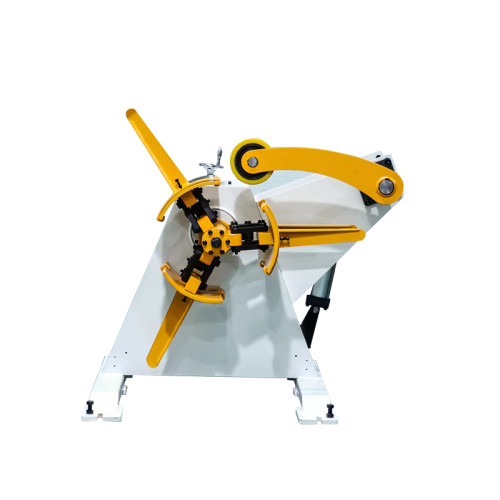
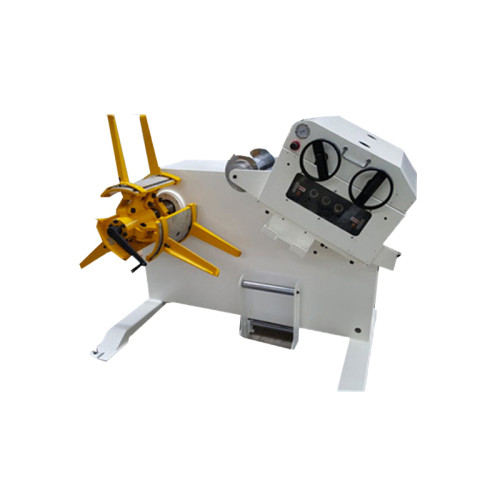
A pneumatic disc brake with a dancer arm is the cheapest way to hold tension. A servo-driven motorised decoiler holds it more precisely and costs more to buy and to commission.
| Arrangement | What it gives the line | Where it costs you |
|---|---|---|
| Friction brake, fixed torque | Lowest cost, simple to maintain | Over-tensions the coil tail; tension drifts as pads wear |
| Pneumatic disc with dancer | Closed-loop tension, tolerant of speed changes | Air quality becomes a tension variable; dancer needs space |
| Motorised decoiler in torque mode | Programmable tension curve, regenerative braking | Drive tuning and encoder setup; higher capital cost |
| Motorised decoiler with load cell | Tension measured, not inferred | One more sensor in the strip path to protect and calibrate |
For a line that runs one speed all day, the friction brake is defensible. For a line that ramps between 8 m/min and 40 m/min, it is not.
Pad wear is the quiet cost of the friction option. A set of pads loses 10% to 15% of its torque before anyone notices the strip getting loose.
Air quality is the quiet cost of the pneumatic option. A line with a wet compressor and no dryer will hunt tension all afternoon and blame the brake.
Motorised options move the cost to commissioning. Drive tuning takes half a day, and it is worth paying for if the line changes speed often.
Four of the questions below come up in every brake sizing conversation, and each one has a number behind it.
How much brake torque does a 1,500 mm coil at 2,880 N need?
About 2,160 N·m at full diameter, falling to 732 N·m at a 508 mm core. Size the brake at the full-coil figure and control the fall.
Can a 1.5 kW brake motor hold a 3.7-tonne coil?
Yes. At 30 m/min the braking power is about 1.4 kW regardless of diameter, so the motor is sized on power and the brake on torque.
How much torque does coil inertia add on a 3-second ramp?
Roughly 256 N·m on a 3,680 kg coil, about 12% of the drag torque. Ignore it on slow lines, size for it on stop-start lines.
Does a 5 MPa tension setting suit 0.8 mm stainless?
Usually not. Thin stainless needs 8 MPa to 12 MPa to stay flat, and the higher figure raises the brake torque by 60% to 140%.
What width makes brake tension irrelevant?
Below about 60 mm. Strip tracking and camber dominate at that width, and no tension setting corrects them.
How often should brake pads be checked on a two-shift line?
Every 500 hours, and tension should be re-verified after each pad change. A worn pad loses 10% to 15% of its torque before it looks worn.
Where These Numbers Stop Being Useful
The calculation above assumes the strip leaves the coil and goes straight into a driven stand. Put an accumulator loop in between and the tension story changes completely.
With a free loop, the brake no longer controls tension at all. It only has to stop the coil from overrunning, which is a fraction of the torque.
It also assumes the coil is wound tight. A loosely wound coil, or one that has been re-banded after partial use, will telescope before it reaches full tension.
Narrow strip is another boundary. Below about 60 mm width the tension per unit area matters less than the strip wandering sideways, and no brake setting fixes that.
A coil wound loose at the mill will telescope under tension no matter how well the brake is sized. That is a coil handling problem, not a brake problem.
Speed is the other boundary. Above about 60 m/min the brake has to release and re-apply faster than a pneumatic caliper can respond, and a motorised drive wins by default.
Finally, the numbers describe steady state. If your mill stops and starts with every cut, the duty cycle matters more than the torque figure, and the brake will size on heat rather than load.
One more honest limit: brake torque cannot compensate for a badly aligned uncoiler. A spindle out of square by 0.5 mm will pull the strip to one side regardless of tension.
What to Put on the Specification Sheet
Six numbers settle the brake question before a supplier quotes. Write them down and the conversation gets shorter and more accurate.
- Strip section. Width times thickness, plus the material grade and its yield strength.
- Tension target. The MPa figure you want at the coil, with a tolerance band.
- Coil range. Maximum outside diameter, core diameter and weight, not just the nominal.
- Speed range. Minimum and maximum line speed, plus the acceleration time between them.
- Duty cycle. Hours per shift and starts per hour, which drive the thermal sizing.
- Tension control. Dancer, load cell or open-loop torque, and who owns the tuning.
Suppliers who ask for all six are usually the ones who get it right. Suppliers who quote from a coil weight alone are quoting a catalogue item.

The wider decision chain, from capacity through mandrel to control, is set out in the coil line guide library.
Where to go next
Brake torque is one line on a specification that has four decision stages before it. Capacity, type, mandrel and control are worked through in order in our coil line knowledge base.
The Coil Line Guide Library