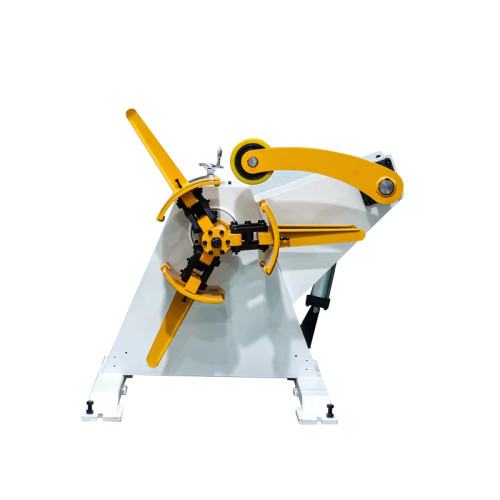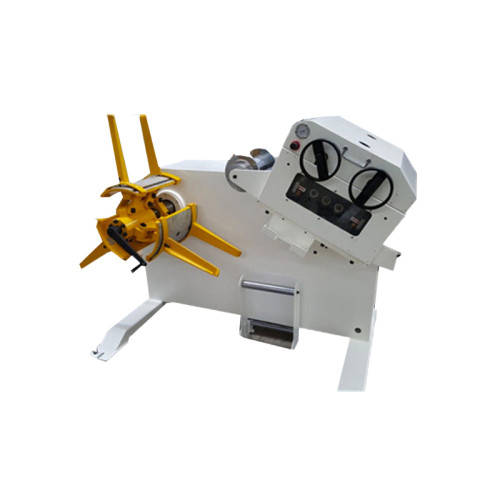
How Does a Coil Reel Handle an Out-of-Round Coil?
A coil arrives with a dented eye, the mandrel expands into it, and the first two hundred metres pay off with a thump on every revolution. The operator blames the brake.
The real problem is that two of the four mandrel segments are doing all the work.
This article works through the arithmetic that decides whether a coil reel can hold an out-of-round coil safely.
It covers what to measure, how much radial force the segments need, and where a coil reel should be taken out of the argument.
It is written for plants running a decoiler or uncoiler ahead of a press line.

Out-of-round coils are normal, not exceptional. A coil that has sat on a stillage for a month, been re-wrapped by hand, or been lifted by a clamp instead of a C-hook will close its eye unevenly.
Nothing about that is a defect in the coil reel. It is an input condition the machine has to be sized for.
Measure the Coil Before You Blame the Reel
Four measurements separate a coil the mandrel can hold from one it cannot. Take them before the coil goes on the mandrel, not after the run fails.
- Minimum and maximum eye diameter. Measure at four positions 45° apart. The spread between the smallest and largest reading is the out-of-round figure.
- Eye straightness along the width. A coil whose eye is conical, wider at one edge, contacts the segments unevenly across the face.
- Surface condition inside the eye. Scale, rust or wrapping tape changes the friction coefficient, and friction is what the whole calculation rests on.
- Coil weight and outside diameter. These set the payoff torque that the mandrel has to resist, and torque is what turns into radial load.
Measure the eye with a tape or an internal gauge, not by eye. A 20 mm distortion is easy to feel and hard to see, and two people will estimate different figures.
Record the readings against the coil number. After three months you will know which supplier sends you the damaged coils.
A nominal 508 mm eye with a 6 mm spread is comfortable. A 20 mm spread means the mandrel is holding a shape, not a bore.
The Expansion Range That Decides Whether It Grips
A mandrel does not need to fill the eye. It needs to reach the eye and then hold it without slipping. Two numbers govern that: how far the segments can travel out, and how much radial force each one can deliver.
| Parameter | Typical Working Range | Where It Costs You |
|---|---|---|
| Mandrel expansion travel | Nominal eye plus 20-25 mm of outward travel, for a 508 mm bore | Wider travel needs a bigger hydraulic cylinder and a heavier drum, which raises the coil reel's own price and footprint |
| Segment count | 3 or 4 segments is standard; 6 appears on very heavy duty uncoilers | More segments distribute load better but add linkages and more places for scale to jam |
| Friction at the eye | 0.15 dry steel-on-steel, 0.10 with oil film, 0.08 with heavy rust scale | A drop from 0.15 to 0.10 raises the required clamping force by 50%, which most mandrels are not sized for |
| Grip contact length | At least 70% of the coil width for a stable hold | Short segment pads on a wide coil concentrate pressure and can bell the eye |
| Payoff tension | 2-5 kN on a typical press line, higher with heavy back tension control | More tension buys flatter strip but loads the mandrel and the brake harder |
The rule worth remembering is a ratio, not a number. Required radial force rises in direct proportion to payoff tension and outside diameter, and in inverse proportion to friction and eye radius.
That is why the same coil reel holds one coil comfortably and slips on the next one, even though the weight is identical.
Working the Numbers on a 5-Tonne Coil
Take a realistic job: a 5-tonne steel coil, 1,250 mm outside diameter, 508 mm eye, running at 3 kN of payoff tension on a 1,250 mm wide uncoiler.
Step one, payoff torque. Torque is tension multiplied by the outside radius: 3,000 N × 0.625 m = 1,875 N·m.
Step two, required radial clamp force. Divide torque by the product of friction and eye radius: 1,875 ÷ (0.15 × 0.254) ≈ 49 kN of total radial force.
Step three, load per segment. A round eye touches all four segments, so each carries about 12 kN. That is comfortable for a standard segment design.
| Condition | Segments in Contact | Load per Segment | Outcome |
|---|---|---|---|
| Round eye, 6 mm spread, dry | 4 of 4 | 12 kN | Stable hold, no marking |
| Out-of-round, 20 mm spread, dry | 2 of 4 | 25 kN | Hold is marginal, eye marking starts |
| Out-of-round, 20 mm spread, oily eye | 2 of 4 | 37 kN | Slip under tension, coil telescopes |
| Out-of-round, conical eye, oily | 1-2 of 4 | 45 kN or more | Segment linkage damage, coil rejected |
The oily, out-of-round case is the one that breaks machines. It doubles the design load on two segments while the friction that resists slip has fallen by a third.
If your incoming coils regularly show more than 10 mm of eye spread, size the coil reel for the worst case rather than the average. The premium is small next to a repair that stops the line.
Watch the sensitivity to outside diameter. The same 3 kN of tension produces 2,250 N·m on a 1,500 mm coil, against 1,875 N·m on the 1,250 mm coil above.
A bigger coil therefore demands about 20% more radial force from the same mandrel. That is why a coil reel can hold a half-empty coil comfortably and slip on a full one.
Divide the job between the mandrel and the brake. The brake sets the tension, and the mandrel only has to resist the torque that tension creates.
Loosening the brake lowers the load on the segments, at the cost of a looser strip and a wider tension window.
How much eye distortion can a 4-segment coil reel tolerate?
Up to about 10 mm of spread keeps all four segments loaded. Beyond 15 mm the hold becomes geometry-dependent, and above 20 mm the coil should be re-wrapped or rejected before it goes on the mandrel.
Does an oily coil eye really halve the holding force?
Roughly, yes. Going from a dry eye at 0.15 friction to an oily one at 0.10 raises the required clamp force by 50%, which is the difference between a stable hold and a slip event.
What expansion range should a 508 mm coil reel cover?
Specify a working range of roughly 480-530 mm so it can accept normal mill tolerance and mild out-of-round without losing contact. A range narrower than 40 mm leaves no margin for a damaged coil.
Where a Coil Reel Cannot Help
Some coil conditions sit outside what any mandrel can fix, and pretending otherwise leads to damaged equipment.
- A collapsed or oval eye. Once the eye is genuinely oval rather than slightly irregular, no expanding mandrel can create contact across four points without crushing the coil.
- Telescoped wraps. If the outer wraps have already slid sideways, the coil is unstable in the axial direction and will move regardless of how well the bore is held.
- Loose outer wraps. A coil whose outer wrap has unwound slightly will slap the floor or the guard on the first revolution. A coil car with a hold-down, not a better mandrel, is the fix.
- Mixed eye diameters in one batch. A mandrel that covers 480-530 mm cannot also cover a 610 mm eye. That needs a different mandrel set, not more expansion travel.
Also be careful with the marking question. Higher radial force solves slip and creates print-through on the inner wraps.
On coated or pre-painted stock, the answer is often a wider contact pad rather than a stronger cylinder.
Be careful with a single good test. One coil that holds cleanly at 5 tonnes says nothing about the next one, which may arrive with a 22 mm eye spread and an oil film.
The result describes the coil, not the machine.
What to Write Into the Acceptance Test
Put the grip requirement into the acceptance test so the argument happens at the factory, not in your bay.
Specify the eye range. State the minimum and maximum eye diameter the coil reel must hold at rated tension, and require a test at both ends.
Test at reduced friction. Ask for a holding test with an oiled eye. A mandrel that passes dry and fails oily has not been proven for a real shop floor.
Record the slip threshold. The test report should state the tension at which the coil begins to rotate on the mandrel. That single figure tells you how much margin you have bought.
Agree the test material in advance. A holding test run on a clean, round, dry coil proves only that the mandrel expands.
Ask for the test coil to be drawn from your own incoming stock, or from a coil with a documented 15 mm eye spread.
Every machine shipped from a 45,000 m² plant with CE certification should arrive with that record, and our machines are no exception.
If the specification behind it is still open, the coil line guide library sets out the capacity, type, mandrel and control decisions in order.
Where to go next
This article sits in the coil handling branch of the coil line guide library, one layer below the decoiler specification pillar.
It answers the single question of what happens when the bore you are given is not the bore you designed for.
Read the decoiler specification guide