Can a Servo Feeder Run Without a Free Loop?
A servo feeder can run without a free loop, but only when the coil is small enough that the feeder rolls can accelerate it without slipping.
On a 10 t coil at 60 strokes a minute, the tension needed to spin that mass is about 11.5 kN, and the rolls cannot hold it.
That single number explains why the loop exists, and it also tells you where removing it is safe. Here is the arithmetic, then the four configurations that work in practice.
The Inertia the Rolls Have to Drag
Without a loop, the feeder is not pulling strip. It is accelerating a rotating mass through the strip, and the strip is the only transmission.
Take a 10 t coil, 1,600 mm outside diameter, 610 mm bore. Its mass moment of inertia is about 3,665 kg·m².
Now feed 300 mm per stroke at 60 strokes a minute. The feed window is roughly 0.4 seconds, and peak strip acceleration lands near 2 m/s².
Angular acceleration at the coil surface is 2.5 rad/s², so the torque the feeder must deliver through the strip is about 9 kNm.
Divide by the 0.8 m radius and the required strip tension is 11.5 kN.
That is where it breaks. Oiled steel grips a roll at a friction coefficient near 0.15, so 11.5 kN of tension needs roughly 77 kN of clamp force.
A typical servo feeder on this width applies 20 to 30 kN. It slips, and a slipping roll does not lose length evenly, so the error wanders.
Shrink the coil to 1,000 kg and the whole chain falls by a factor of ten. Tension needed becomes 1.15 kN and the clamp requirement drops to about 7.7 kN, which is comfortable.
Four Configurations and What Each One Costs
The industry has settled on four arrangements. Three of them keep some form of loop, and the fourth removes it by adding a drive.
| Feeding arrangement | What it gives the run | Where it constrains you |
|---|---|---|
| Loop with a photocell | Full speed range, low cost, tolerant of coil variation | Needs 1.5 to 2 m of floor and a loop pit, and the strip can slap at high speed |
| Loop with a dancer arm | Steady tension, best length control on thin strip | Arm pivots and springs wear, and the arm eats another 600 mm of floor |
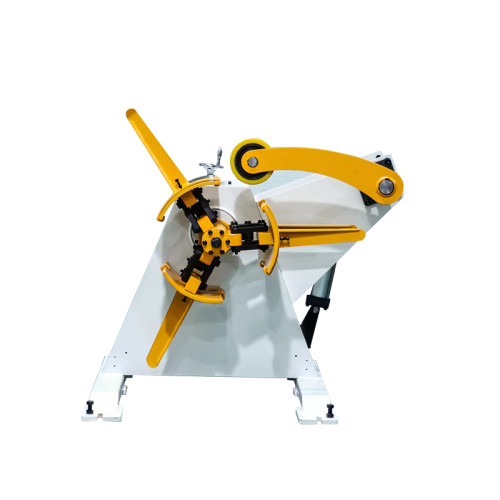
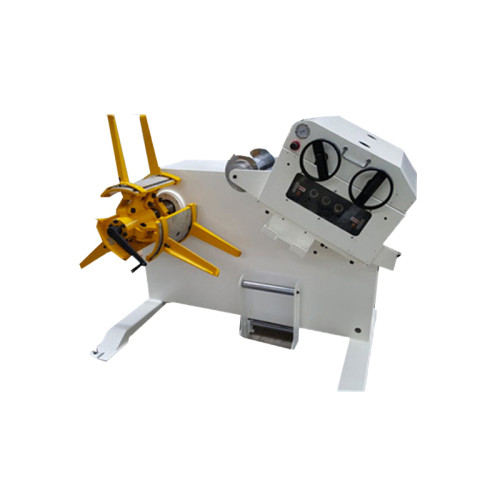
| No loop, powered decoiler in tension mode | Shortest line, cleanest strip path, no pit | Drive must be sized for peak torque, roughly three times the cost of a brake |
| No loop, brake only | Cheapest possible arrangement | Only viable under about 1 t of coil and 100 mm of feed, which rules out most production work |

The third row is the one worth arguing about. A powered decoiler in tension mode is not a brake with a motor bolted on.
It runs closed loop on a load cell or on motor current, and it has to respond inside the feed window rather than across the whole cycle.
That response is what costs money. A drive sized for 9 kNm of peak is a different purchase from a 2 kNm brake.
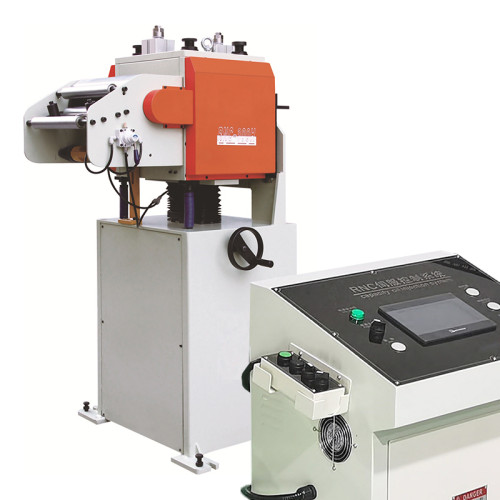
Clamp force and roll diameter for each model are published in the servo feeder data sheets, and that is the figure to hold against the tension number above.
Three Numbers Decide It Before You Cut the Pit
Coil mass, feed length and stroke rate are the only variables that matter. Everything else is detail.
Coil mass. Inertia scales linearly with mass at a fixed diameter, so halving the coil halves the tension demand.
Feed length. Doubling the feed doubles peak velocity, which doubles acceleration if the window stays fixed.
Stroke rate. Higher rate compresses the window, so acceleration climbs even when feed length is unchanged.
A 300 mm feed at 30 SPM instead of 60 cuts peak acceleration by roughly four, because the window stretches while the velocity stays similar.
That is why slow, long-feed jobs sometimes run happily without a loop while fast, short-feed jobs on the same machine cannot.
The feed profile matters too. A servo cam profile with a long ramp spreads acceleration over more of the window and lowers the peak.
Most controllers ship with a trapezoidal or modified sine profile. Ask which one is active before you conclude the drive is undersized.
On one 400 mm feed at 55 SPM, switching from a sharp trapezoid to a longer ramp cut peak tension by about 30 percent on our test stand.
That is enough to bring a borderline job back inside the clamp limit, without buying a larger drive.
If you are holding ±0.05 mm at 200 SPM with a loop today, expect that figure to loosen by 0.03 to 0.06 mm when the loop comes out, unless the drive is properly sized.
Check These Five Things Before Removing the Loop
This is the sequence we run with a plant that wants to shorten its line. It takes a day and prevents a month of arguing.
- Weigh the heaviest coil you actually buy, not the machine rating
- Write down feed length, stroke rate and the feed window from the press controller
- Read the clamp force on the feeder data plate and compare it with the tension the coil needs
- Confirm the decoiler drive can hold torque in both directions, or it will overrun on the return stroke
- Plan the coil-end procedure, because without a loop there is nothing to absorb the last metre
The fourth item catches more conversions than the arithmetic does. A brake resists rotation; it does not reverse it.
Without a loop, the strip goes slack on every return stroke unless something takes up the difference, and a brake cannot.
What Pull-Off Feeding Cannot Do
There is a list of jobs where removing the loop is simply the wrong decision, and it is short enough to memorise.
Foil below 0.3 mm. Tension control resolution on a drive is a percentage of rated torque, and a 10 t drive cannot resolve the 40 N a foil needs.
Coil-end handling. A loop gives the operator a buffer to stop the press before the tail whips through. Without it, the tail arrives at full speed.
Welded joints. The weld passes the rolls under tension and can open. A loop lets it pass at low stress.
Mixed coil sizes. If you run 500 kg and 8 t coils on the same line, no single tension setting covers both.
Retrofit on an existing brake. Adding a drive to an old decoiler usually costs more than the floor space it saves, especially when the shaft and bearing were never sized for it.
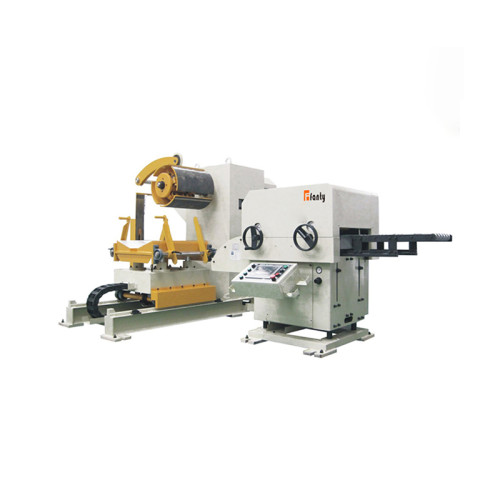
FANTY has built feeders into more than 200 production lines, and the plants that removed the loop successfully all had a powered decoiler from the start.
Prove It on Your Own Coil, Not Ours
A conversion like this is accepted on measurements, not on a demonstration with a light coil.
| Test to run | Pass mark | Why it fails when it does |
|---|---|---|
| Feed length, full coil against last 20 percent | Drift inside 0.05 mm | Tension rises as the radius falls, so the rolls slip more at the end |
| Peak strip tension at the feed rolls | Under 15 percent of yield | Above that the strip stretches and the part grows |
| Roll surface temperature after 30 minutes | Under 60 degrees C | Heat means slip, and slip means wear on both roll and strip |
| Decoiler drive current during the feed window | Under 80 percent of rated | A saturated drive cannot correct, so it behaves like a brake |
Run all four on the heaviest coil in your store, at the fastest rate you intend to sell. Anything less is a test of the weather.
Log the four readings against coil weight and keep the sheet on the machine. A month of those numbers tells you where the limit sits far better than any calculation.
How much tension does a 10 t coil need without a loop?
About 11.5 kN at a 300 mm feed and 60 SPM, which needs roughly 77 kN of roll clamp at a friction coefficient of 0.15. Most feeders on this width deliver 20 to 30 kN.
Can a 2 t coil run loopless at 45 SPM?
Usually yes, if the feed is under 200 mm. Tension demand falls to about 2.3 kN, which sits inside the clamp capability of a standard feeder.
Does removing the loop improve feed accuracy?
No. It removes a source of strip marking and saves floor, but length control gets worse because tension now varies through the stroke. Expect 0.03 to 0.06 mm of extra scatter.
What does a tension-mode drive add to the machine price?
Roughly 8 to 12 percent of the decoiler cost on a 10 t unit, and more if the existing shaft needs a new bearing arrangement. Budget USD 4,000 to 9,000 on a typical build.
Can I keep the loop and just shorten it to 800 mm?
Yes, and it is often the better answer. A 800 mm loop still decouples inertia and saves about 1 m of floor compared with the usual 1.8 m pit.
At what stroke rate does a loop stop being optional?
Above roughly 90 SPM on a 300 mm feed, the feed window is too short for any drive to follow, so the loop becomes the only workable arrangement.
Where to go next
Whether the loop stays or goes, it remains one line in the tolerance stack that runs from coil to die.
That pillar allocates the error between decoiler, loop, rolls and pilot release, which is the only way to see what a change actually buys.
Open the feed accuracy pillar