Can a Coil Reel Beat an Uncoiler on Light Gauge?
A 0.5 mm strip at 300 mm wide does not need much pull. That single fact decides most of this argument before anyone opens a catalogue.
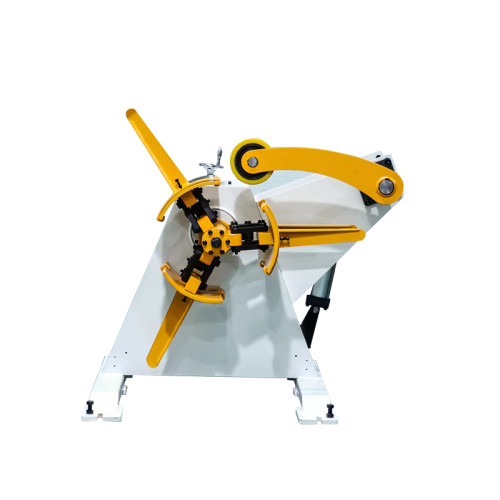
A plain coil reel holds the coil on a shaft and lets the line pull strip off it. A powered uncoiler holds the coil, drives it, and controls how fast it pays off.
Both are sold as coil handling equipment, both sit at the front of the line, and the price difference is larger than most buyers expect.
Two Ways to Pay Off a 300 kg Coil
The reel is a shaft on bearings with a drag brake. Strip tension comes from the brake and from the weight of the coil itself.
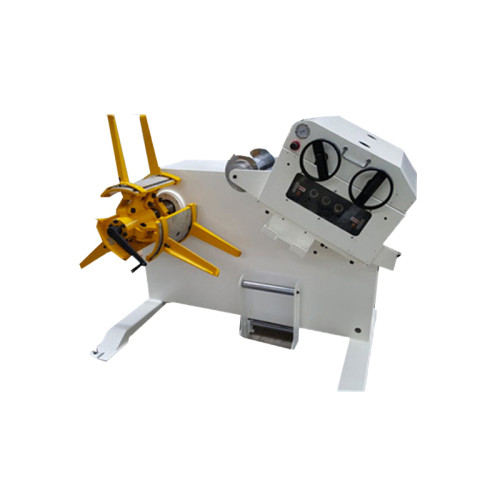
The powered uncoiler is the same shaft with a motor, a variable speed drive and usually a dancer or loop sensor feeding control back to the drive.
On paper both deliver strip. The difference is who controls the payoff speed: the line, or the machine.
On a light gauge line running slowly, letting the line pull the coil is perfectly workable. On a fast line it becomes a source of slack loops and coil end snaps.
What the Powered Unit Actually Does Differently
It holds back tension constant as the coil diameter shrinks. On a reel, tension rises through the coil because the lever arm shortens while brake torque stays fixed.
That rising tension is why light strip on a reel starts to stretch in the last third of the coil, and why the same strip on a powered unit does not.
It also decelerates the coil before the end arrives, which is the single biggest difference in scrap rate between the two.
There is a maintenance asymmetry worth knowing before either is priced. A drag brake needs periodic adjustment and nothing else.
A drive brings a motor, a brake and an encoder into the maintenance schedule, and each of those has a failure mode a brake never had.
A coil end that whips loose on a reel can mark several metres of strip or, worse, reach the operator. A powered unit stopping at three metres per minute removes that failure entirely.
Comparison on the Numbers That Matter
| Criterion | Coil Reel | Powered Uncoiler | Where It Costs You |
|---|---|---|---|
| Coil weight ceiling | Up to about 300 kg by hand | 1,000 kg and well beyond | Above 300 kg the reel needs a hoist and two people |
| Back tension through the coil | Rises as diameter falls | Held constant by the drive | Strip stretch in the last third of the coil |
| Coil end handling | Manual, or a friction drag | Programmed deceleration | Scrap and a real safety exposure on the reel |
| Changeover | Manual load, manual centring | Coil car, auto-centre | Two to four minutes more per coil on the reel |
| Capital cost | Lowest of the three options | Two to three times the reel | You pay for control you may not need |
| Footprint | Small, no drive panel | Adds a panel and a coil car bay | Two square metres, plus access |
The tradeoff column is where the decision usually gets made. Two of those rows are money and four are operating cost.
What the Price Difference Buys Over Five Years
The capital gap between a bare reel and a 1,000 kg powered unit runs from about USD 6,000 to USD 12,000, depending on control and coil car.
Set against it, coil end scrap on a reel runs 1 to 2 metres per coil on thin coated strip. Most of that is preventable, and none of it is free.
At 600 coils a year on 300 mm strip at 0.5 mm, two metres per coil is 1,200 metres, or roughly 1.2 tonnes of material.
At USD 900 a tonne that is about USD 1,000 a year, so on scrap alone the drive difference takes six to twelve years to repay.
The arithmetic only becomes convincing when changeover minutes and coil end exposure are priced in the same table. That is rarely how they are presented.
| Cost line, first five years | Coil Reel | Powered Uncoiler | Where It Costs You |
|---|---|---|---|
| Capital | USD 3,000 to 5,000 | USD 9,000 to 17,000 | Six to twelve years to repay on scrap alone |
| Coil end scrap, 3,000 coils | 3 to 6 tonnes | 0.6 to 1.2 tonnes | Small on bright strip, large on coated |
| Labour per changeover | 8 minutes | 4 minutes | Half a shift a month at six coils a day |
| Drive maintenance | Drag brake only | Motor, brake and encoder wear | Adds a service line to the PM schedule |
| Coil end exposure | Whip risk at the operator | Programmed deceleration | The row that never appears in either quote |
The last row settles more of these decisions than the other four combined, and it is the one both quotations leave out.
Ask for it in writing. A supplier who cannot describe what happens in the last three metres of a coil has not thought about the failure that hurts people.
- Price the five-year cost at your own coil count, not at the catalogue's illustrative figure.
- Carry the coil car as a separate line, because it usually returns more minutes than the drive does.
- Check tension control at 10 percent of rated speed, which is where light strip actually runs most of the time.
- Confirm the coil end stop is programmable rather than a fixed deceleration ramp.
The reel stops being adequate at the point where the operator cannot load a coil alone, which is somewhere around 250 to 300 kg on a standard shaft height.
It also stops working when the line speed exceeds what a friction brake can hold steadily, typically above 30 metres per minute on thin strip.
And it stops when the strip is coated. Rising tension on a reel scratches coated material against its own wraps, and the marks are not recoverable downstream.
None of this makes the reel a bad machine. It makes it a machine with a defined envelope, and the envelope is smaller than most catalogues suggest.
Where a Powered Uncoiler Is Overkill
A powered unit is overkill on a line that runs under 300 kg coils at under 20 metres per minute with an operator standing there anyway.
It is also overkill where the strip is thick enough that tension variation does not matter, which covers most 2 mm and heavier work.
And it is overkill in a job shop where the coil changes every hour. The drive spends its life accelerating and decelerating and never reaches steady control.
A plant without a maintenance electrician on shift should think twice as well. A reel fails to a known symptom; a drive fails to a fault code.
Both machines need a level foundation and both need the coil centred. Those two costs are identical and often quoted as if they differ.
In those cases the money is better spent on a coil car, which removes more minutes per changeover than a drive ever will.
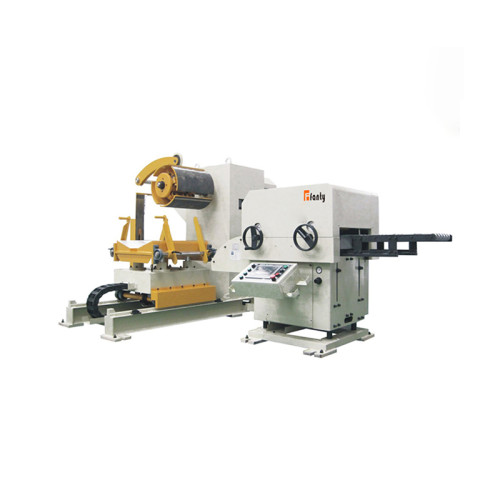
If a coil car is already in the plan, the decoiler and coil handling range lists mandrel size and coil weight per model, which is the pair of numbers that decides this choice.
Bring those two numbers to any comparison and most arguments about drive type settle themselves.
Choosing Between Them in Ten Minutes
Four questions settle it. Answer them honestly and the answer is not close.
- What is the heaviest coil you will run, and can one person load it? Above 300 kg, the reel is out.
- What is the maximum line speed, and what is the strip thickness at that speed? Thin plus fast points to the powered unit.
- Is the strip coated or polished? If yes, constant tension is worth the price difference on its own.
- How many coils per shift? Above six, changeover time dominates and the coil car matters more than the drive.
A fifth question is often worth asking: what happens when the coil runs out at 3 a.m. with nobody watching. The answer usually decides in favour of the powered unit.
Where to go next
This comparison sits under the decoiler cluster, which treats capacity, mandrel type and control choice as one decision rather than three. If the coil range is still open, start there before pricing either option.
The Coil Line Guide LibraryAt what coil weight does a 300 mm coil reel stop being practical?
Around 300 kg. Above that, loading needs a hoist or two people, and the time saved by the lower price disappears in labour.
Does a powered uncoiler really reduce scrap at coil end?
Yes, typically 1 to 2 metres per coil. On a 600-coil year that is 600 to 1,200 metres of strip, which often pays for the drive difference alone.
Can a reel run coated aluminium without marking it?
Only with a felt-lined drag brake and reduced speed. Most plants find the marks unacceptable and move to a powered unit with constant tension.
How much floor space does the powered version add?
About two square metres for the drive panel, plus a coil car bay of 3 by 1.5 metres. Plan the bay before the machine arrives.
Is a coil reel still right for a shop running 4 coils a week?
Usually yes. Under four coils a week and under 300 kg, the reel's simplicity is worth more than the drive's control.
What line speed forces the switch to a powered uncoiler?
Above roughly 30 metres per minute on strip thinner than 1 mm, friction braking becomes inconsistent and the loop starts to hunt.