Why Did an Appliance Line Stop Every 90 Minutes?
The maintenance log for the appliance panel line showed a stop every 86 minutes, all day, for eleven weeks. The plant blamed the operators. The operators blamed the coil supplier.
Both were wrong. The line ran 41 minutes and stopped 45, and the stop was made of four separate tasks that nobody had timed separately.
The job was a 1.0 mm SPCC side panel, 1,600 mm wide, 1,150 mm pitch, 18 strokes a minute on a 400 tonne press. One coil produced 709 parts.
This is the field record: what the stop was made of, what a coil car changed, and the two cases where the same money is better spent elsewhere.
The Stop That Looked Like an Operator Problem
Eleven weeks of logs, one number each shift: 41 minutes of running, 45 minutes of standing still. Nobody had written down what happened during the 45.
The plant manager asked for a fix to operator discipline. The shift supervisor asked for bigger coils. Both requests were reasonable and both were guesses.
What settled it was a stopwatch and a clipboard for two days. Every stop was written down with a start time, an end time and one word for what the crew was doing.
The result was uncomfortable. The crew was not slow. The work they were doing during the stop had never been designed, so each task started from whatever state the last one left.
An 8 tonne coil at 1,250 mm wide and 1.0 mm thick holds 815 m of strip. At a 1,150 mm pitch that is 709 strokes, which is 39 minutes at 18 strokes a minute and 41 with the ramp at each end.
Breaking 45 Minutes Into Five Parts
Five tasks, timed separately, over twelve consecutive coil changes. The spread between the fastest and slowest change was 19 minutes, which is the first sign of an undesigned process.
| Stop Element | Minutes Before | Minutes After | What Changed, and What It Cost |
|---|---|---|---|
| Coil end and tail out | 6 | 3 | Coil end detection plus a tail-out sequence in the control; 1,400 USD in sensors and logic |
| Coil removal and loading | 18 | 7 | Coil car with a second saddle so the next coil is staged during running; 28,000 USD |
| Threading to the first roll | 12 | 4 | Threading table and a peeler that lifts the wrap clear of the mandrel; 9,600 USD |
| First piece and die check | 9 | 3 | Recipe recall for the four settings plus a go/no-go gauge at the press; 2,200 USD |
| Housekeeping and paperwork | 6 | 1 | Nothing bought. The tasks were moved to the running period, where they belong |
Forty-five minutes became fourteen, and the cycle went from 86 minutes to 55. Output rose from 494 parts an hour to 773 on paper.
The paper number is the one to distrust. Real capture depends on whether the press, the die and the operator can sustain the shorter cycle without a new constraint appearing.
Why the Coil End Cost More Than the Coil Change
Six minutes at coil end looks trivial. It is not, because of what happens on either side of it.
The tail of a coil is bent, oiled differently and often has a rust band or a weld. Feeding it into a die at full speed is how a pilot pin shears and a die section goes out for repair.
The crew knew that. So they slowed down 40 strokes before the end, watched the tail, and stopped early to be safe, which turned a 6-minute task into a 12-minute one on the slow changes.
Coil end detection removed the guesswork. A proximity sensor on the mandrel plus a length counter in the control gives a repeatable warning with 3 m of strip left, and the control ramps the line down on its own.
The 1,400 USD for two sensors and a logic block bought back three minutes a change and, more importantly, removed a judgment call from a tired operator at the end of a shift.
What the Coil Car Changed on the Floor
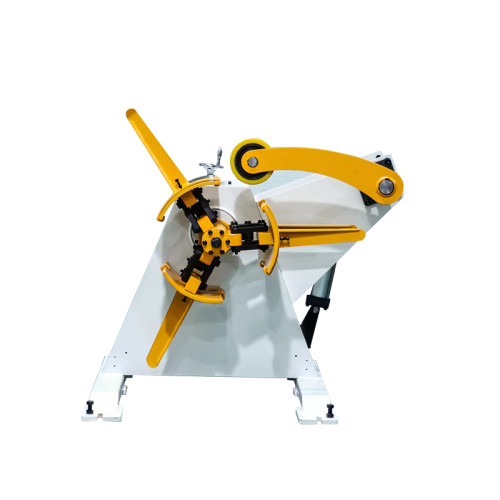
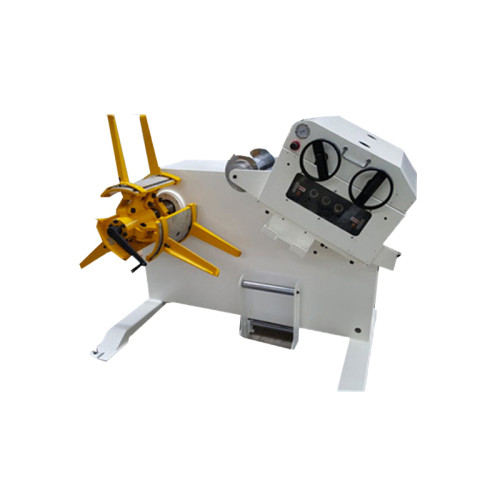
A coil car is a low platform on rails that carries a coil from the storage saddle to the mandrel and lifts it to centre height. It sounds like a convenience. On this line it was the change that mattered.
Before the car, loading meant a forklift, two slings and a spotter, with the line stopped and the operator standing where a falling coil would land. Eighteen minutes and a permanent risk.
With a car and a second saddle, the next coil is placed during the run. At coil end the crew releases the mandrel, the car takes the empty core and delivers the loaded one, and the total is seven minutes.
The second saddle is the part buyers skip. A car without a staging saddle still needs the forklift at changeover; it just moves the wait from the mandrel to the rails.
Floor space is the constraint nobody prices. A 10 tonne car needs 4.5 m of travel plus 2.2 m of clearance at each end, and on this line that meant moving a scrap bin and a die cart.
Car travel, saddle height and rail length are sized per line rather than chosen from a catalogue, and the dimensions for each capacity are in the coil handling product index.
The other half of the gain was not bought. Four tasks were moved out of the stop and into the 41 minutes of running, where they cost nothing.
- Staging the next coil on the second saddle. Done during the run, by the same person who used to wait at the mandrel.
- Checking the coil edge for transit damage. A two-minute inspection that used to happen after the coil was on the mandrel, when it was too late to reject it.
- Writing the coil number and heat number on the run card. Paperwork that had been done standing still for six minutes a change.
- Emptying the scrap bin. Moved to the middle of the run, which also stopped the bin overflowing onto the walkway.
Those four changes cost nothing and gave back five minutes. They also made the bought equipment work, because a car that arrives at a changeover with nothing staged saves less than half of what it should.

The Payback Arithmetic Behind 41,000 USD
The plant spent 41,200 USD in total, and it did not spend it on the biggest single item first. The sensors and the recipe recall came before the car, because they were cheap and they removed two judgment calls.
The gain per running hour is 279 parts, at 0.62 USD of contribution each. That is 173 USD an hour if every extra part can be sold, which is the assumption that makes or breaks this kind of project.
At 60 percent capture, the real figure is 104 USD an hour. Against 41,200 USD that is a 396-hour payback, or roughly ten weeks of two-shift running.
Ten weeks is short enough that the decision did not need a capital committee. That is unusual, and it is a function of the line being capacity-limited rather than cost-limited.
The plant could not make enough panels. Every hour recovered was an hour of sales. On a line with idle capacity the same 41,200 USD buys nothing at all.
Where This Fix Does Not Pay
Three conditions make a coil car a poor buy, and they are common enough to check before quoting one.
The coil supply is the limit. If the mill or the service centre can only deliver 4 tonne coils, a car shortens the change and the line still stops twice as often. Fix the supply before the handling.
Volume is below about 150,000 parts a year. At that level the line is not capacity-limited, the changeovers are not the constraint, and the money belongs in a die or a second shift.
The press is the bottleneck. On this line the press could hold 22 strokes a minute. If yours is at 12 while the coil line could feed 20, shortening the stop does not raise output by a single part.
There is a fourth case that is not about money. Where the current loading method puts a person under a suspended coil, the car is a safety purchase and the payback calculation is the wrong tool for it.
The honest summary is that this project worked because four conditions lined up: capacity-limited demand, 8 tonne coils, a forklift loading method and 45 minutes of undesigned stop.
Change any two and the arithmetic changes.
What Still Limits the Line
Six months after the change the cycle sits at 58 minutes, not 55. Two constraints appeared that were invisible at 86 minutes.
The first is strip supply from the accumulator. With a shorter stop the loop has less time to recover, and a coil that arrives with a welded joint now costs 90 seconds instead of being absorbed.
The second is the die. At 18 strokes a minute the die ran cool between coils. At a 55-minute cycle it runs hotter for longer, and the plant added a 4-minute die check every third coil.
Neither is a fault in the upgrade. Both are what happens when a constraint moves: the line gets faster until something else becomes the slowest part, and then that thing sets the rate.
That is also why the next 41,000 USD should not go into coil handling. It should go into the die and the loop, which are now the two places where the line waits.

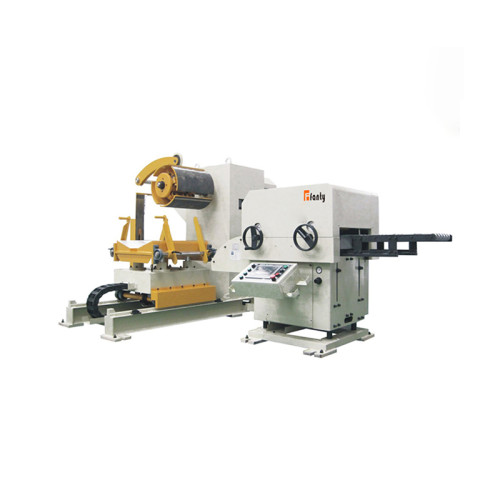
How the three functions of a coil line divide the work, and where each one adds cycle time, is set out in the coil line guide library.
What a car, a saddle and a threading table each add to a line price is a different question from what they save.
Both sets of figures come out of a line configuration request built around your part mix rather than a brochure.
How many parts does an 8 tonne coil yield at a 1,150 mm pitch?
709 strokes on 1.0 mm SPCC at 1,250 mm width. That is 815 m of strip and 41 minutes at 18 strokes a minute.
How much does a 10 tonne coil car cost with a staging saddle?
28,000 to 36,000 USD depending on travel length and whether the rails are cast in. The saddle is 4,000 to 6,000 USD of that.
At what annual volume does a coil car stop paying back?
Below roughly 150,000 parts a year on a single-shift pattern, because the line is no longer capacity-limited.
Can changeover drop below 10 minutes on this size of line?
Yes, with a staging saddle, a threading table and recipe recall. Below 10 minutes needs a second mandrel or a coil joining station.
Does a shorter cycle need a bigger loop?
It needs a faster recovery, not a bigger pit. This plant kept its 3.5 m loop and added a joint sensor instead.
Where to go next
Changeover time is one of four inputs that decide what a coil line costs to run. The other three are strip quality, die protection and the accuracy budget from coil to die.
Open the coil line guide library