Which Roll Pitch Fits an NC Straightener Feeder?
Ask three straightener builders what roll pitch they recommend for 0.8 mm cold-rolled steel and you will get three different numbers, all defended with confidence. The reason is that pitch is not a single magic figure. It is a ratio, and the ratio has to be matched to the strip you actually run rather than to the strip in the catalogue.
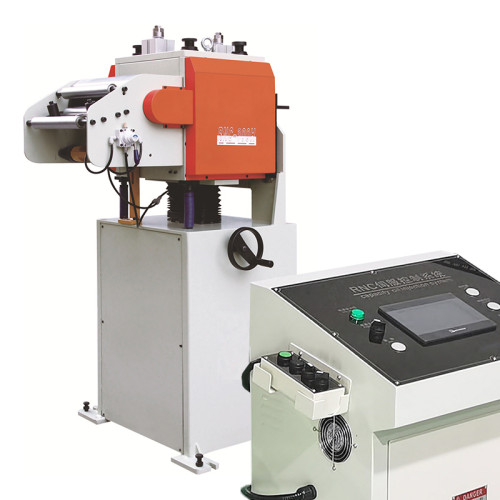
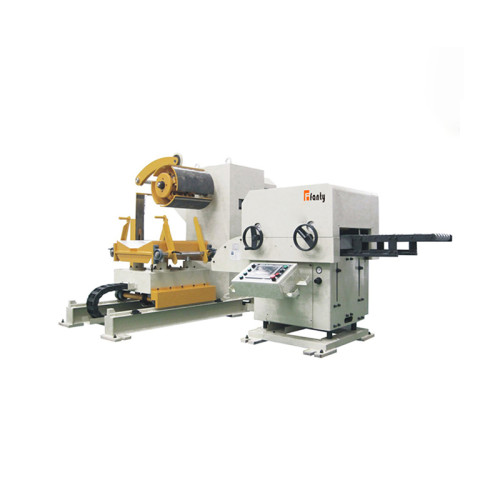
Roll pitch is the centre-to-centre distance between adjacent straightening rolls. It decides how many times the strip is bent as it passes through, and the number of bends is what determines how much residual stress and curvature the NC Straightener Feeder can remove. Get the pitch wrong and the machine will still run — it will simply leave a level of residual curvature that shows up later as twist, bow or a part that will not sit flat in the die. This article works through the ratio, compares measured results from two pitch classes on the same strip, and explains why adding rolls is not a substitute for correct spacing. Our straightener feeder range lists pitch and roll diameter for each model.
Roll Pitch Sets How Many Times the Strip Bends
Every time strip passes over a roll, it bends in one direction and then reverses over the next roll. A machine with nine rolls delivers seven full bend cycles to the strip, because the first and last rolls set the entry and exit line rather than doing straightening work.
Each bend cycle applies a plastic strain increment that counteracts the coil's original curvature. The magnitude of that increment depends on how far the roll offsets the strip — the greater the offset relative to the pitch, the sharper the bend.
Pitch is therefore doing two jobs at once. It sets how many cycles the strip receives, and it sets how severe each cycle is. A short pitch packs more cycles into the same machine length but limits how far each roll can offset. A long pitch allows a deeper bend but gives you fewer of them.
The Pitch-to-Thickness Ratio
The number that actually governs performance is pitch divided by strip thickness. For most coil-fed stamping work the practical band runs from about 40 to 70.
Work the arithmetic on a typical mid-range machine. A 45 mm pitch running 0.8 mm strip gives a ratio of 56. The same machine running 0.4 mm strip gives a ratio of 112, which is well above the useful band. That is the mechanical reason thin strip is harder to straighten well: at a fixed pitch, the bend radius relative to thickness becomes too gentle to reach the plastic range at every roll.
Push in the other direction and the limit is machine load. A 45 mm pitch running 3.0 mm strip gives a ratio of 15, which forces very large roll offsets and very high separating forces. The rolls and the frame have to be built for it, and most light machines are not.
| Strip thickness | Pitch range for ratio 40–70 | Practical note |
|---|---|---|
| 0.3–0.5 mm | 15–30 mm | Small pitch, low offset, support rollers essential |
| 0.5–1.0 mm | 25–60 mm | The most common band, widest machine choice |
| 1.0–2.0 mm | 50–110 mm | Long pitch, check frame separating force |
| 2.0–4.0 mm | 90–220 mm | Heavy frame, roll diameter becomes the limit |
Two constraints sit alongside the ratio. Roll diameter should be large enough to avoid marking thin strip, generally at least 20 times the strip thickness. And the pitch should stay close to 1.2 to 1.5 times the roll diameter so the strip wraps each roll properly rather than skimming across it.
Small Pitch vs Large Pitch: Measured Flatness
The comparison below comes from a controlled run on 0.8 mm cold-rolled steel, 400 mm wide, with the same entry coil set and the same exit speed. Only the roll cassette changed.
| Parameter | Small pitch (35 mm, 11 rolls) | Large pitch (65 mm, 11 rolls) |
|---|---|---|
| Bend cycles | 9 | 9 |
| Entry flatness | 16 I-units | 16 I-units |
| Exit flatness | 2.4 I-units | 5.1 I-units |
| Residual curvature | 0.4 mm/m | 1.3 mm/m |
| Roll separating force | 18 kN | 11 kN |
| Strip marking | None observed | None observed |
Same roll count, same total machine length, different result. The small-pitch cassette removed twice as much residual curvature because each of the nine bends was sharper relative to the strip thickness. The large-pitch cassette needed less force to do it, which is exactly why it suits thicker material and why it underperforms on thin.

Why Adding Rolls Does Not Fix a Wrong Pitch
This is the most persistent misunderstanding in straightener selection. Buyers compare roll counts, assume more is better, and pay for eleven rolls when nine at the right pitch would outperform them.
Adding rolls to a machine with the wrong pitch gives you more bends at the wrong severity. If the pitch is too long for the strip, each additional bend is still too gentle to reach the plastic range, and the extra rolls contribute little beyond friction and marking risk.
Roll count matters within a correct pitch band, where it buys you a longer progressive sequence — the first rolls take a large bend to break the coil set, and later rolls reduce to progressively smaller offsets. That graduation is what produces a flat, low-stress strip. A graduated sequence with nine rolls at the right pitch beats a uniform eleven-roll stack at the wrong pitch every time.
Pitch, Roll Diameter and Strip Support
Three supporting details decide whether a correct pitch actually delivers its theoretical result.
- Roll diameter must suit the thickness. Undersized rolls mark thin strip, oversized rolls cannot wrap it. Aim for a diameter at least 20 times the strip thickness.
- Entry and exit support matter more on short pitch. A short pitch means more bends over a shorter span, so the strip must be held flat right up to the first roll and all the way out of the last one.
- Roll hardness and surface finish affect marking, not straightening. They do not compensate for a pitch mismatch, and treating them as a fix wastes money.
Reading a Straightener Specification Sheet
Most specification sheets list roll count, roll diameter and capacity. Fewer list pitch. Ask for it, and check three things.
- Pitch, in millimetres. If it is not stated, the number is probably not flattering.
- The thickness range the pitch is designed for. A single machine rarely covers 0.3 mm to 4.0 mm well; interchangeable cassettes exist for that reason.
- Whether pitch changes with the cassette. On a line that runs several thicknesses, a swappable cassette is cheaper than a compromise machine.
FANTY has been building coil feeding equipment for 12 years and has commissioned more than 200 production lines. The pattern from that experience is consistent: pitch problems are almost always specification problems, and they surface in the first month as flatness complaints rather than as machine faults.
Questions Buyers and Setup Engineers Ask
What pitch should I specify for a mixed thickness range?
Split the difference toward the thinner end, because thin strip is the harder case. If your range is 0.5 to 1.5 mm, a 40 mm pitch serves 0.5 mm well and is workable at 1.5 mm. The reverse choice would fail on the thin material.
Does a shorter pitch always give better flatness?
Only down to the point where the rolls can no longer offset enough to reach the plastic range without marking the strip. Below that, a shorter pitch adds friction, heat and marking risk with no flatness gain.
How do I know if my current pitch is wrong?
Run the same coil through the machine at two different roll offsets. If increasing offset stops improving exit flatness before you reach the load limit, the pitch is likely too long for that thickness.
Can I straighten 0.4 mm strip on a machine sized for 3 mm?
Not well. The pitch-to-thickness ratio would be far too high, and the roll diameter would be far too large. A cassette change or a second machine is the realistic answer.
Is roll pitch the same as roll spacing?
In practice, yes. Both terms describe the centre-to-centre distance between adjacent rolls. Some builders quote roll diameter and leave you to infer pitch, which is worth clarifying in writing.
Specifying a Straightener for a Mixed Thickness Range?
Send us your strip thickness range, width and flatness requirement. Our engineers will recommend a pitch, roll diameter and roll count, and confirm whether one machine or a cassette change is the right answer.
Request a Straightener Recommendation