Which Coil Line Layout Fits a 45 SPM Progressive Die?
A 400 tonne press with a 1,800 mm progressive die needs 320 mm of strip every stroke, 45 times a minute. The press is the easy part of that sentence.
The layout that delivers the strip decides how much floor you lose, how long a changeover takes, and whether the die ever sees a square edge.
Three layouts reach 45 strokes a minute on this duty. They differ by 5.5 m of floor, 34 minutes of changeover and roughly 30,000 USD of civil work.
This comparison sets them against the die rather than the catalogue, and names the duty where the cheapest layout is the one that costs most over five years.
Machine envelopes for each arrangement are listed in the machinery specification index, and the numbers below assume the standard 1,250 mm strip width.
Start With the Die, Not the Machine
Layout decisions get made from a machine brochure far more often than from a die drawing, and the die drawing is where the constraints live.
Four numbers come off it before anything else: strip width, feed length, die height and the shut height of the press. On this job they are 1,250 mm, 320 mm, 420 mm and 900 mm.
Feed length sets the acceleration. A 320 mm feed inside a 45 SPM cycle gives 1.33 seconds, of which the strip is moving for perhaps 0.55 seconds.
That is a peak velocity near 1.0 m/s and an acceleration around 9 m/s². Any layout has to deliver it without slipping, which is a roll and clamp question, not a frame question.
Die height sets the space between the feed exit and the press centreline. A 420 mm die with a 300 mm bolster leaves very little room for a loop or a second set of rolls.
The fourth constraint is invisible on the drawing: where the operator stands. A layout that puts the control panel behind the coil is a layout that loses ten minutes a shift to walking.
Three Layouts That Reach 45 Strokes a Minute
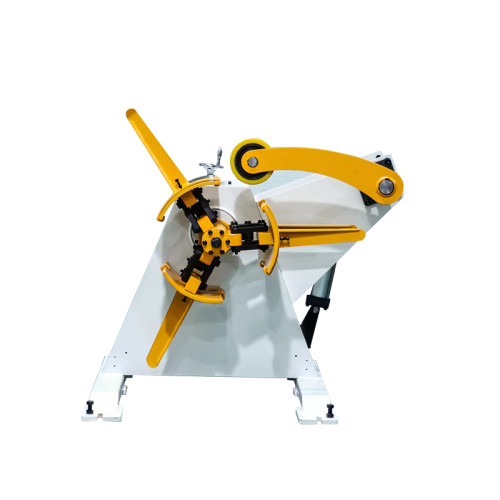
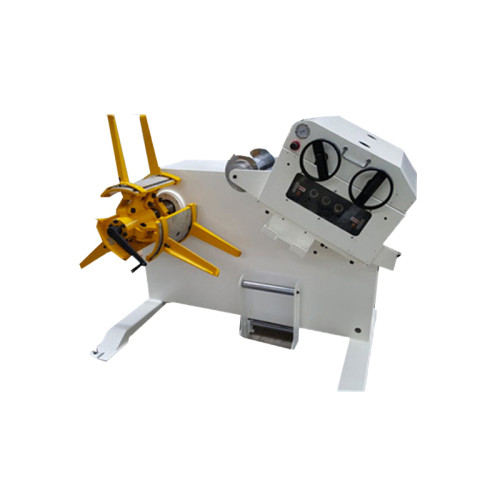
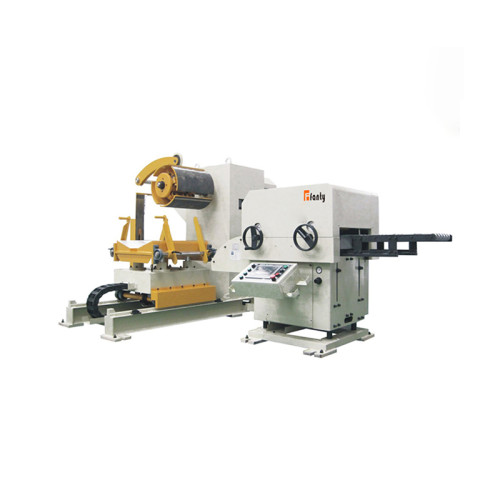
The integrated layout. Uncoiler, straightener and feed rolls sit on one base, roughly 7.5 m long, and the strip travels about 900 mm from the last roll to the die.
The short path is the whole argument. There is no loop to control, no slack to manage and no second operator station, so the strip arrives with the tension the last pass put into it.
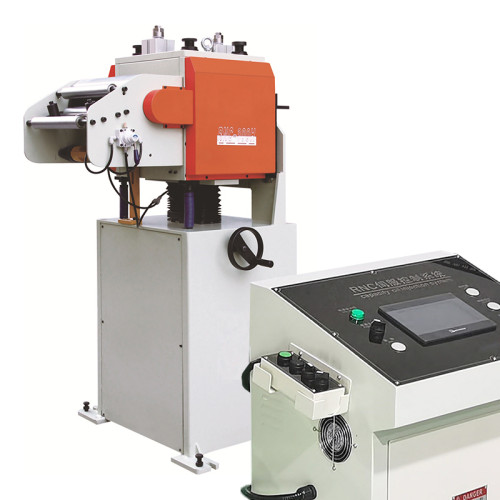
The split layout. A separate uncoiler, a separate straightener and a separate feed unit, each with its own base and its own control, spread over 11 to 12 m.
It buys service access and it buys the ability to change one module without moving the others. It also introduces a free loop between straightener and feed, which has to be controlled.
The loop pit layout. The uncoiler stands at floor level and the strip drops into a pit 1.5 to 2 m deep before rising into the straightener. Total length runs 13 m plus the pit.
The pit absorbs the difference between continuous uncoiling and intermittent feeding. It is the classic answer on a line running at high stroke rates with a heavy coil.
What Each Layout Costs in Floor and Changeover
| Layout | What it gives the run | Where it costs you | Floor and civil |
|---|---|---|---|
| Integrated, 7.5 m | Shortest strip path, one operator, one control, fastest coil change | Module service means stopping the line; a roll change is a 2 hour job | 7.5 m of flat slab, no pit |
| Split, 11.2 m | Independent service, mixed-vendor modules, easy to extend | Free loop control, two more alignment points, 25 minute changeover | 11.2 m plus cable trenches |
| Loop pit, 13 m | Continuous uncoiling, lowest strip tension variation at high speed | Pit drainage, coil drop risk, confined-space rules, 40 minute changeover | 13 m plus 18,000 to 35,000 USD of pit work |
The middle column is the sales case. The right-hand columns are what you live with, and the third one is the column buyers skim.
Changeover is where the gap shows up first. An integrated layout swaps a coil in six to nine minutes because the coil car, the mandrel and the peeler all sit inside one control sequence.
A split layout needs the operator to thread a loop by hand, or to trust an automatic loop former that was set for a different gauge. Twenty-five minutes is realistic, forty is common.
Floor is the second gap. On a leased building at 90 USD a square metre a year, 5.5 m of extra length across a 4 m width costs about 2,000 USD a year in rent alone.
None of these numbers decides the question on its own. They decide it together with the batch size, which is the next section.
If the plant runs three changeovers a week, the 34 minute gap costs 34 minutes times three, or about 1.7 hours a week. That is 88 hours a year, and against a line carrying 1,000 USD an hour it dwarfs the rent.
Can a 7.5 m integrated layout really hold 45 SPM on a 320 mm feed?
Yes, on 1.5 mm mild steel. The limit arrives with strip above 3 mm or a feed over 500 mm, where the moving mass needs a longer path to settle.
How much floor does a loop pit save against a split layout?
It adds 1.8 m rather than saving any. The pit buys tension stability, not space, and it costs 18,000 to 35,000 USD in civil work.
At how many changeovers a week does the integrated layout pay back?
Above two a week, the 20 minute saving per change pays back a 15,000 USD price difference inside 18 months on a line carrying 1,000 USD an hour.
What pit depth does a 1,250 mm strip need?
1.5 m for a 5 tonne coil at 45 SPM. Below 1.2 m the strip touches the pit floor on the down-stroke and marks the surface.
Is a split layout ever the better choice at this stroke rate?
Only when the modules come from different suppliers or the building cannot take a pit. Otherwise the loop control is work you pay for every day.
The Loop Pit Case
The pit exists for one reason: a 5 tonne coil cannot start and stop 45 times a minute, and the press will not wait while it tries.
Uncoiling continuously and feeding intermittently means the strip length between them changes constantly. Something has to absorb that, and a free hanging loop does it without a dancer or a tension sensor.
The pit version puts the loop below floor level so the strip enters the straightener on a rising path. Gravity keeps the loop open and the strip under light tension.
That arrangement holds tension variation to a few hundred newtons across the whole coil, which matters on thin strip where 500 N of extra tension changes the flatness result.
It also survives a coil with a bad weld or a heavy coil set, because the loop has somewhere to go when the strip surges.
The cost side is real. A pit collects oil, coolant and swarf, so it needs a sump pump and a cleaning routine that somebody has to own.
Coil drop is the risk nobody prices. A mandrel that releases early drops 5 tonnes into a 1.8 m pit, and recovering it takes a crane and a shift.
Where an Integrated Layout Stops Working
The integrated layout is the default recommendation for this duty, and it is the wrong answer in five situations worth naming.
- Strip above 4 mm. The straightening load on 4 mm high-strength steel needs roll diameters and a frame that no longer fit on a 7.5 m base with a feed unit attached.
- Feed length over 500 mm. The strip has to accelerate for longer, and the short path leaves no room for it to settle before the pilot enters.
- Die change without line stop. Plants that change dies on a moving bolster want the feed unit to stay put while the die moves, which means a separate base.
- Two presses from one coil. The moment the strip splits, the layout needs a loop or an accumulator, and the integrated frame has no space for either.
- Buildings with a low clear height. An integrated unit is taller at the straightener head, and a 4.5 m ceiling with a crane at 3.8 m can leave no room to lift a roll set out.
Each of those is a physical limit rather than a preference. A supplier who promises an integrated layout for 6 mm HSLA is either misunderstanding the duty or quoting a different machine.
There is a softer limit too. An integrated layout ties you to one supplier for every module, and that is fine until the day the supplier's service lead time is longer than your buffer.
Choosing on Numbers You Already Have
Four numbers settle most layout decisions, and a plant usually has all four before it asks for a quotation.
- Changeovers per week. Above two, buy the shortest changeover. Below one, buy the cheapest floor plan.
- Thickest gauge in the next five years. Specify the frame for that, not for today's 1.5 mm job.
- Longest feed length. It sets the acceleration and therefore the strip path, which sets the layout.
- Building constraints. Ceiling height, slab thickness and whether a pit is permitted decide more layouts than engineering does.
With those four, the comparison above narrows to one or two options. The rest of the decision is commercial, and it belongs in the quotation review rather than the technical review.
One practical test before you sign: ask for the layout drawing with the die in place and the operator's walking route marked. Most layout problems show up as a route that crosses the strip.

Layout is one of four decisions that shape a stamping line, and the other three are worked through in our coil line knowledge base.

Where to go next
The layout sets how the strip reaches the die. What happens to that strip inside the straightener is a different set of numbers, and they decide whether the part is flat.
Read the line guide