Which 3-in-1 Layout Fits a Tight Press Bay?
Nine metres by fourteen. That is the bay most plants have, and it is the bay every 3-in-1 decoiler straightener feeder quotation quietly assumes.
Three layouts fit inside it, and they differ in ways a general arrangement drawing does not show: how a coil gets in, how long a changeover takes, and whether the rigging crew can work.
The comparison below uses one real bay, one coil weight and one press, so the numbers mean something rather than describing a principle.
Three Layouts That Fit the Same Bay
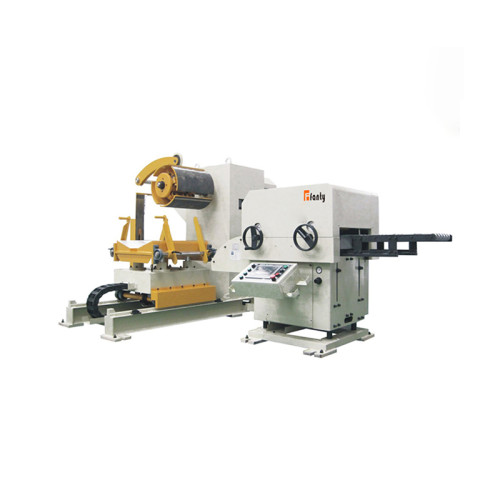
Straight-through puts decoiler, straightener and feeder in one line along the bay's long axis, feeding the press at the far end.
L-shaped turns the decoiler 90 degrees at the entry, which shortens the overall length and widens the coil handling area.
Side-entry brings the coil in from the side of the press, perpendicular to the feed direction, with the straightener close to the die.
All three work. They fail in different ways, and each failure costs a different amount to live with.
A general arrangement drawing shows the machine. It does not show where a forklift can turn or where an operator stands at 3 a.m.
Each layout also implies a different maintenance access pattern, which decides how long a roll change takes.
Comparison Across the Criteria That Decide It
| Criterion | Straight-through | L-shaped | Side-entry | Where It Costs You |
|---|---|---|---|---|
| Bay length used | 13.5 m of 14 m | 10 m, 4 m spare | 8 m, 6 m spare | Straight-through leaves no room for a car |
| Coil access | End of the bay only | Wide side access | Best access of the three | End access forces a 90-degree coil turn |
| Coil car travel | 14 m each way | 9 m each way | 6 m each way | Changeover time follows this number |
| Rigging clearance | Crane over the full line | Crane over two thirds | Crane over half | A low bay limits straight-through first |
| Changeover time | 22 to 28 minutes | 16 to 20 minutes | 14 to 18 minutes | Six changes a shift makes this the deciding row |
| Foundation cost | One long slab | Two slabs at right angles | One compact slab | L-shaped needs the most concrete |
The last row surprises most buyers. L-shaped layouts need more concrete because two slabs meet at a corner that has to carry both loads.
Score the three on changeover first. That cost repeats every shift, while the foundation cost happens once.
Then score maintenance access. A layout that saves a metre of slab but blocks the roll stack will cost more every year.
Ask the drivers rather than reading the drawing. The people who move coils know which bay corners are already tight.
Where the Coil Enters Decides the Rigging
Straight-through forces every coil to arrive at one end of the bay and turn 90 degrees if the aisle runs across the building.
That turn is where most coil handling damage happens, because a forklift or car turning with a 5-tonne coil has very little margin.
L-shaped and side-entry layouts allow the coil to arrive in the direction the aisle already runs, which removes the turn entirely.
If the bay has a crane, this matters less. If it does not, it decides the layout on its own.
An NC straightener feeder with a long decoiler run makes that turn worse, because the coil has further to travel while turning.
Shortening the run between decoiler and straightener is possible within limits, and the limits are usually set by the foundation.
The Layout That Looks Cheapest on Paper
Straight-through is always the cheapest drawing. One slab, one line, minimal steelwork and the simplest electrical run.
It is also the layout that consumes the most length, and length is what a tight bay does not have.
Plants that choose it in a 14-metre bay end up with no space for a coil car and load with a forklift, which costs four to six minutes per changeover forever.
At six changes a shift and two shifts a day, that is roughly an hour a day of press time, which is far more than the foundation saving.
A cheap foundation that adds four minutes per changeover repays its saving in lost press time inside a year.
Twelve minutes a day at a line rate of USD 1,570 an hour is about USD 7,800 a year, against a foundation difference of a few thousand.
That comparison is worth putting on one page before the layout is signed, because it is the last moment it is cheap to change.
Changeover and Coil Access in a Tight Bay
Changeover time in a tight bay is dominated by how far an operator walks and how far a car travels, not by the machine.
Side-entry wins here because the coil car route is shortest and the operator can work from one position.
L-shaped is a close second and it fits a bay that is wide but short, which describes most leased units.
Straight-through should be chosen when the bay is genuinely long, or when a crane makes coil handling independent of layout.
Walking distance matters as much as car travel in a tight bay. Eight metres of walking per change adds a minute every time.
Side-entry keeps both the mandrel and the die within a few steps of the panel, which is why operators prefer it once they have used one.
Put the control panel where the operator can see both the mandrel and the die. That single decision removes most of the walking.
Where None of the Three Layouts Fits
A bay under eight metres wide cannot take a side-entry layout with a coil car, because the car needs turning room.
A bay with a crane height under five metres rules out straight-through for a 1,300 mm machine with a tall decoiler.
And a bay with a column in the middle rules out L-shaped, because the corner falls exactly where the column stands.
In those cases the honest answer is that the bay needs modification or the machine needs to be smaller. Forcing a layout into a bay it does not fit produces a line that runs at reduced speed forever.
A bay that needs modification is not a failed project. It is a project with a foundation line item that belongs in the budget from the start.
Measuring the Bay Before Choosing
- Measure from the press centreline to the nearest wall, not from the press frame.
- Note every column, every door and the crane hook height at the lowest point of travel.
- Check the aisle direction, because it decides whether a coil has to turn 90 degrees to enter the bay.
- Measure the slab thickness at the decoiler position. A 5-tonne coil needs a different slab from a 2-tonne coil.
- Confirm the electrical panel position. A long cable run can cost more than a layout change.
Worked Example: A 9 by 14 Metre Bay
A 1,300 mm 3-in-1 unit with a 600 mm feed height needs about 9 metres for the machine line and 3 metres of coil space.
Straight-through uses 12 metres plus a car route, which does not fit in 14 metres with a press at the far end.
L-shaped uses 10 metres along one wall and 4 across, leaving a 3-metre aisle that a car can work in.
Side-entry uses 8 metres with a 6-metre car route along the adjacent aisle, which is the most comfortable of the three.
The coil line range lists overall length and feed height per model, which is the pair of figures this calculation starts from.
Where to go next
Layout is the first decision and the hardest to reverse, because it sets the slab. The 3-in-1 overview covers capacity, roll count and control architecture, which are the choices that follow once the bay is fixed.
The Coil Line Guide LibraryWhat is the minimum bay length for a 1,300 mm 3-in-1 line?
Fourteen metres for a straight-through layout, or ten metres if an L-shaped turn is possible. Below ten metres, side-entry is the only workable option.
How much space does a coil car need to turn?
Three metres of clear width for a 5-tonne car, plus 1.5 metres at each end of travel for approach and braking.
Does an L-shaped layout really need more concrete?
Yes, typically 15 to 25 percent more, because two slab loads meet at a corner that has to carry both.
How much does layout add to changeover time?
Four to ten minutes per change, driven almost entirely by coil car travel distance and operator walking distance.
Can a straight-through layout work with a forklift instead of a car?
Yes, but loading takes four to six minutes longer per coil and the operator has no view of the mandrel while loading.
What crane height does a 1,300 mm line need?
Five metres minimum under the hook, and 5.5 metres is comfortable once a coil is standing on its edge.