What Does an NC Straightener Feeder Acceptance Test Cover?
Most buyers sign off on an NC Straightener Feeder after watching it run a few hundred strokes. That is the weakest test you can run. I have stood on shop floors through more than forty factory acceptance tests, and the failures that actually hurt — a 0.4 mm drift in feed length after two hours, a safety relay that quietly bypasses in manual mode, a leveler that cannot flatten 4 mm HRPO — never appear in a ten-minute demo.
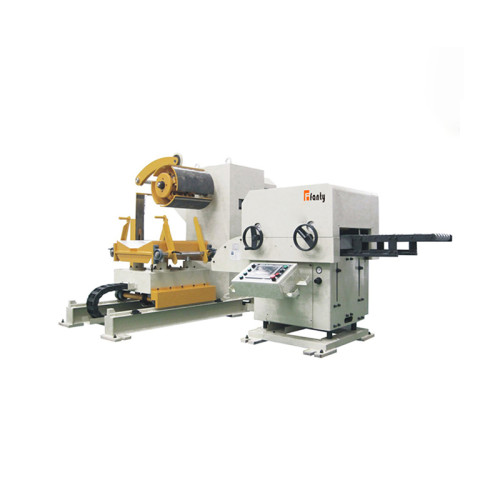
A real acceptance test answers one question: will this machine hold your print tolerance, on your material, in your die, at your takt time, after a full shift? The checklist below covers what that test has to include before you release final payment on a 3-in-1 decoiler straightener feeder.
Why a Demo Run Proves Almost Nothing
A demo runs on the builder's material, with the builder's operator, at a speed the builder chooses. Three things are missing, and all three are where problems live.
First, material variation. A coil from your supplier has thickness scatter across the width and crown at the center. A demonstration coil is usually a clean, uniform sample picked for exactly this purpose. Second, thermal drift. Servo drives, hydraulic power units and leveler bearings all change dimension and clearance as they warm. A machine that holds ±0.05 mm cold may sit at ±0.12 mm after ninety minutes of continuous running. Third, operator behaviour. Your press crew will thread the line differently, adjust roll pressure differently, and clear jams differently than the person demonstrating it.
None of that means the demo is worthless. It means the demo is a capability screening step, not an acceptance test. Treat it that way and put the real burden of proof on a structured test with recorded numbers.
Build the Test Matrix Before the Machine Ships
Write the matrix into the purchase order, not into an email thread after the machine is finished. When the criteria sit in the PO, the builder has a reason to run the checks internally before your team arrives. When they sit in an email, you will be negotiating interpretation on the shop floor with your container already booked.
A workable matrix has four columns: what you test, how you measure it, what number passes, and where the test happens. Here is the version I hand to clients.
| Test item | Method | Pass criteria | Stage |
|---|---|---|---|
| Feed length repeatability | 500 consecutive strokes, digital caliper on 30 samples per 100 | Spread within ±0.05 mm, no upward trend | FAT + SAT |
| Thermal drift | Run 3 hours continuous, log feed length every 15 min | Drift under 0.03 mm across the run | FAT |
| Strip flatness | Straightness gauge on 10 cut blanks, both directions | Under 1.0 mm per meter, no edge wave | FAT + SAT |
| Coil changeover | Time a full change with two operators | Under the cycle written in the PO | SAT |
| Safety interlock chain | Defeat each guard and light curtain individually | Press stops in every case, no bypass in manual | FAT + SAT |
| Hydraulic pressure hold | Pressurise mandrel, isolate, watch gauge 30 min | Drop under 5 percent | FAT |
| Noise at operating speed | Sound meter at operator position, full takt | Within the limit in your local regulation | SAT |
| Documentation handover | Check against the PO list | Every item present and in your language | SAT |
Feed Accuracy: The Test That Decides the Machine
Feed accuracy is the reason you are buying a servo-driven line instead of a mechanical roll feeder. Test it properly and it will tell you more about the machine than any other measurement on the sheet.
Use your material, not theirs
Bring your own coil. If your production runs 2.5 mm hot-rolled pickled and oiled, do not accept a test on 1.2 mm cold-rolled. Material thickness changes the inertia the servo must overcome, and oil film changes the friction coefficient at the feed rolls. Both move the accuracy number.
Log the whole run, not the best 100 strokes
Ask for a data log covering the full test, exported from the controller. Averages hide drift. What you want to see is a flat line with small random scatter and no slope. If the log shows the first 200 strokes tight and the last 300 wandering, the machine has a thermal or mechanical settling problem that will show up in your plant on a hot afternoon.
Test at your takt, then at your ceiling
Run at the speed your production plan calls for, then push to the maximum the builder claims. If a 200 SPM claim collapses to ±0.15 mm at 180 SPM, you have learned something the brochure will not tell you.
Flatness, Surface and Strip Condition
Flatness is where a straightener feeder either earns its cost or becomes a source of scrap. Ask the builder to run your worst-case coil — the one with visible crossbow or a tight coil set — and check the blanks coming out of the die, not just the strip leaving the leveler.
Cut ten blanks and lay them on a surface plate. Check lengthwise bow, crosswise bow and edge wave separately, because each has a different cause and a different fix. Crosswise bow points at leveler roll penetration. Edge wave points at excessive roll pressure or a worn work roll. Lengthwise bow that survives straightening usually means the roll cluster is undersized for your yield strength.
Surface condition matters just as much. Run a strip through and inspect under raking light for roll marks, scoring and coating damage. A machine that flattens beautifully but leaves pressure marks every 120 mm is not acceptable on exposed automotive or appliance panels.
Safety and Interlock Verification
This is the section buyers skip and the section that generates the largest liability. Defeat every protective device one at a time and confirm the outcome.
Open the leveler guard while the line is running. Break the light curtain at the feed entry. Trip the emergency stop at the operator station and at the remote pedestal. Pull the coil car interlock. In each case the press must stop, the servo must drop out, and the controller must display a fault you can read and reset deliberately.
Then check the manual mode. A depressingly common finding is a maintenance jog mode that lets the feed rolls turn with the guard open and the light curtain muted. That is not a feature, it is an incident waiting for a date. FANTY machines ship with CE certification and a documented interlock matrix, and I ask for that matrix on every audit I run — a builder who cannot produce one has not thought carefully about the control architecture.
Documentation and Handover Package
Machines are easy to compare. Handover packages are not, and that is exactly why they get neglected. Before the final payment, confirm you have received:
- Electrical schematics and a hydraulic circuit diagram matching the as-built machine, not the generic catalogue drawing
- Servo drive parameter backup file, plus written instructions for restoring it after a drive replacement
- PLC program copy with a documented password, or a written commitment to supply it within a set period
- Spare parts list with part numbers, lead times and the recommended first-year stock
- Leveler roll gap and penetration settings for each material you run, recorded as a setup sheet
- Maintenance schedule with lubrication points, grease type and interval in hours of operation
- Operator manual and training record for the crew who will actually run the line
If a supplier resists handing over the drive parameter file, treat that as a red flag about the next five years of ownership, not just about this week.
Factory Test and Site Test Are Two Different Events
Run the acceptance test twice. The factory test happens on the builder's floor with their power, their air supply and their rigging crew. The site test happens on yours, after a sea freight and a crane lift, with your transformer and your compressed air.
Vibration during shipping loosens fasteners, shifts sensor brackets and can move encoder couplings. I have seen a line arrive with a feed roll gap 0.2 mm out of adjustment because a locking collar worked loose in transit. The site test is not a formality; it is the only test that proves the machine survived the trip.
Hold a retention — typically 10 percent — until the site test passes and the documentation package is complete. That single clause changes how seriously the handover is treated.
Questions Buyers Ask About Acceptance Testing
How long should an acceptance test run?
Plan for a full shift, minimum six hours, with at least three hours of continuous running. Thermal drift is the main reason. A one-hour test on a cold machine tells you the geometry is right but says nothing about whether it stays right once the hydraulic oil reaches 45 °C.
Can I test with my own die on the builder's floor?
Only if the builder has a press with the right bed size and tonnage. Most do not. In that case, split the test: measure feed accuracy and flatness at the builder using a simple test die, and validate die interaction, pilot release timing and tooling clearance during the site test on your own press.
What if the machine misses a criterion by a small margin?
Do not accept a verbal promise to fix it later. Either the builder corrects it before shipment with the fix documented, or you agree a written remedy with a deadline and hold retention against it. Small margins on feed accuracy have a habit of growing once the machine is in daily production.
Who should be present from my side?
Three people: the maintenance technician who will own the machine, the press operator who will run it, and whoever holds the purchase authority. Send only managers and you get a signed sheet with no institutional knowledge behind it. The technician is the person who will notice a bracket that looks wrong.
Does the builder's own test data count?
As a pre-check, yes. As acceptance evidence, no. Ask for it in advance so you know what to expect, then reproduce the measurements yourself. If their internal report and your findings diverge sharply, that gap is worth understanding before money changes hands.
Want a Ready-to-Use Acceptance Test Template?
Tell us your material, strip thickness and takt time. Our engineering team will send a test matrix tailored to your line, along with the leveler settings we recommend for your material grade.
Request the Test MatrixFanty · 3-in-1 Compact Line
Short on Floor Space? One Machine Does Three Jobs
A 3-in-1 unit replaces three standalone machines and gives back four to six metres of floor. Send your coil width, thickness and press tonnage and we confirm the model.
Get a Free QuoteFANTY Machinery · 13 years on stamping automation · 2,000+ coil lines installed · engineers reply within 24 hours