What Does Roll Diameter Change Do to Flatness?
A toolroom ground 0.35 mm off the radius of a worn roll set, refitted it, and the line produced 2.4 mm of centre buckle on the first coil.
Nothing else had changed. Same strip, same speed, same gap setting on the handwheel.
The gap setting was the problem. Grinding 0.35 mm off each roll opens the working gap by 0.7 mm, and the 0.4 mm of penetration the job needed had become negative.
Roll diameter is the one dimension on a straightener that quietly rewrites every setting downstream of it.
This is the arithmetic that turns a regrind into a number, and the point where the number stops being useful.
Why Ground Rolls Change the Penetration You Set
Penetration is not a distance on the machine. It is the overlap between the top and bottom roll surfaces, measured through the strip.
Set it once and the handwheel records a gap between roll centres. That gap is only valid for the diameter the rolls had on the day it was set.
Take 0.35 mm off the radius of every roll and the centres do not move. The surfaces do, and the gap grows by twice the radius removed.
On a 9-roll head the error compounds through the train. Each pair passes strip that is already less worked than the previous pair expected.
Operators compensate by winding the gap down until the strip looks flat. That works until the rolls bottom out or the drive overloads.
The correct response is arithmetic, not feel. Two numbers settle it: how much radius was removed, and what penetration the job actually needs.
A straightener head is a bending machine with fixed geometry. Change the geometry and the same handwheel number means something different.

The Geometry: Diameter, Pitch and Intermesh
Three dimensions describe a straightener head: roll diameter, roll pitch and the intermesh you can achieve.
Pitch is the centre-to-centre distance along the strip. On a 48 mm pitch with nine rolls, the working zone is 384 mm long.
Roll diameter sets how sharply the strip bends at each pass. A 42 mm roll bends 1.2 mm strip to a tighter radius than a 50 mm roll at the same intermesh.
That is why a reground roll does not simply need a new gap. It also changes the bend radius, and therefore the strain at the outer fibre.
For 1.2 mm SPCC, the outer-fibre strain at 42 mm diameter and 0.4 mm penetration is about 1.9 percent. At 41.3 mm it rises to about 2.1 percent at the same true intermesh.
| Roll diameter | Gap opened at same setting | True penetration | Where it costs you |
|---|---|---|---|
| 42.0 mm (new) | 0 mm | 0.40 mm | Reference setting only valid on this diameter |
| 41.8 mm | 0.20 mm | 0.20 mm | Flatness drifts 0.3 mm/m; still inside most drawings |
| 41.5 mm | 0.50 mm | −0.10 mm | No intermesh at all; the head becomes a roll feed |
| 41.3 mm | 0.70 mm | −0.30 mm | 2.4 mm centre buckle on 1.2 mm strip |
| 41.0 mm | 1.00 mm | −0.60 mm | Rolls may not touch strip; bearing load drops to zero |
The third column is the one to write on the setup sheet. It is the number the job needs, and it survives a regrind.
Once the head is back in service, the handwheel value is a machine coordinate, not a process value. Keep them in separate columns.
A Worked Example: 42 mm Rolls Ground to 41.3 mm
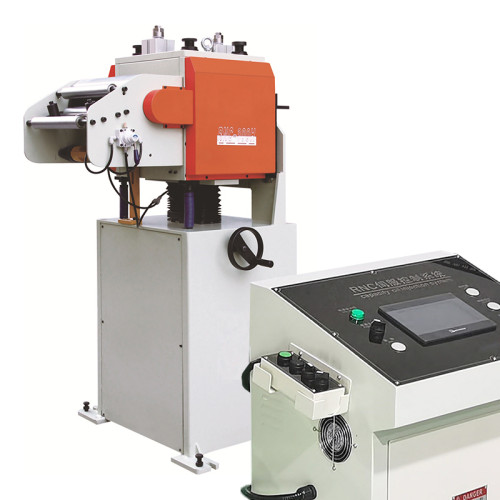
Take a 300 mm wide, 1.2 mm SPCC job running at 200 SPM on a 9-roll NC straightener feeder with 48 mm pitch.
The setup sheet called for 0.4 mm penetration on new rolls, with a handwheel gap of 0.80 mm.
After the regrind the radius was 0.35 mm smaller on both top and bottom rolls, so the surfaces had receded 0.70 mm in total.
Keeping the handwheel at 0.80 mm now produced −0.30 mm of penetration. The head was pulling strip straight through without bending it.
The correction is to reduce the handwheel gap by 0.70 mm, from 0.80 to 0.10 mm, which restores 0.40 mm of true penetration.
But 0.10 mm is close to the mechanical stop on many heads, and it leaves almost no adjustment range for the next regrind.
That is the practical signal that a roll set has reached the end of its life. When the required gap approaches the stop, the geometry is gone.
The strip told the story before the gauge did. Pilot marks were clean, feed length was correct, and the panel was bowed along its length rather than across it.
On this head the manufacturer's minimum was 0.15 mm, so the set was replaced rather than re-set. A new set cost $4,200.
Sensitivity: Where 0.1 mm of Diameter Starts to Show
Not every regrind matters. Sensitivity depends on strip thickness, because thin strip needs less penetration to reach yield.
On 1.2 mm SPCC, 0.1 mm of diameter loss costs about 0.1 mm of penetration, which is 25 percent of a typical setting.
That shows up as 0.3 to 0.4 mm/m of flatness change, which most drawings tolerate and most operators notice.
On 0.6 mm strip the same 0.1 mm loss matters more, because the penetration window is narrower to begin with.
On 3.0 mm hot-rolled material it barely registers. The strip needs 0.8 to 1.2 mm of penetration, and 0.1 mm is inside the noise.
The window widens with thickness. On 2.0 mm cold-rolled steel a 0.4 mm loss is a routine re-set, because the head still has 0.3 mm of usable range.
Rule of thumb for a 9-roll head: total diameter loss under 0.15 mm is a setting change; over 0.5 mm is a new roll set.
Between those figures the decision is economic. Re-setting costs an hour; a new set costs $3,500 to $5,500 and two weeks.
What the Arithmetic Cannot Tell You
The geometry explains penetration. It does not explain flatness, and the difference between the two is where most regrind arguments start.
Roll crown is not in the calculation. A roll ground flat will leave a centre buckle on wide strip regardless of penetration, because the strip needs crown to match its own profile.
Bearing play is not in it either. A 0.05 mm radial float on the backup bearings changes the true intermesh by more than a light regrind does.
Residual stress from the coil is not in it. A coil with 8 mm of crossbow will not flatten to 0.8 mm/m at any penetration setting.
And the calculation says nothing about marking. Grinding to a finer surface finish reduces marking; grinding past the hardness layer increases wear fourfold.
Any head with a chrome or carbide coating should not be ground at all beyond the coating thickness. Once the coating is through, the roll wears at a rate the geometry model never predicted.
Where a line still misses flatness after the gap is corrected, the fault usually sits in crown, bearing condition or coil quality, in that order.
When to Re-Shim Instead of Re-Set
- Record the diameter before and after every regrind. Two numbers per roll, written on the setup sheet, remove the guesswork permanently.
- Convert the handwheel value into penetration. The machine coordinate belongs to the machine, not to the part.
- Check the mechanical stop. If the corrected gap is within 0.05 mm of it, the roll set is finished.
- Measure a first-article strip on a surface plate. A 1 m straight edge and a feeler gauge settle more arguments than any calculation.
FANTY has been building coil line equipment for 12 years, and roll maintenance records are the single most requested document when a customer reports a flatness complaint after two years of service.
Any NC straightener feeder with a 9-roll head behaves the same way after a regrind. The geometry is not brand-specific.
Write the penetration figure on the job card next to the gap. Two shifts later the handwheel number means nothing on its own.
Roll counts, diameters and pitch for the coil feeding equipment range are published per model, which is the starting point for the calculation above.
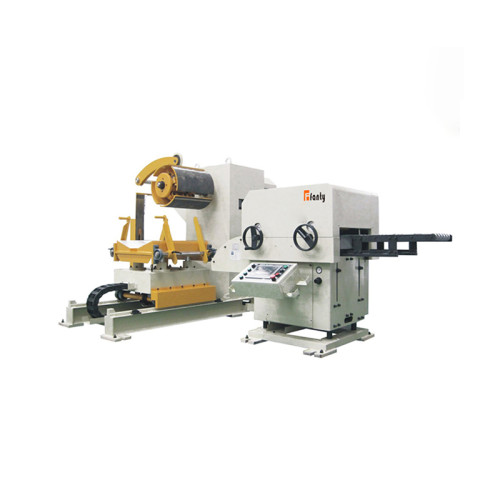
The full sequence from flatness spec to roll count, pitch, gap and penetration is set out in the 3-in-1 decoiler straightener feeder guide, including the defect matrix this article assumes.

Does grinding 0.35 mm off the radius really cost 0.7 mm of gap?
Yes. Both top and bottom rolls recede, so the working gap opens by the sum of the two radius reductions, not by one of them.
At what diameter loss should a 9-roll set be replaced?
Around 0.5 mm total, or earlier if the corrected gap lands within 0.05 mm of the mechanical stop. Below 0.15 mm a setting change is enough.
Can I hold 0.8 mm/m flatness on 0.6 mm strip with reground rolls?
Usually not beyond 0.2 mm of diameter loss. The penetration window on 0.6 mm strip is about 0.25 mm wide, and the regrind consumes most of it.
How much does a replacement 9-roll set cost for a 300 mm line?
$3,500 to $5,500 depending on diameter, bearing class and coating, with two to three weeks of lead time. Budget it at year four, not at failure.
Where to go next
This article belongs to the flatness cluster, where roll geometry is treated as a calculation rather than a setting.
If the gap is correct and the strip is still not flat, the pillar page covers crown, bearing condition and coil quality in the order they usually fail.
Read the flatness specification guide