What Documents Ship With an NC Straightener Feeder?
Three weeks after a new line was commissioned, the maintenance lead asked for the electrical drawings. Nobody could find them.
The vendor had sent them to a project mailbox belonging to an engineer who had already left the company.
That is the usual shape of the problem. An NC straightener feeder is bought on capacity, accuracy and price, while the paperwork that keeps it serviceable is treated as an afterthought.
It is not an afterthought. The gap between a two-hour repair and a two-week one usually sits in a document that cost the supplier nothing to produce and the buyer nothing to request.
Where the money goes on a coil line purchase is mapped out in the coil line guide library. This article covers the paper that should arrive with the machine. The machine range itself is listed under our machines.
Why the Handover Pack Is a Purchase Decision
Most buyers treat documents as an administrative tail to the order. The commercial case for treating them as a deliverable runs the other way.
A line that stops for a 60-dollar sensor still stops.
What decides how long it stays stopped is whether the maintenance team can find that sensor's maker part number, its page in the schematic, and the interlock that made the PLC refuse to start.
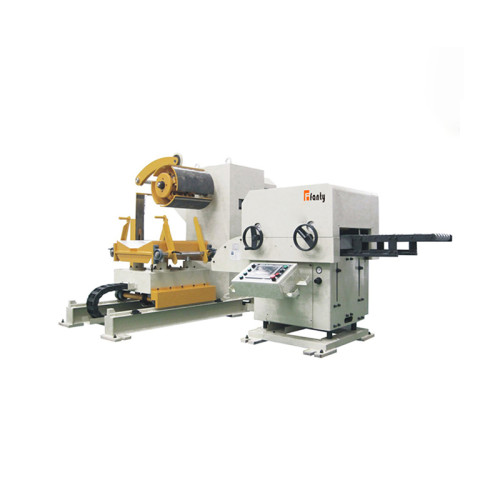
On a 3-in-1 machine, the three systems that fail most often are the hydraulic clamping circuit, the servo drive package and the feed roll set. Each one is diagnosed from a different document.
None of those documents are expensive to create. They are expensive to reconstruct, because reconstruction means reverse-engineering a machine that is already bolted to the floor and already needed in production.
FANTY has shipped into more than 60 export markets, and the pattern is consistent. Buyers who name the document pack in the order get it.
Buyers who assume it will arrive usually receive a binder that stops at the operator manual.

Which Six Documents Do the Real Work
Suppliers deliver a binder. Six items inside it carry almost all of the practical value, and the rest is context.
- General arrangement drawing with foundation data. Anchor positions, static and dynamic load per foot, and the utility connection points. Without it, a plant move becomes a survey.
- Electrical schematic plus an I/O list. The I/O list is the one that gets used, because it maps every signal to a terminal number and a PLC address.
- PLC project backup in native format. Not a PDF printout, and not a compiled upload pulled off the CPU. The editable project, plus the parameter set that was proven at run-off.
- Hydraulic and pneumatic schematics. Line by line, with component maker and maker part number on each symbol, not the supplier's internal code.
- Spare parts list with current lead times. A list without lead times tells you what to order but not when, and on imported equipment that second number drives the stock decision.
- Run-off records and the setup recipe table. What was measured at acceptance, on which material, and the roll gap, penetration and feed parameters that produced it.
The recipe table is the item buyers most often forget to ask for. It is also the only document that lets a new shift reproduce the settings that were validated before shipment.
What a Missing File Costs at 3 a.m.
The cost of a gap is not the price of the document. It is the production lost while the gap is closed, and the two are separated by an order of magnitude.
| Missing item | What it costs on a stoppage | How it shows up in practice |
|---|---|---|
| PLC project backup | 1 to 3 days of engineering plus lost output | A corrupted or battery-flat program leaves the line manual-only while the logic is rebuilt from the machine's behaviour |
| Maker part numbers | 3 to 6 weeks of lead time | A substitute proportional valve with different spool overlap changes the clamping curve and the feed accuracy with it |
| Foundation and load data | 2 to 3 weeks and a re-poured slab | A relocation to a mezzanine or a new bay fails a floor loading check after the machine has been quoted into the plan |
| Setup recipe table | 1 to 2 days per new material | Every new coil specification is redeveloped on the floor, with scrap, instead of being read off a validated sheet |
| Hydraulic schematic | 1 to 4 shifts of fault-finding | A pressure loss is traced by substitution rather than by reading the circuit, so two good components get replaced first |
Read the right-hand column as a sequence. The cheap documents prevent the expensive repairs, and they are the same documents that prevent the expensive guesses.
On a line running at 200 SPM, one lost shift is not an inconvenience.
It is several thousand parts, and on an automotive or appliance contract it is also a delivery commitment that has to be recovered somewhere else.
Which Files You Can Leave Behind
A pack that asks for everything is a pack that arrives late and gets read by nobody. Two categories of document are worth dropping.
| Document | What holding it gives you | Where it costs you to hold it |
|---|---|---|
| Component-level datasheets for every bought-in part | A complete reference set for the machine as built | Adds a week to the pack and 300 pages nobody opens, while the part number on the schematic already answers the question |
| Full software source for the HMI | Freedom to modify screens in-house | Transfers warranty risk on the interface and is rarely maintained, so the first upgrade is done from the vendor build anyway |
| Manufacturing and weld drawings for fabricated frames | Ability to have a frame remade locally | Discloses the supplier's design without giving you the material certificates that actually matter for a structural repair |
| Material certificates for load-bearing welds | Evidence for insurance and for a plant safety audit | Nothing. This one belongs in the pack and is the cheapest insurance item on the list |
The rule that separates the two groups is simple. Ask for a document if its absence would stop a repair, a relocation or an audit. Skip it if its absence would only slow a modification you may never make.
What the Handover Pack Cannot Prove
A complete document set is a real asset, and it has limits that buyers should understand before they rely on it.
It does not transfer tacit knowledge. No manual explains how an experienced operator hears a roll set going light, or when a coil's edge condition justifies slowing the line.
That knowledge moves through training days and through a person, not through a PDF.
A CE declaration covers the machine as supplied. Once the machine is integrated into a line with other equipment, guarding and control architecture, the assembled line is a new entity.
The declaration you hold describes the unit on the shipping frame, not the installation on your floor.
Drawings go stale after the first field modification. A changed sensor bracket or a relocated valve is usually noted on the machine and not on the drawing.
Treat the pack as a baseline and mark it up as the machine evolves.
Run-off data was measured on the supplier's sample coil. Flatness and feed accuracy recorded at acceptance describe one material on one day.
They are a reference point for your own materials, not a promise about them.
Where the pack is thin, the honest position is to note the gap at handover rather than to discover it during a breakdown.
FANTY ships PLC backups in native project format as standard because a backup that arrives six months late has usually already been needed once.

Four Clauses That Put the Pack in Writing
Every point above is enforceable, and none of it needs a lawyer's rewrite. Four lines in the purchase order are enough.
Name the list and tie it to payment. Attach the six documents to the order as a delivery milestone, with the final balance released when the pack is complete. A named list converts a favour into an obligation.
Specify the PLC format. Ask for the editable project in the manufacturer's own software version, plus a parameter file. A compiled upload cannot be edited, and a printout cannot be restored.
Require maker part numbers and lead times. Both columns, for every item on the spare list. That single requirement is what turns a list into a stocking plan.
Ask for revision service. A defined period, commonly five years, during which the supplier reissues any drawing changed by a factory modification. It costs nothing at order stage and it keeps the pack usable.
None of these clauses add cost to the machine. They change what arrives with it, and on a line that has to run for a decade, that is the part of the purchase that ages best.
Questions buyers raise once the pack is specified.
How much downtime does a missing PLC backup cause on a 200 SPM line?
Typically one to three days on a 3-in-1 line. The logic has to be observed and rewritten, then re-validated with the press before production restarts.
How many spare parts should a 5 tonne machine list at handover?
Between 40 and 80 line items on a 3-in-1 machine. Below 40 usually means consumables were omitted; above 80 usually means the list has been padded with items that never wear.
Does a CE declaration cover the whole coil line once it is installed?
No. It covers the machine as supplied. Once you add a press, guarding and line controls, the assembled installation needs its own assessment.
How often should drawings be reissued after a modification?
Within one maintenance cycle. A revision that waits for the next annual shutdown is a revision that will be missed by the shift that needs it.
Where to go next
This article covers what should arrive with the machine. How each specification line on a coil line translates into machine price and local landing cost is worked through in the buyer guide.
the coil line guide library