What Causes NC Servo Feeder Encoder Drift?
Three weeks ago a customer called to tell me his NC servo feeder was drifting. Parts were coming out 0.4 mm long by the end of a shift, the operator had been trimming the feed length offset to compensate, and by Friday the offset was at its limit and the alarm was going off. Classic drift complaint.
It was not drift. I spent two hours on site with a dial indicator and a strip of paper and found a loose encoder coupling bolt, a cable running beside a servo drive, and a belt that had stretched 2 mm since commissioning. Three separate causes, all presenting as one symptom, all fixable in an afternoon. Drift complaints are almost never a single fault. Here is how I work through them, in the order that finds the cause fastest.
First: Is It Actually Drift?
Drift means position error that grows steadily and consistently over time. Before you accept that diagnosis, separate it from the two things that look similar and are not drift at all.
Offset error is constant. Every part is 0.15 mm long from the first one to the last. That is a calibration or reference problem, not drift, and chasing it as drift wastes days. Random scatter is variation without a trend. Parts land at plus or minus 0.1 mm around a correct mean, and the fix is mechanical, usually roll condition or strip lubrication.
Measure a sample of twenty consecutive parts at the start of a shift and twenty at the end. If the mean has moved, it is drift. If the spread has widened but the mean has not, it is scatter. If neither has changed and the parts are simply wrong, it is offset. This one test decides which half of this article you need.
How the Position Loop Actually Works
The feeder closes a loop between three elements: the servo motor, the encoder that reports actual position, and the controller that compares the two and issues a correction. Drift means one of those three has changed its relationship to the other two.
The encoder is normally mounted on the motor shaft or on the feed roll shaft, connected by a coupling, belt or gear. Whatever the mechanical link is, it sits between the rotating element and the measurement. If that link develops backlash, stretch or slip, the encoder reports a position that the roll did not actually reach. The controller then corrects toward a number that is no longer true, and the error accumulates over thousands of cycles.
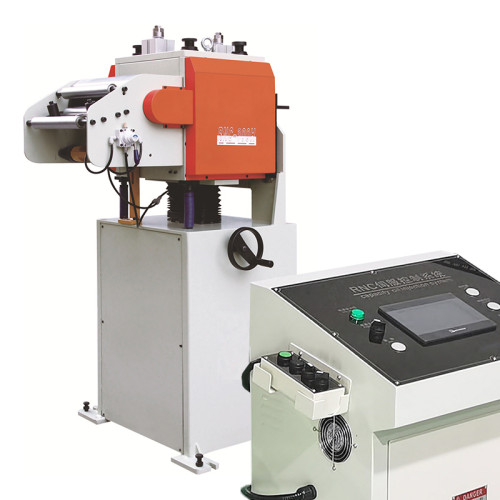
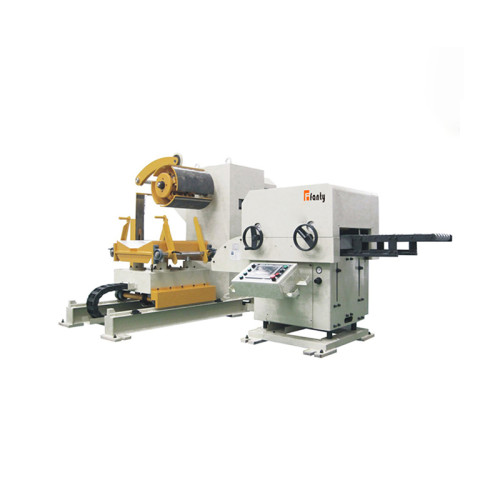
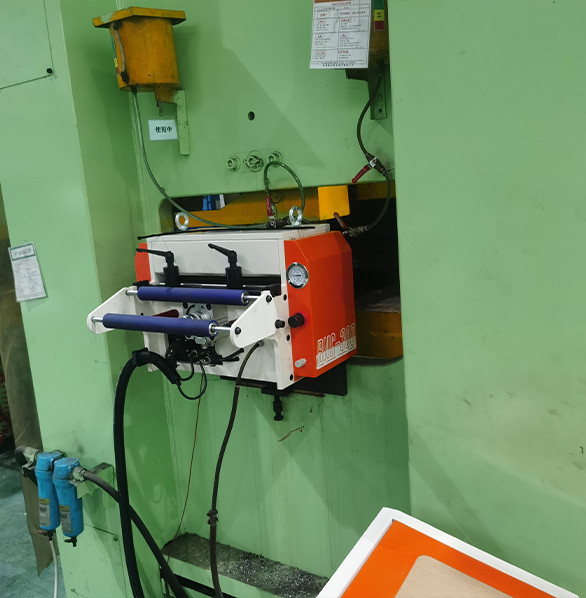
That single sentence explains most encoder drift on coil feeding equipment: the measurement has drifted away from the motion, not the other way around. If you want to see how the loop is arranged on a typical machine, the layout is shown on our NC Straightener Feeder range.
Six Causes, Ranked by How Often I Find Them
I have worked through this list on dozens of lines. The ranking is consistent enough to be worth following in order.
| Rank | Cause | Typical drift rate | First check |
|---|---|---|---|
| 1 | Loose or worn encoder coupling | 0.2-0.5 mm per 8 h shift | Torsional play by hand |
| 2 | Encoder cable routed beside drive power | Intermittent, load dependent | Cable separation and shielding |
| 3 | Timing belt stretch or tension loss | 0.1-0.3 mm per shift | Belt deflection at mid-span |
| 4 | Grounding and shield termination | Random, worse in humid weather | Single-point ground at controller |
| 5 | Encoder bearing wear or contamination | Step change, not gradual | Runout and signal quality |
| 6 | Feed roll slip from worn or glazed rolls | Material dependent | Roll surface and pressure |
Number six is the one people misdiagnose most often, because roll slip produces a length error that looks like drift but has nothing to do with the encoder. If the roll slips on the strip, the encoder is telling the truth and the strip is not going where the encoder thinks it is.
Mechanical Causes: Coupling, Backlash and Belt Stretch
Start here, because mechanical causes are the most common and the easiest to confirm without instruments.
- Coupling play. With the machine isolated, hold the feed roll shaft and rock the encoder shaft by hand. Any perceptible rotation before the roll moves is lost motion, and it accumulates in one direction only.
- Belt tension. Press the belt at mid-span. Deflection beyond about 10 mm per metre of span means the belt has stretched. A belt does not slip gradually; it slips on the acceleration stroke, which is why the error appears at speed and disappears at low takt.
- Encoder mounting bracket. A bracket that flexes under torque changes the phase relationship between motor and encoder. Check for paint cracks around the mounting bolts, which usually indicate movement.
- Set screw witness marks. Before you touch anything, mark the coupling and shaft with a paint pen. If the marks rotate relative to each other after a run, the coupling is slipping and you have your answer in one shift.
Electrical Causes: Noise, Grounding and Cable Routing
If the mechanical checks are clean and the error is intermittent rather than steady, the cause is usually electrical.
Encoder signals are low-voltage differential pairs carrying millivolt-level transitions at kilohertz rates. A single conductor of encoder cable running parallel to a servo motor power cable for a metre is enough to couple switching noise into the signal, and the controller interprets that noise as motion. The error is small per event, but it happens thousands of times per shift and it only accumulates in one direction because the correction is always applied to the same side.
The fix is separation and shielding. Route encoder cable at least 200 mm from motor power cable, cross other cables at right angles rather than running parallel, and terminate the shield at one end only, at the controller. A shield grounded at both ends creates a ground loop, and a ground loop is worse than no shield at all.
Encoder-Side Causes: Mounting, Contamination and Bearing Wear
These are less common, and when they occur the symptom is usually a step change rather than a gradual drift. A sudden 0.5 mm shift that never goes back is a different animal from a slow creep.
Contamination is the usual culprit in a stamping environment. Airborne oil mist and fine metal dust find their way into an encoder housing that is not sealed to IP65, and the optical disc becomes partially obscured. The signal degrades unevenly across the revolution, and the controller sees a position that wobbles. If the encoder is mounted low and near the strip path, it will collect debris faster than one mounted high on the motor.
Bearing wear shows up as runout. A dial indicator on the encoder shaft will show it in seconds, and no amount of recalibration will compensate for it. If runout exceeds the encoder manufacturer's specification, replace the encoder rather than trying to adjust around it.
How to Isolate the Cause in One Shift
Run these five steps in sequence. Each one either finds the cause or eliminates a whole category, and the whole sequence fits inside a single shift.
One: mark the coupling with a paint pen and run a full coil. Check the marks. Two: with the machine isolated, measure torsional play by hand at the coupling and at the feed roll. Three: measure belt deflection at mid-span and compare against the specification in the manual. Four: run twenty parts at low speed and twenty at production speed, and compare the mean of each group. A speed-dependent error points at belt or slip; a speed-independent error points at the encoder or its cable. Five: physically inspect the encoder cable route for any length running parallel to motor power.
Step four is the one that narrows the field fastest, and it costs one coil of material.
What to Change So It Does Not Come Back
Fixing the immediate cause is half the job. The other half is making the failure visible earlier next time.
Put a paint mark on every encoder coupling at commissioning and add it to the monthly inspection route. Add belt tension to the preventive maintenance schedule with a recorded value rather than a pass or fail judgement. Record the encoder cable route on the electrical drawing so the next technician does not add a power cable beside it during a retrofit. And log feed length against time on every shift, so a slow creep shows up in the trend before an operator starts trimming offsets to hide it.
We have shipped coil feeding equipment into more than 60 countries, and the lines that stay accurate are not the ones with the best components. They are the ones where somebody wrote down what the correct value was, so a change was noticeable. Every machine we build carries CE marking, and that same documentation discipline is what keeps a feeder inside tolerance for years rather than months.
Encoder and accuracy questions we get asked
How much drift is normal on an NC servo feeder?
None that accumulates. A correctly maintained feeder should hold its feed length over a full shift without operator offset changes. If an operator is trimming the offset daily, something in the loop has changed and should be found rather than compensated for.
Can I recalibrate instead of fixing the cause?
You can, and it will hold for a while. But recalibration hides a mechanical or electrical fault that is still progressing, and eventually the offset limit is reached and the line stops. Fix the cause, then recalibrate.
Why does the error appear only at high takt?
Because belt slip and coupling backlash are torque dependent. At low speed the torque demand is small and the lost motion does not show. At production speed the acceleration stroke loads the drive hard enough to expose it.
Does encoder cable length matter?
Yes. Long cable runs attenuate the differential signal and pick up more noise. Follow the encoder manufacturer's maximum cable length and never splice an extension into an existing run.
How do I tell encoder drift from roll slip?
Compare a measured part against the commanded feed length with a stopped strip. If the roll is slipping, the strip is short while the encoder reports a correct position. If the encoder has drifted, the encoder position itself is wrong.
Chasing a feed length problem?
Send us your machine model, the measured error, and when it appears in the shift. We will tell you which of the six causes fits your symptom and what to measure first.
Ask our service teamFanty · NC Straightener Feeder
Still Fighting Strip Memory After Straightening?
Send the strip thickness, material grade and target flatness. We specify roll diameter, roll count and NC feed pitch so the line holds tolerance from the first coil, not the fiftieth.
Get a Free QuoteFANTY Machinery · 13 years on stamping automation · 2,000+ coil lines installed · engineers reply within 24 hours