Is a 5-Roll Straightener Feeder Enough at 3 mm?
Five rolls will flatten 3 mm mild steel. They will not flatten 3 mm HSLA to the same number, and the difference is not a setting. Roll count is a geometry decision, and it is fixed at the drawing stage.
This is the arithmetic behind that choice: which inputs move the answer, a worked example at 1,250 mm wide, and how sensitive the result is to a 100 MPa change in yield.
What Roll Count Actually Buys You at 3 mm
Every roll pair bends the strip past yield and releases it. What comes back after release is a smaller version of the curvature you put in, so each reverse bend leaves less to remove.
The decay is roughly geometric. A well-set head removes 60 to 70 percent of the residual curvature per reverse bend, which means five rolls get you four bends and seven rolls get you six.
That extra pair is worth less than the first pair and more than nothing. At 3 mm on mild steel, four bends is usually enough. At 3 mm on 420 MPa HSLA, four bends leaves measurable bow.
The thickness matters twice. A thicker strip has a smaller elastic core relative to its section, so it straightens more per bend.
It also needs more torque per roll, which is why heavy-gauge heads carry bigger motors.
The Four Inputs That Decide the Number
Four numbers settle the roll count. Get all four from the material certificate and the part drawing, not from the machine brochure.
Yield strength. This is the dominant input, because elastic recovery scales with yield over modulus. Doubling yield roughly doubles the penetration needed to cancel the same residual curvature.
Thickness and thickness tolerance. A coil that runs 3.0 to 3.15 mm needs the roll gap set for the thick end. Setting to nominal produces a head that cannot grip the thin end of the coil.
Roll diameter and pitch. Larger rolls bend the strip over a longer arc, which reduces the strain per pass and lets you use fewer rolls.
Small rolls on wide strip deflect, and deflection is the quiet killer at 1,250 mm.
Target flatness. Flatness stated in I-units is stricter than flatness stated in millimetres per metre.
One I-unit is roughly 0.01 percent of a wave height over a given wave length, so 10 I-units is a far tighter target than 2 mm per metre.
A Worked Example: 3 mm SPHC at 1,250 mm Wide
Take 3.0 mm SPHC at 235 MPa yield, 1,250 mm wide, target 2 mm per metre. A five-roll head with 90 mm rolls runs this comfortably, and the settings below are typical.
| Pass | Roll gap setting | Residual bow after release | Where it costs you |
|---|---|---|---|
| Roll 1, first bend | 2.1 mm, deep penetration | 8 to 10 mm per metre | Deep setting loads the roll necks; skip it and nothing downstream works |
| Roll 2, reverse | 2.4 mm, lighter | 3 to 4 mm per metre | Under-penetrate here and the head leaves a visible crossbow |
| Roll 3, third bend | 2.7 mm | 1 to 1.5 mm per metre | Close to the target, so operators stop adjusting too early |
| Roll 4, final reverse | 2.9 mm, near strip thickness | 0.4 to 0.8 mm per metre | Set below strip thickness and the roll marks the surface |
| Roll 5, exit | 3.0 mm, gap only | Under 0.5 mm per metre | This roll guides rather than forms; treat it as a pass line control |

Read the table as a decay curve, not as a recipe. The absolute gaps depend on roll diameter and on how the head is built, but the pattern of decreasing penetration is universal.
How Sensitivity Moves the Answer
Change one input at a time and watch what happens to the roll count. This is the part of the decision most buyers skip.
Yield from 235 to 420 MPa. At the same thickness, penetration has to rise by roughly 70 percent to hold the same residual curvature. A five-roll head runs out of penetration range before it runs out of torque.
Thickness from 3.0 to 4.0 mm. Torque demand rises with the square of thickness, so a head sized at 3 mm is marginal at 4 mm even though the flatness maths still works.
Width from 1,000 to 1,500 mm. Roll deflection grows with the fourth power of the span between bearing supports.
This is why wide heavy-gauge heads carry backup rolls or crowned rolls, and why a 1,500 mm head is not simply a longer version of a 1,000 mm one.
Target from 2 mm per metre to 10 I-units. The last few percent of flatness costs a whole extra roll pair. On a visible panel that is justified; on a bracket it is money burned.
What a 5-Roll Head Can and Cannot Do
Five rolls is the workhorse configuration, and most 3 mm jobs in mild steel belong on it. Being clear about the boundary protects both the buyer and the machine.
It can hold 2 mm per metre on 3 mm SPHC or SPCC. It can also run 2 mm galvanized without marking, provided the roll surface is right.
It cannot hold 10 I-units on 3 mm HSLA 420. The penetration range and the roll count both run out, and no operator skill closes the gap.
It cannot fix crossbow and edge wave at the same time. Those are different defects with different corrections, and one setting trades one for the other.
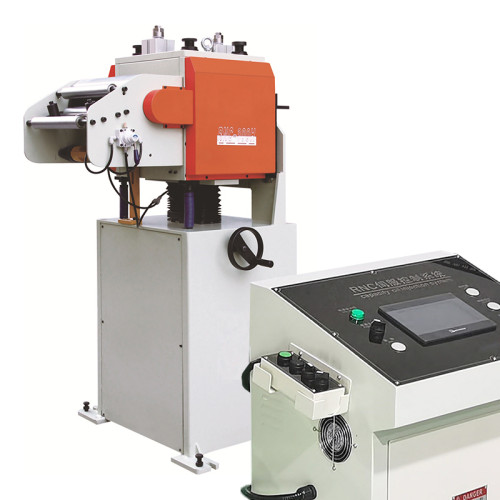
An NC straightener feeder built around a five-roll head is a genuinely capable machine within that envelope. Stretching it beyond the envelope is how buyers end up paying twice.
Where the Calculation Stops Being Useful
The decay model above predicts longitudinal bow well. It says nothing useful about three other defects, and buyers regularly read it as a flatness guarantee.
Edge wave is a width problem. It comes from uneven elongation across the strip, which roll bending cannot remove. A nine-roll head will not fix a coil that was rolled with edge wave in it.
Crossbow is a roll alignment problem. It appears when the top and bottom rolls are not parallel across the width, and it gets worse as the head is adjusted deeper.
More rolls multiply the error rather than reducing it.
Coil set is not the same as bow. A coil with a strong set has a memory across its full length. Straightening removes curvature at a point, and the coil remembers the rest until it has passed through.
Wide strip deflects the rolls. On 1,250 mm at 3 mm, a 90 mm roll bends measurably under load. The strip is flat where the roll is stiff and wavy where it is not, and the defect shows as a periodic pattern.
How to Prove the Head on Your Own Coil
Send a coil, not a data sheet. A 3 mm coil from your actual supplier settles the yield question in a way no certificate does, because mill certificates quote a minimum and coils run above it.
On site, run three metres through the head with no forming and lay it on a surface plate. Check with a one-metre straightedge and a feeler gauge at three positions across the width, then flip the strip and repeat.
Record the gap setting for each roll alongside the flatness reading. That pairing is what makes the setting reproducible, and it is what the next operator needs at changeover.
- Three metres, no forming, laid on a surface plate with the crown side up.
- One-metre straightedge at the centre, at the quarter points and at both edges.
- Feeler gauge reading recorded in millimetres per metre, not described as good or bad.
- The strip flipped and measured again, because a head that is out of parallel only shows it one way up.
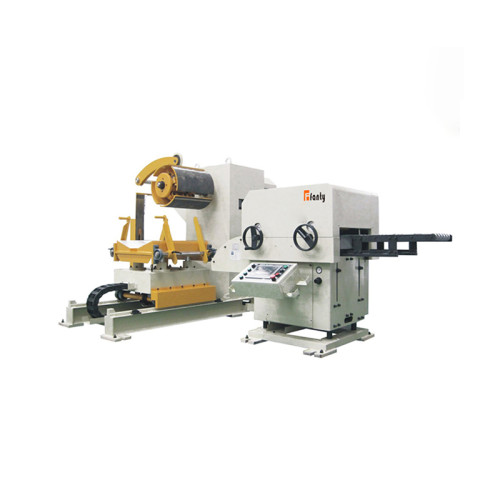
The roll geometry behind these numbers is set out in full on our 3-in-1 decoiler straightener feeder flatness guide, including how pitch and roll diameter change the strain per pass.
What to Ask Before You Buy Either Head
Three questions separate a specification from a sales sheet, and all three have numeric answers.
Ask for the maximum penetration per roll in millimetres, not as a percentage of thickness. Ask for the roll deflection at your working width, or the crown built in to compensate for it.
Ask what flatness the head holds at your yield and thickness, stated in the unit you will measure.
A supplier who answers all three in numbers has done the arithmetic. One who answers in adjectives has not, and the shortfall lands on your shop floor in the first month.
Model roll counts, diameters and motor ratings sit in the equipment data pages, so the comparison can start from drawings rather than from conversation.

How many rolls does 3 mm HSLA 420 need to hold 10 I-units?
Seven as a minimum, and nine on widths above 1,300 mm. Five rolls runs out of penetration range before it reaches that flatness.
At what width does roll deflection become the limiting factor?
Above roughly 1,200 mm at 3 mm thickness, a 90 mm roll bends enough to show a periodic wave. Backup rolls or a larger diameter are the usual fixes.
Does a seven-roll head cost much more than a five-roll one?
Expect 20 to 35 percent more on the head, plus a taller frame. Whether that pays depends on whether 10 I-units is a real requirement or a habit.
Can I run 1.5 mm and 3 mm strip on the same five-roll head?
Yes, but the gap settings differ by more than a millimetre per roll. Write both sets on the machine and verify with a three-metre sample at each changeover.
Where to go next
Roll count is one line of a specification that has several.
The flatness cluster guide in our coil line knowledge base covers pitch, gap and penetration together, which is the combination that decides whether a head holds the number you measured.