Is In-Die Tapping Worth It on a Coil Line?
A 200 SPM line that adds six tapped holes in the die runs at 45 SPM, and the arithmetic that justifies it is rarely done before the tool is cut.
In-die tapping is sold as a way to remove a second operation. It does remove the operation, and it also removes most of the press speed.
Whether that trade is good depends on hole count, annual volume, and whether the tap can be kept from pulling the strip while the feed is holding it.
This compares the three places a tapped hole can be made, prices the speed you give up, and names the volumes where the in-die route stops paying.
Three Places a Tapped Hole Can Be Made
Every tapped hole in a stamped part is made in one of three places, and the choice is usually made by whoever owns the tooling budget.
Inside the die. A tapping unit sits in a station after the pierce, driven by the press stroke or by its own motor. The hole is tapped while the strip is stationary, so the die owns the operation and the cycle time.
After the press. Parts go to a secondary tapping machine or a machining centre. The press keeps its speed and the plant gains a handling step, a WIP buffer and a second quality gate.
As an insert. A rivet nut, clinch nut or weld nut replaces the thread. The die gets a simpler station, the part gets a fastener, and the cost moves from machine time to purchased hardware.
The decision is not about which method is more advanced. It is about where the cost lands: tooling, cycle time, labour, or hardware.
What Tapping Does to the Feed Cycle
A tap needs the strip still. The feed, by definition, needs the strip moving. Everything about in-die tapping follows from resolving that conflict.
The dwell. An M6 tap in 1.5 mm cold-rolled strip needs 0.6 to 1.2 seconds of stationary strip to cut and reverse out. That is two to four press strokes at 200 SPM.
The effective rate. Six holes tapped in one station, with the strip stopped for 1.1 seconds each cycle, drops a 200 SPM line to roughly 45 SPM. The press is not slower; the line is idle.
Pilot release timing. The pilots must be out of the strip before the feed starts and back in before the tap begins.
Retiming that sequence is where most first runs fail, because the tap is still in the hole when the feed rolls take up.
Strip grip. A tap cutting into a hole pulls the strip toward the tool. If the feed rolls are not holding, the strip creeps and every downstream hole moves by 0.1 to 0.3 mm.
None of these are reasons to avoid the method. They are the numbers that belong in the justification, and they are usually missing from it.

The Comparison That Actually Decides It
Price all three routes against the same annual volume and the answer is usually obvious within one table.
Take 600,000 parts a year, four M6 holes each, 1.5 mm CR4 strip, and a line that runs 200 SPM without tapping.
In-die tapping adds $24,000 to $34,000 of tooling, cuts the rate to about 45 SPM, and removes a handling step and one operator.
Secondary tapping on a dedicated machine runs at 900 to 1,400 holes an hour including load and unload, costs $0.018 to $0.035 a hole, and needs 0.4 of an operator across the year.
Clinch nuts cost $0.06 to $0.11 each plus a press station, and they change the part design, which is often the real blocker.
| Route | What it gives the run | What it takes back |
|---|---|---|
| Tapping inside the die | One operation, no WIP, thread concentric with the pierce | 155 SPM of press capacity, $24k–34k of tooling, and a tap that can break inside a closed die |
| Secondary tapping cell | Full press speed, tap changes offline, easy rework | Handling, a buffer, 0.4 operator, and a second chance to scrap a finished part |
| Clinch or weld nut | No thread cut in the strip, strong pull-out, one press station | $0.06–0.11 of hardware per hole and a part design change that may not be allowed |
| Pierce only, thread at assembly | Cheapest die, fastest line | Puts the thread operation on your customer, which rarely survives a supplier review |
At 600,000 parts and four holes, secondary tapping costs $43,000 to $84,000 a year in machine time and labour. In-die tapping costs the tooling once and about 9,000 hours of press capacity a year.
That comparison is the whole argument. If the press has spare hours, in-die tapping wins. If the press is the constraint, it loses badly.
Tooling Details That Decide Whether It Works
Most failed in-die tapping installations fail on hardware, not on the concept. Four details carry the risk.
Torque monitoring. A tap that dulls raises torque before it breaks. A unit with a torque limit and a per-stroke readout turns a broken tap from a scrapped die into a stopped line.
Chip clearance. Blind holes in 1.5 mm strip produce short chips that pack. A through hole with air blast clears itself; a blind hole needs a form tap or a fluted tap with forced coolant.
Tap holder float. A rigid holder transmits every misalignment into the thread. A floating holder with 0.5 mm of radial compliance extends tap life by two to three times on a die that is not perfectly aligned.
Lubrication. Tapping needs more lubricity than forming. A die that runs on a light drawing oil will produce torn threads at 8,000 holes where a heavier oil reaches 15,000.
Tap life on M6 in 1.5 mm CR runs 8,000 to 15,000 holes depending on coating. At four holes a part that is 2,000 to 3,750 parts between changes, which has to fit inside a shift pattern.

How many SPM does in-die tapping cost on a 200 SPM press?
Between 140 and 160, depending on hole count and thread depth. A single M6 through hole costs about 0.7 seconds a cycle; six holes cost 1.1 seconds because they are tapped in parallel.
At what annual volume does secondary tapping become cheaper?
Below roughly 250,000 parts with four holes, the tooling premium for in-die tapping does not pay back inside two years. Above 500,000 it usually does, provided the press has spare hours.
Does in-die tapping change the feed length or the strip width?
No to width, yes to feed timing. The pitch stays the same, but pilot release has to move earlier and the feed has to complete before the tap starts, which shortens the usable feed window.
What torque does an M6 tap need in 1.5 mm steel?
2 to 3 Nm cutting torque for CR4, and 4 to 5 Nm at the top of the range for stainless. Set the torque limit at 150 percent of the expected peak, not at the tap's breaking torque.
Can a coil line run in-die tapping without losing accuracy?
Yes, if the strip is held during the cut. Hold the feed rolls closed through the dwell and the hole position stays inside ±0.05 mm; release them and it drifts by 0.2 mm within a thousand parts.
The Boundary the Press Hour Draws
The method has a hard boundary, and it is drawn by the press hour, not by the tooling cost.
A press that is already the bottleneck. Giving up 155 SPM to save a handling step is a bad trade when the press runs 6,000 hours a year. The lost output costs more than the secondary operation ever did.
Thin strip below 0.8 mm. The thread has fewer than three full turns, pull-out strength falls, and the tap tends to distort the hole instead of cutting it. A clinch nut is the better answer at that gauge.
Stainless and HSLA above 400 MPa. Torque roughly doubles, tap life drops to 3,000 to 5,000 holes, and the dwell lengthens. The economics invert.
Where the data misleads. Tooling quotes usually price the tapping unit and leave out the die protection, the torque monitor and the retiming of pilot release.
Those three items add $6,000 to $9,000 and are not optional.
One boundary is worth stating for anyone comparing routes on rate alone.
A 45 SPM line that never stops beats a 200 SPM line that stops every 2,000 parts to change a tap, and the comparison depends entirely on how good the tap monitoring is.
A Trial That Answers It in 200 Strokes
Before committing to a tool, run the question on the existing die with a temporary unit. Two hundred strokes produce enough data to decide.
- Log the cycle time with and without the tapping dwell, measured at the press, not calculated from the nameplate.
- Measure hole position on the first ten and the last ten parts, with the feed rolls held closed during the cut.
- Record peak torque per stroke for 200 strokes and note the drift; a rising curve predicts the tap change interval.
- Pull-test ten parts to the drawing's thread strength, because a form tap and a cut tap do not give the same result.
- Time a tap change with the die in the press, since that number decides the real output more than SPM does.
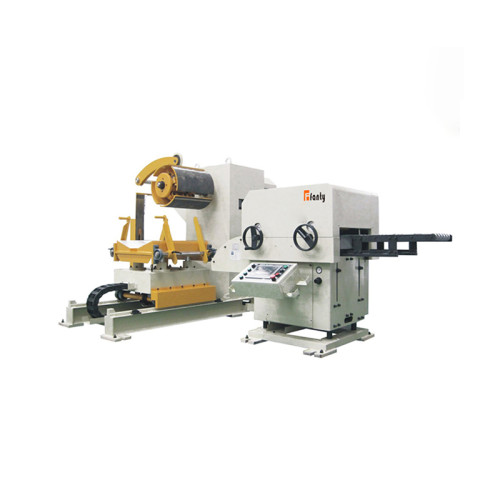
Line speed, pitch and pilot timing for the machines that feed this kind of tool sit in the machine list we publish. Those figures decide the feed window a tapping station has to fit inside.
The coil line guide library treats roll count, pitch and penetration as one system, which is the same habit that makes a tapping station predictable.
Where to go next
Tapping is one of several operations that compete with press hours, and the same arithmetic applies to every station added after the pierce.