How to Fix Twisted Strip in an NC Straightener Feeder?
Strip that comes off a coil line with a visible twist — one edge higher than the other, rotating along the length like a slow helix — is one of the more confusing defects to chase, because it looks like a material problem and is often a machine problem. In most cases the NC Straightener Feeder is not creating the twist so much as failing to correct it, or in some setups, exaggerating it through misalignment. The good news: twist is diagnosable and correctable with a systematic check of roll parallelism, pass line alignment, and entry condition. This guide walks through the causes and the fix sequence so you can return the strip to flat before it ruins parts or damages the die.
First, confirm it is twist and not something else
Twist gets confused with three other strip defects, and treating the wrong one wastes a shift. Lay a cut length of strip on a flat table. If the strip rocks diagonally corner-to-corner, that is twist — a rotation of the cross-section along the length. If it lies flat but the edge curves sideways, that is camber. If it bows upward in a long arc, that is coil set or longitudinal curl, and if the ends lift while the middle stays down, you are looking at center buckle or edge wave from uneven roll pressure. Each defect has a different correction, so the first step is always to identify which one you actually have.
Twist has a distinctive fingerprint: it usually appears worse near the ends of the cut length and relaxes toward the middle, and it often shows up on only one side of the coil width. When you see that pattern, the next question is where the twist begins — at the coil, at the slitter, or inside the straightener feeder.
Quantify it before you adjust anything. Lay the sample on a flat table, hold one end down, and measure how high the opposite corner lifts; then flip the strip end for end and repeat. If the lift reverses with the flip, the strip has a true helix. Recording that number gives you a baseline — after each adjustment you can tell whether the twist improved by half or disappeared, instead of judging by eye.
Upstream causes: slitting and coil condition
Twist frequently starts before the strip ever reaches the feeder. Slitting lines create twist when the knife clearances or tensions differ between the two edges of a slit strand — one edge is worked harder than the other, and the residual stress releases as a helix. Edge burrs from a dull slitter knife produce the same result on a smaller scale. If the twist is consistent coil after coil from the same supplier, check the slitting process before adjusting your straightener.
Coil condition matters as well. A coil that was wound with uneven tension, or stored on its edge and deformed, can carry a latent twist that the straightener must overcome. When you load a new coil, cut a trial length before threading the die and look at it end-on. Finding twist at the coil stage saves you from diagnosing a machine that is actually fine.
Ask your slitter or supplier one question when twist appears coil after coil: are both edges of the slit strand produced with the same knife clearance and the same pull tension? Strands slit from one master coil can twist in opposite directions when the two sides of the slitting line are set up differently — a fault no straightener setting will fully remove. Balancing clearances or re-tensioning the rewind at the slitter is faster than fighting the defect at the press.
Machine causes inside the straightener feeder
When the coil and slitter are cleared, the machine is the suspect. Twist inside an NC Straightener Feeder almost always traces to one of four alignment faults, and each has a specific signature you can measure.
| Symptom | Likely cause | Correction |
|---|---|---|
| Twist appears only at one edge of the strip | Work rolls not parallel — gap tighter on one side | Check roll parallelism with a dial indicator; re-shim the bearing blocks |
| Twist worsens as strip speeds up | Entry pinch rolls or guides misaligned with pass line | Align entry guides to the true strip centerline |
| Twist returns after roll changes | Rolls reassembled without parallelism check | Re-verify gaps after every roll service |
| Twist plus edge marks on one side | Worn or damaged roll on that side | Inspect and replace the suspect roll |
| Twist with inconsistent strip tension | Decoiler braking or loop control hunting | Stabilize tension before the straightener entry |
The core principle is simple: a straightener removes defects by elongating the strip evenly across its width. The moment roll pressure becomes uneven side to side, the strip leaves with different edge lengths, and that differential is what twists it. So the single most valuable maintenance habit on an NC straightener feeder is verifying roll parallelism after every roll change, with the machine stopped and a dial indicator on the roll faces.
Roll squareness is a second, less obvious machine cause. If a work roll is tilted in plan view — square to the frame but not square to the direction of strip travel — it wipes the strip sideways as it passes, and that sideways drag emerges as twist at the exit. Checking squareness takes a straight edge and a dial indicator across the roll ends, and it belongs in the same service interval as the parallelism check.
The correction sequence, step by step
Work through this order and re-test after each step — most twist problems are solved at step two or three, and you will know exactly which adjustment did the job.
- Cut a fresh sample, mark the strip edges A and B, and confirm which edge rides high along the length.
- Stop the line and check work-roll parallelism across the width with a dial indicator; correct any taper with the roll shims.
- Verify the entry pinch rolls and side guides sit on the true centerline of the pass line, not offset to one edge.
- Re-run a sample at low speed and check the twist direction; if it reversed, you have over-corrected — ease back by half.
- Once flat at low speed, ramp to production speed and confirm the twist stays gone — a speed-related return points to vibration or guides.
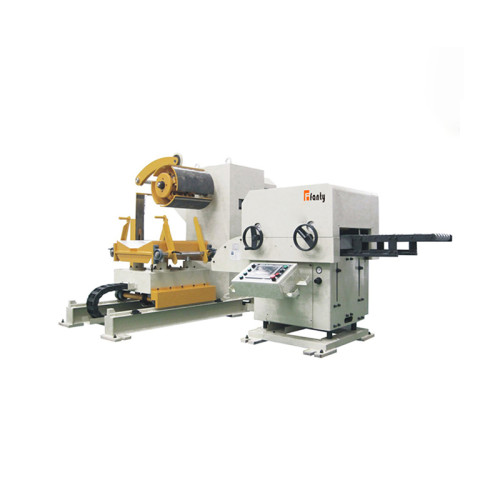
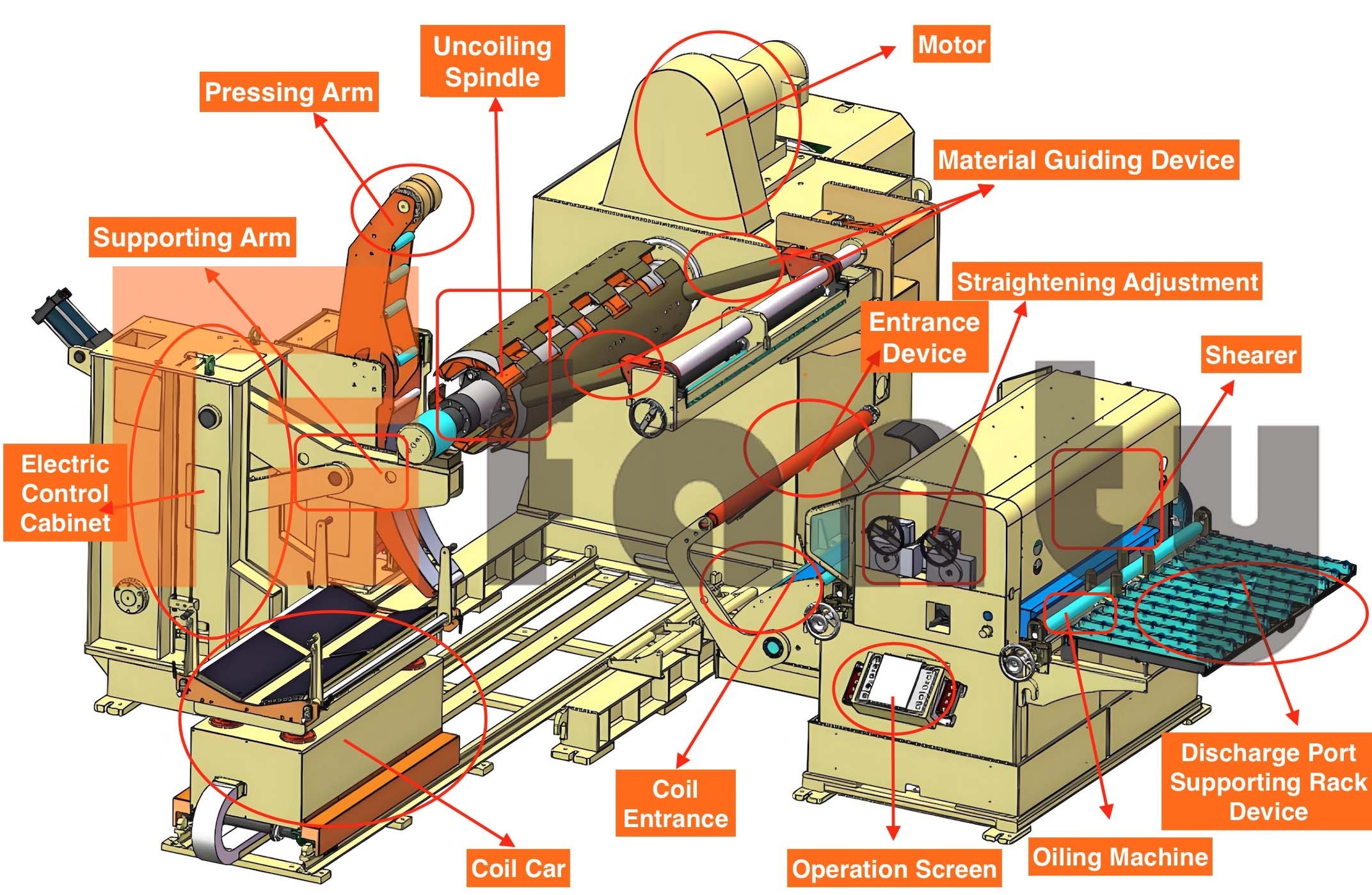
Remember that the straightener works together with the feed function in a 3-in-1 decoiler straightener feeder: strip that enters the rolls under uneven tension from the loop or the decoiler will not straighten evenly no matter how well the rolls are aligned. Stabilize the entry tension before fine-tuning roll pressure. On combined units, the straightening section and the NC servo feeder share one pass line, so a guide that is off by even a few millimetres disturbs both straightening and feeding at once — one more reason to check entry alignment before anything else.
Record the settings that work. Note the roll gap at each end of the top rolls, the entry guide position, and the speed at which you verified the fix. Twist corrections are easily lost on the next roll change or shift handover, and a written baseline turns a one-off repair into a repeatable setup that the next operator can trust.
Strip twist FAQ
Can an NC Straightener Feeder correct twist that comes from the coil?
Yes, within limits. If the twist is mild and consistent, correct roll parallelism and entry alignment will remove it. Severe twist from a badly wound coil or poor slitting may need to be fixed at the source — the straightener is not a substitute for a good coil.
Why does twist show up only after we change the work rolls?
The most common cause is reassembly without a parallelism check. Even a small taper across the roll width changes the elongation balance and produces twist. Always verify gaps with a dial indicator after any roll service.
Is twist the same as camber?
No. Camber is a sideways curve in the strip edge while the strip lies flat; twist is a rotation of the cross-section along the length. They need different corrections, so identify the defect on a flat table before adjusting anything.
How often should we check roll parallelism?
After every roll change or bearing service, and as part of the scheduled straightener maintenance — typically monthly on a single-shift line and weekly on continuous high-speed operation. It is a ten-minute check that prevents a full shift of scrap.
Could the feeder itself cause twist on a perfectly flat coil?
Yes. If entry guides push the strip off the roll centerline, or roll pressure is uneven across the width, the machine will induce twist on otherwise good strip. That is why the machine-side checks come before blaming the material supplier.
How do I tell a slitting twist from a straightener-induced twist?
Test a fresh coil sample before it enters the straightener: cut a length straight off the coil or slitter and lay it flat. If the twist is already there, fix the source upstream. If the sample is flat and the twist appears after the feeder, the machine alignment is the problem.
Strip defects costing you parts?
Send a photo of the cut sample and your strip details. FANTY's engineers — 12 years in coil line engineering, 80+ R&D staff, CE-certified machines in 60+ countries — will help you pin down whether the fix is a shim, a roll, or a slitter.
Ask a Straightening EngineerFanty · NC Straightener Feeder
Coated, High-Strength or Thin Gauge? Each Needs Different Rolls
Roll finish and pressure setting decide whether you mark the surface or hold flatness. Send your material spec and we size the straightener feeder properly the first time.
Get a Free QuoteFANTY Machinery · 13 years on stamping automation · 2,000+ coil lines installed · engineers reply within 24 hours