How Much Roll Penetration Suits an NC Straightener Feeder?
Two operators can run the same 1.5 mm cold-rolled coil on the same machine and get visibly different results, with the only difference being how far they wound the upper roll bank down. One produces strip that sits flat on a surface plate. The other produces strip that looks acceptable in the die but shows a 3.5 mm per metre bow when you cut a sample. Roll penetration is the setting responsible, and it is the one most often set by feel rather than by number.
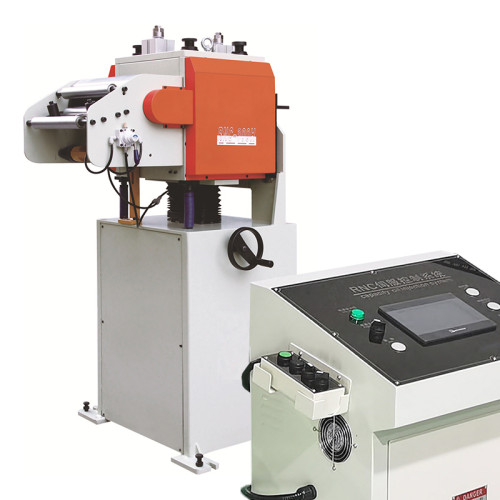
This guide covers what penetration physically does to the strip, how to calculate a starting value from thickness and roll diameter, what the measured effect looks like across a range of settings, and where more penetration stops helping. Straightener roll configurations and adjustment ranges are documented across the NC Straightener Feeder range.
What Roll Penetration Means in Practice
Penetration is how far each successive roll pushes the strip past its own neutral plane. In a straightener with alternating upper and lower rolls, the strip is bent up, then down, then up again as it passes through. Each reversal of curvature removes some of the residual stress built into the coil.
Penetration is expressed as a depth in millimetres, and it is set independently for the upper and lower banks on a properly equipped machine. When both banks are set to the same depth, the strip exits with the same curvature it entered with — you have bent it repeatedly without removing anything. When the entry side is set deeper than the exit side, curvature is progressively reduced along the roll stack. That gradient is what actually flattens the strip.
The single most common setup error is setting both banks to the same value and then increasing both together to chase flatness. It does not work, because the straightener is not a rolling mill. It removes curvature through bending cycles, not through reduction.
Penetration Is Set by Thickness, Not by Feel
The governing variable is the ratio of penetration depth to strip thickness. As a working rule for the first upper roll in the stack:
- Thin strip, 0.4–0.8 mm. Start at 0.8–1.2× thickness on the entry roll, tapering to roughly 0.3× at the exit.
- Medium strip, 0.8–2.0 mm. Start at 0.6–0.9× on entry and 0.2–0.3× at exit. Roll diameter matters more here than at either extreme.
- Heavy strip, 2.0–4.5 mm. Start at 0.4–0.6× on entry, tapering to 0.15–0.2×. Going deeper requires a machine with enough roll diameter to reach the plastic zone without overloading the frame.
Roll diameter enters through the strain calculation, not the depth setting. A 65 mm roll bends the strip to a tighter radius than an 85 mm roll at the same penetration depth, which means it does more work per pass. If you are comparing two machines on penetration numbers alone, you are comparing the wrong figures.
Measured Effect of Penetration on Flatness
The figures below come from a 1.5 mm CRS coil, 300 mm wide, run through a five-roll cassette with 65 mm rolls. Flatness is expressed in I-units, where lower is better; a typical press-ready target is under 2 I-units.
| Entry penetration | Exit penetration | Measured flatness | Surface condition | Comment |
|---|---|---|---|---|
| 0.5 mm | 0.5 mm | 4.6 I-units | Clean | Under-worked; curvature largely unchanged |
| 1.0 mm | 0.9 mm | 3.4 I-units | Clean | Marginal improvement; gradient too shallow |
| 1.2 mm | 0.4 mm | 1.6 I-units | Clean | Good production setting for this material |
| 1.5 mm | 0.3 mm | 1.1 I-units | Clean | Best flatness measured in this trial |
| 1.8 mm | 0.3 mm | 1.3 I-units | Faint roll marks | No further gain; surface starting to suffer |
| 2.2 mm | 0.3 mm | 1.9 I-units | Visible marks | Over-worked; strip also work hardens |
The flatness curve is not monotonic. It improves to a minimum around 1.5 mm entry penetration and then gets worse, for two reasons that reinforce each other. The strip begins to work harden at the roll contact, so additional bending produces less permanent deformation and more springback. At the same time, contact pressure rises enough to mark the surface. Past that point you are paying in roll life and surface quality for a result that is measurably worse.
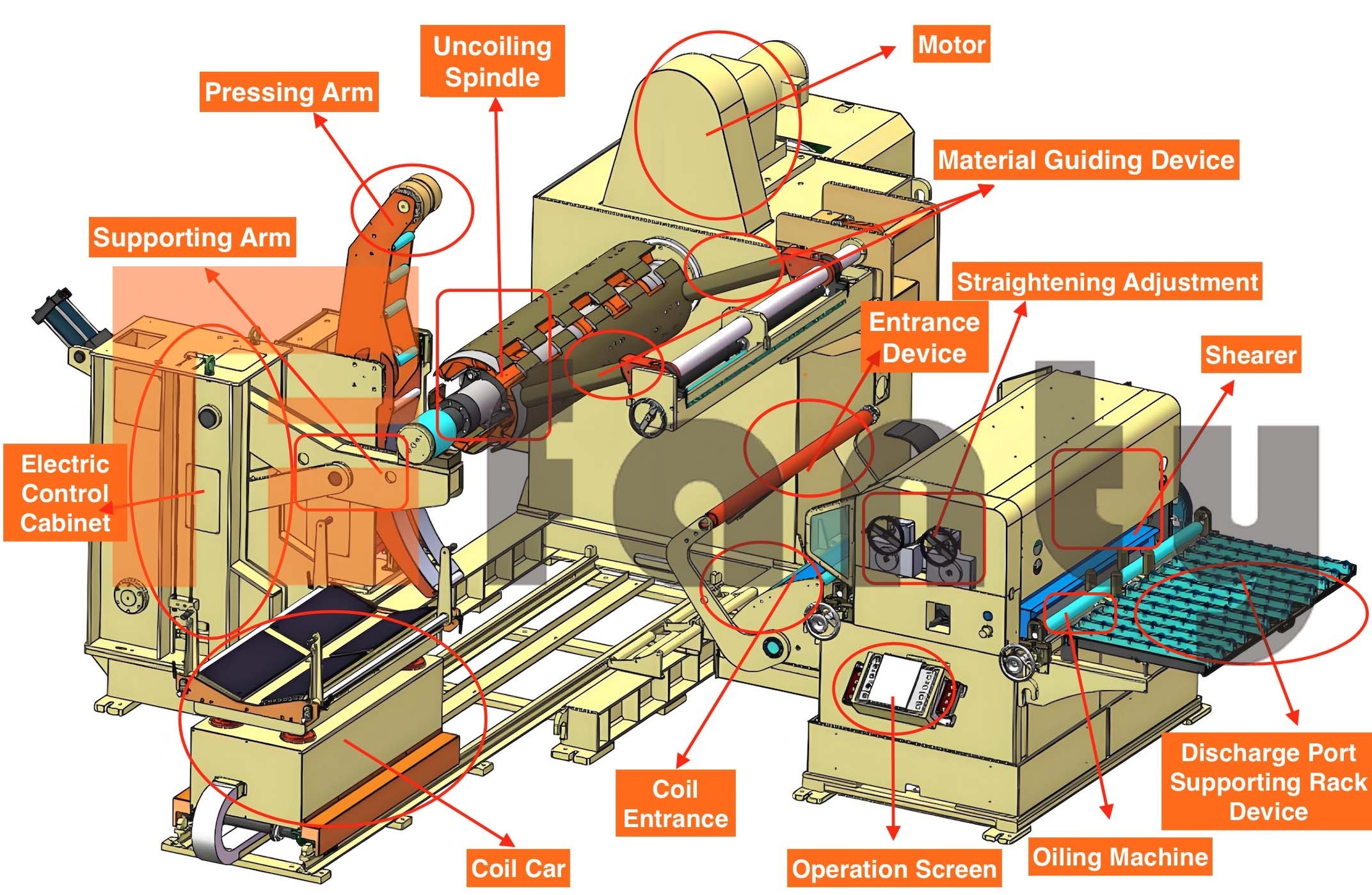
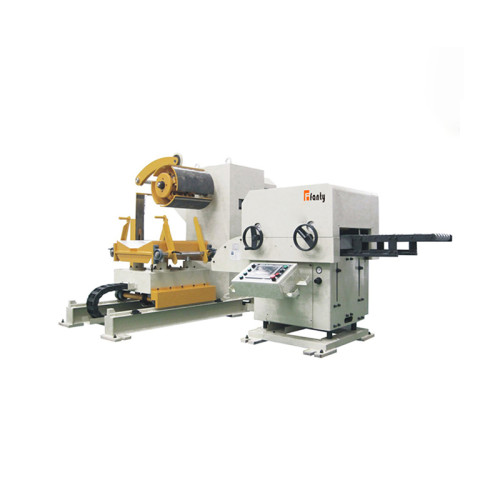
Detailed structurer of nc straightener feeder
Setting Penetration Step by Step
- Step 1 — Back everything off. Open all rolls until the strip passes freely. Record the zero position on each adjusting screw; you will want it again.
- Step 2 — Set the exit bank first. Bring the last lower roll up to light contact with the strip. The exit setting anchors the whole gradient.
- Step 3 — Work backwards through the stack. Each roll going upstream gets progressively more penetration. The first roll takes the most.
- Step 4 — Cut and inspect a 1 m sample. Lay it on a surface plate or a granite table and measure the gap under the ends and the middle. Convert to millimetres per metre.
- Step 5 — Adjust the entry roll only. Increase entry penetration in 0.1 mm steps and re-test. Do not touch the exit bank once it is set.
- Step 6 — Record the numbers in the recipe. The correct setting for a material is a data point, not a memory. Store it so the next setup starts from the right place.
Penetration and Roll Life
Rolls are a consumable, and penetration is the main variable that decides how quickly they wear out. Contact pressure rises faster than penetration depth, so the last 0.3 mm of extra penetration costs disproportionately more roll life than the first 1.0 mm.
On a five-roll cassette running 1.5 mm CRS two shifts a day, a shop setting 1.2 mm entry penetration might see roll regrinding every 18 months. The same shop pushing to 2.2 mm to chase a marginal flatness gain may need to regrind at 9 months. The flatness improvement between those two settings, from our measurements above, is negative — the tighter setting is actually worse. Paying double for a worse result is the clearest argument there is for setting penetration by measurement.
FANTY has supplied these machines into more than 60 countries, and the pattern that recurs across all of them is that shops which record penetration settings per material get better flatness and longer roll life than shops which adjust by feel. It is not a machine difference. It is a record-keeping difference, and it costs nothing to fix.
Which Curvature Penetration Can Fix
Not every flatness defect responds to penetration depth, and knowing which is which saves hours of pointless adjustment.
Longitudinal bow is curvature along the length of the strip, visible when a sample is laid on a flat surface. This is what penetration is designed to remove, and the entry-to-exit gradient is the lever. If increasing entry penetration improves the sample, you are working on the right defect.
Crossbow is curvature across the width, so the strip sits like a shallow trough or arch. It comes from uneven penetration across the roll face, not from depth. Check that the roll banks are parallel to each other and square to the strip path before you change any depth setting. Adding penetration to fix crossbow makes the bow worse as well.
Edge wave and centre buckle are flatness defects in the plane of the strip, caused by uneven elongation across the width. A straightener can reduce them, but only marginally, because the material has already been stretched unevenly at the mill. If you are chasing a wavy edge that survives a correctly set straightener, the answer usually lies with your coil supplier rather than with your machine.
Penetration Questions From Setup Engineers
Can I set penetration without a surface plate?
You can get close. Stand a 1 m sample on edge on a flat machine table and look along it against a straight edge. It is less precise than a granite plate, but it will catch the 3–4 mm per metre errors that matter most.
Does more penetration help with high-strength steel?
Up to a point. HSLA needs deeper penetration to reach the plastic zone, but it also work hardens faster, so the useful window is narrower than for mild steel. Expect to hit the flatness minimum sooner and then back off.
Why does the strip curve sideways instead of bowing up and down?
Sideways curvature is crossbow or camber, and it comes from uneven penetration across the width rather than from depth. Check the parallelism of the roll banks before adjusting depth.
How many rolls do I need for a given penetration?
Roll count sets how many bending cycles you get, not how deep each one goes. A five-roll stack at correct penetration beats a nine-roll stack at the wrong gradient. Fix the gradient first, then consider whether you need more rolls.
Want the Right Penetration for Your Material?
Send us your material grade, thickness, width and target flatness. Our engineers will return starting penetration values for each roll in the stack, plus the sample test that confirms them.
Request Straightener Setup Values