How Much Back Tension Does an NC Straightener Feeder Need?
Back tension is the one setting on a coil line that is almost never calculated. It is set by feel, then left alone for years.
Get it right and the strip enters the straightener flat, the loop stays stable and the feed holds tolerance. Get it wrong in either direction and you buy scrap, slip or surface marks.
This is a worked calculation for the back tension on an NC straightener feeder, plus the point where more tension stops buying anything.

Two Numbers Decide Back Tension Up Front
Strip section and yield strength set the target. Machine size, motor power and press tonnage do not enter the calculation at all.
Strip section. Width times thickness gives the area the tension acts on. A 300 mm by 1.5 mm strip has a section of 450 mm².
Yield strength. Tension is expressed as a percentage of yield, so the material matters as much as the size. SPCC runs near 280 MPa, HSLA 340 near 340 MPa, SUS304 well above 200 MPa in the annealed condition.
The working range. Most coil lines run best between 2 and 6 percent of yield.
Below 2 percent the strip goes slack and the loop wanders; above 6 percent it starts to mark and the payoff works harder than it needs to.
That is the whole framework. Everything else is arithmetic on those two numbers, and the arithmetic takes about five minutes.
Why Payoff Drag Is Not the Same as Back Tension
Operators talk about drag and engineers talk about tension, and the two are related by the coil radius. That relationship is where most of the confusion lives.
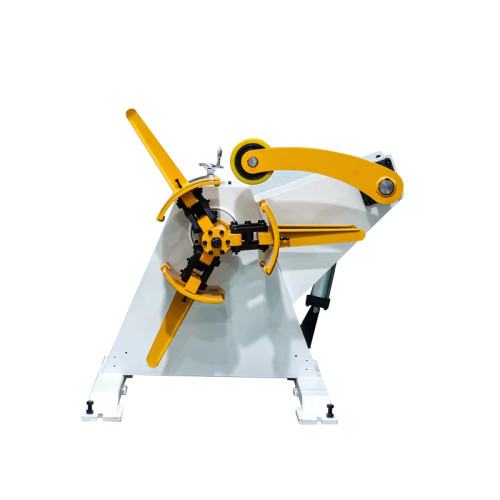
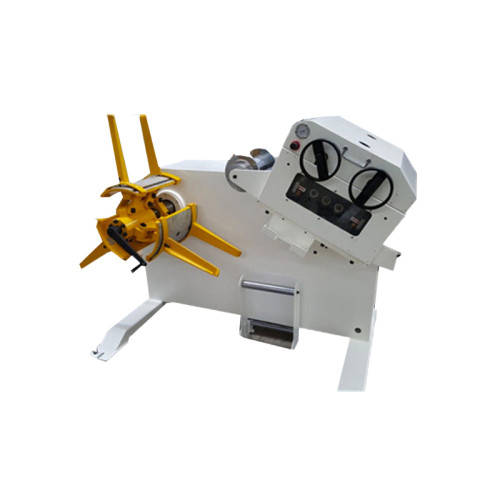
Drag is a torque. It is what the brake or the payoff motor applies at the mandrel, measured in newton-metres.
Tension is a force per unit area. It is what the strip actually feels as it is pulled off the coil, measured in megapascals or as a percentage of yield.
The coil radius converts one into the other. Torque equals tension force times radius, so a fixed torque produces less tension as the coil empties.
This is the reason a line can be perfectly set on a full 5-tonne coil and visibly slack by the time it reaches the core. Nothing changed except the radius.
A Worked Example on 1.5 mm Mild Steel
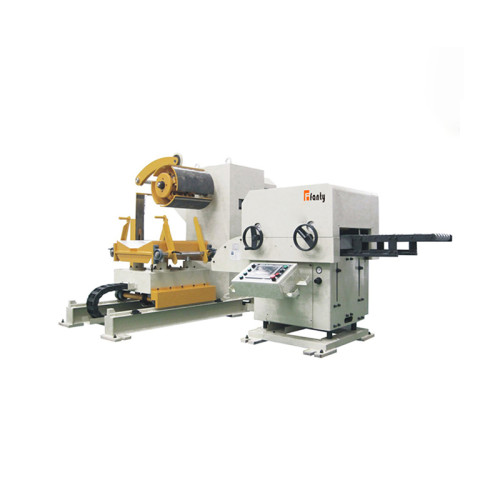
Take 300 mm wide, 1.5 mm SPCC at 280 MPa yield, running into a three-in-one machine at 45 m/min.
Section area. 300 mm times 1.5 mm equals 450 mm².
Yield force. 280 MPa across 450 mm² is 126 kN. That is the force at which the strip would begin to yield if pulled.
Target at 4 percent. Four percent of 126 kN is about 5.0 kN of strip tension, which is the figure to aim for at the payoff.
Convert to brake torque. At a full coil radius of 625 mm, 5.0 kN needs roughly 3,130 N·m at the mandrel. At a 350 mm core radius the same tension needs only 1,750 N·m.
Convert to strip stress. 5.0 kN over 450 mm² is 11 MPa, or 4 percent of yield. That is comfortably inside the working range and well below any level that would mark the strip.
| Strip Section | Target Back Tension | Torque at Full Coil | Where It Costs You |
|---|---|---|---|
| 150 mm × 1.5 mm SPCC | 2.5 kN | 1,560 N·m | Low tension suits thin narrow strip, but a fixed drag over-brakes the core badly |
| 300 mm × 1.5 mm SPCC | 5.0 kN | 3,130 N·m | Needs a brake with real torque range; a small brake will sit at its limit all shift |
| 300 mm × 3.0 mm SPCC | 10.0 kN | 6,250 N·m | Torque demand doubles with thickness, which is where drive sizing stops being trivial |
| 300 mm × 1.5 mm HSLA 340 | 6.1 kN | 3,810 N·m | Higher yield raises tension at the same percentage, so a setting tuned on mild steel over-brakes |
| 300 mm × 1.5 mm SUS304 | 5.0–8.0 kN | 3,130–5,000 N·m | Wide band because annealed stainless varies by mill; marking risk rises with the top of the range |
Read the last row as a warning. On stainless the same nominal grade can arrive with meaningfully different properties, so a percentage-of-yield target needs a strip test rather than a nameplate value.
How Sensitive the Result Is to Strip Width
Tension scales linearly with width and with thickness, so a change in either moves the target in a straight line. There is no threshold and no knee.
Width. Doubling width from 150 mm to 300 mm doubles the target tension at the same percentage of yield. Nothing else changes.
Thickness. Doubling thickness from 1.5 mm to 3.0 mm also doubles the target, and doubles the section the tension acts on.
Both together. A 300 mm by 3.0 mm strip needs four times the tension of a 150 mm by 1.5 mm strip. That is the range a single line is usually expected to cover.
The practical consequence is that a brake sized for the narrowest job will be at its limit on the widest, and a brake sized for the widest will be over-braked on the narrowest unless the control follows.

The Ceiling on Back Tension
More tension is not more control. Above a point it starts costing accuracy and surface quality at the same time.
Marking. Tension increases contact pressure at every roll in the machine. On coated, pre-painted or polished stock, the first visible cost of excess tension is a mark, not a measurement error.
Roll and bearing load. Doubling tension roughly doubles the load on the payoff mandrel, the brake and the first set of rolls. That shortens bearing life on machines sized near their limit.
Strip stretch. Above roughly 8 percent of yield, elastic stretch in the loop becomes measurable and the feed length reference shifts with tension. The controller then chases a target that moves.
Slip at the payoff. If drag exceeds what the strip can pull without slipping on the coil, the strip skates on the wraps and the payoff becomes unpredictable in a way no setting fixes.
So the useful ceiling is not a machine rating. It is the lowest tension that keeps the loop stable, plus a margin for coil variation, and nothing more.
What Happens Below the Minimum
Under-tensioning is quieter than over-tensioning and causes more argument, because the symptoms look like something else.
The loop wanders. With too little tension the loop height drifts, and the loop controller spends its time correcting instead of holding position. Feed length varies with the correction.
The coil loosens on the mandrel. Wraps that are not held apart can nest, and a nested coil pays out with a jerk each time a wrap releases.
The strip arrives with coil set intact. Without tension the strip enters the straightener with its built-in curvature still present, and the rolls then have to remove it as well as flatten the material.
- Under-tension looks like a loop control fault. Check the payoff setting before the loop parameters.
- Nesting on the mandrel is a tension symptom, not a coil quality symptom, in most cases.
- If flatness improves when tension is raised slightly, the machine was being asked to remove coil set as well as flatten.
Measuring It on the Line Rather Than Calculating It
The calculation gives a target. The line gives the truth, and the two are usually within a few percent of each other on a well-set machine.
Load-cell payoff. The cleanest method. A load cell in the payoff arm reads tension directly, and the target becomes a number on the screen rather than a pressure setting.
Motor current on a driven payoff. Current is proportional to torque, so a current reading at a known radius gives tension. It needs the radius, which means it drifts as the coil empties unless the control tracks it.
Strip elongation. Measure a marked length before and after the payoff. Elastic strain divided by modulus gives stress, and stress times section gives tension. Crude, but it needs no instrumentation.
Sag measurement. On a free loop, sag over a known span is a usable proxy. It is the method most shops already use, and it is accurate enough for setting a starting point.
Whichever method you use, record the coil radius with the reading. A tension figure without a radius is not a measurement, it is a coincidence.
Acceptance Thresholds to Write Into the Setup Sheet
Numbers on a sheet are what keep a setting stable across shifts. Four entries are enough for back tension.
Target tension as a percentage of yield. For SPCC and similar mild steel, 3 to 5 percent covers most jobs. Write the percentage, not the pressure.
Acceptable band. Plus or minus 1 percent of yield. Outside that band, either the loop or the surface quality will show it within a coil.
Feed length tolerance. The line's overall acceptance figure. On a well-set machine, ±0.05 mm at 200 SPM is achievable and is the number to hold the setting against.
Coil radius at which the setting changes. If the payoff runs a fixed drag, record the radius where the operator must step the pressure down. On a 5-tonne coil that is usually near half.
FANTY has supplied three-in-one machines into more than 60 countries, and the units that hold tolerance across a full coil are consistently the ones where tension was calculated once and then written down.
Machine configurations are listed on the 3-in-1 machine range page.
What back tension should 1.5 mm strip run, 3 or 8 percent of yield?
Three percent for a first setting on mild steel, moving up to 5 percent if the loop is unstable. Eight percent is above the practical ceiling and will start to mark coated stock.
Does doubling strip width from 150 to 300 mm double back tension?
Yes, at the same percentage of yield. The target rises from about 2.5 kN to 5.0 kN, and the torque needed at the mandrel rises with it.
At what coil diameter ratio does a fixed drag go wrong, 1.2 or 1.8?
It starts to matter above about 1.2 to 1 and becomes obvious near 1.8 to 1, which is typical for a 5-tonne coil. Below 1.2 to 1, a fixed setting is usually good enough.
Can back tension remove coil set?
Partly, and that is a useful side effect rather than its purpose. Tension reduces the curvature arriving at the rolls but cannot remove a set that needs bending past yield.
How much does 1 kN of excess tension cost in marking?
On 300 mm by 1.5 mm mild steel, 1 kN is about 2 percent of yield, which is usually invisible. On polished stainless it can be enough to leave a visible rub line.
Where to go next
Back tension is one input to the flatness result and one line in the feed accuracy budget. Roll geometry, gap and penetration sit alongside it, and the full framework is set out in the same cluster.