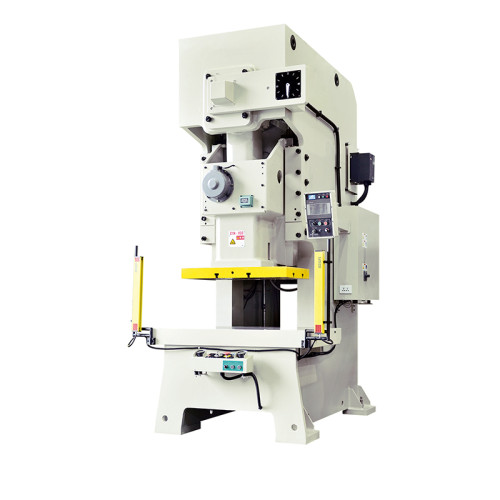
How Does Coil Weight Change Your Changeover Count?
Two plants run the same 400-tonne press at the same 120 strokes a minute. One gets 84% uptime out of a shift. The other gets 56%, and the only difference is the weight of the coil on the mandrel.
That gap is a coil changeover problem before it is a steel-buying problem.
Coil weight looks like a purchasing detail. It is really a throughput decision, because every coil change stops the press for the same eighteen minutes no matter how much strip is left on the spool.
The arithmetic below takes four inputs and produces the number that matters: how much of the shift you spend changing coils instead of making parts.
Four Numbers Decide the Answer
You need the strip section, the coil weight, the feed length per stroke, and the minutes a coil change actually takes on your floor. Everything else is decoration.
Strip section gives you mass per metre. For carbon steel at 7.85 g/cm³, a 300 mm wide, 1.2 mm thick strip weighs 2.83 kg per running metre. Aluminium at 2.70 g/cm³ is roughly a third of that.
Feed length per stroke is the part pitch plus the carrier or scrap bridge. A 300 mm part with a 20 mm bridge consumes 320 mm of strip every stroke, whether or not the die is making a good part.
Changeover minutes are the figure people guess and then argue about. Time it with a stopwatch for ten changes before you trust any number in a business case.
Parts Per Coil, Worked Both Ways
Take a 5-tonne coil of SPCC at 300 mm by 1.2 mm. Divide 5,000 kg by 2.83 kg/m and you get 1,767 running metres.
Divide that by the 320 mm pitch and the coil yields 5,522 strokes. At one part per stroke, that is 5,522 parts, less the ramp-up and ramp-down pieces at each end.
Double the coil to 10 tonnes and you get 3,534 metres and 11,044 strokes. The press time per coil doubles, and the number of interruptions per shift roughly halves.
The physical constraint. Coil weight is an outside-diameter problem. A 300 mm wide coil wound to 1,800 mm OD on a 508 mm bore weighs about 5.5 tonnes. Reaching 10 tonnes at the same width needs a 2,400 mm OD.
That larger coil does not fit every cradle, every coil car and every mandrel. Check the machine envelope before you negotiate a heavier coil with the mill.
What a Changeover Really Costs in Minutes
Eighteen minutes is a fair figure for a coil change with a coil car, a threading cycle and a first-part check. Without a car, add six to ten minutes for the crane and the chain.
Break the eighteen down and the number stops looking like a single event. Positioning and clamping takes four minutes, threading and closing the loop takes five, and the first-part measurement takes the rest.
The first-part check is the part people try to skip. It is also the only step that catches a strip that was threaded upside down or a feed length that shifted during the change.
At 120 SPM, a 5-tonne coil runs for 46 minutes. Add 18 minutes of changeover and the press is available 72% of the time. On a 10-tonne coil the same press runs 92 minutes and reaches 84%.
| Step in the change | Minutes on a good day | Where it costs you |
|---|---|---|
| Coil car in, clamp, mandrel expand | 4 | Manual loading doubles it and adds a crane lift |
| Thread, close the loop, set tension | 5 | A powered threading table removes three of these |
| First-part measurement | 4 | Skipping it moves the cost to the scrap bin |
| Restart, ramp to speed | 3 | Long ramps eat the gain from a heavier coil |
| Documentation and traceability | 2 | Paperwork done afterwards costs double |
That 12-point gap is not a rounding error. On a two-shift operation it is close to 1,000 press-hours a year on a single machine.
| Coil weight | Parts per coil | Run time at 120 SPM | Coils per 8 h shift | Where it costs you |
|---|---|---|---|---|
| 2.5 t | 2,760 | 23 min | 12 | 44% of the shift lost to coil changes and first-part checks |
| 5 t | 5,522 | 46 min | 8 | 28% lost; the common compromise for mixed work |
| 8 t | 8,835 | 74 min | 5 | 20% lost; needs a 2,150 mm OD and a 10-tonne car |
| 10 t | 11,044 | 92 min | 4 | 16% lost; crane, floor space and working capital all rise |
The table assumes one die running all shift. Change the die twice and the arithmetic changes completely, because a die change costs 25 to 40 minutes and a heavy coil locks you into a long run of one part.
The Handling Chain Behind a Heavier Coil
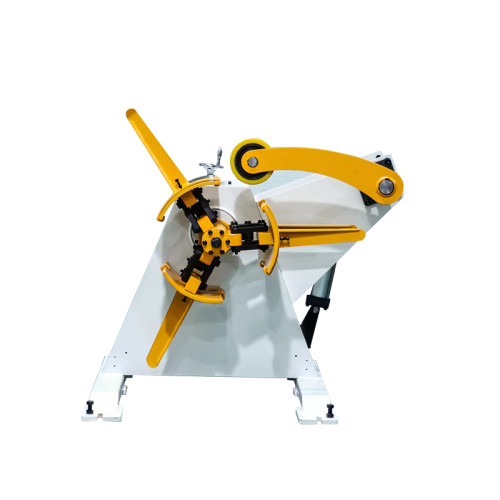
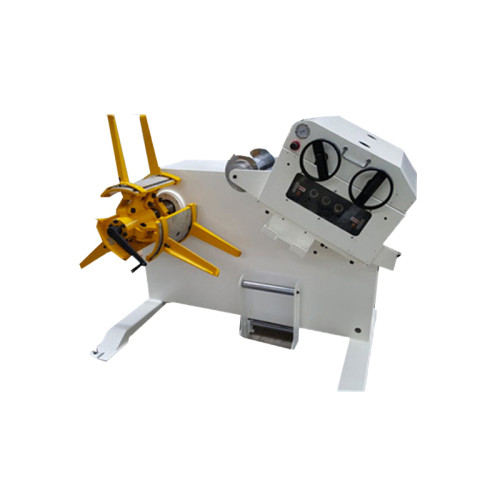
A 10-tonne coil changes four things around the press, not one. The crane, the coil car, the mandrel and the floor all have to carry the new load, and any one of them can veto the plan.
The crane needs a rating of 1.25 times the lift at the working radius. A 15-tonne crane at 10 m radius is often rated at 8 tonnes, so the nameplate tells you very little.
The mandrel needs enough contact length for the wider coil and enough grip to hold 10 tonnes without slipping. A 300 mm coil on a 1,300 mm mandrel is a cantilever problem, not just a weight problem.
Floor space grows with coil diameter. Storing 2,400 mm coils in a rack needs a 2.8 m aisle for the car, and most bays were laid out for 1,800 mm coils.
Brake torque has to grow with coil diameter as well. The same strip tension that a 1,800 mm coil needs at 40% of its capacity becomes a much larger torque arm at 2,400 mm.

Where the Arithmetic Stops Being Useful
The calculation assumes a single die and steady demand. Neither holds in a job shop, and a heavy coil in a high-mix plant is a liability rather than an asset.
If monthly demand for a part is 3,000 pieces and a 10-tonne coil yields 11,000, you have bought three months of finished inventory. That is working capital sitting on the floor and a quality risk with a long tail.
A defect found 9,000 parts into a coil run means 9,000 suspect parts to sort. On a 2.5-tonne coil the same defect surfaces after 2,000.
Coil-end scrap barely matters. A 1.5 m tail at 300 mm by 1.2 mm weighs about 4 kg. Halving the number of coil ends saves a few kilograms a shift, which is noise next to 12 points of availability.
The arithmetic also ignores strip quality. Heavier coils mean longer runs from one heat, and a mill defect at the inner wrap will not appear until hour six of the run.
Break-Even Between 5 and 10 Tonnes
Moving from 5 to 10 tonnes buys 12 points of availability on a single-die line. Paying for it means a larger car, a stronger crane and a bigger coil order, and those costs are fixed.
A coil car rated for 10 tonnes costs roughly 40% more than a 5-tonne unit. A crane upgrade in an existing bay can exceed the car, because it touches the building structure.
If your mix runs one die for a full shift, the upgrade pays back inside two years on labour and press hours alone. If the die changes twice a shift, it may never pay back.
The decision rule is simple: divide the minutes saved per shift by the minutes a die change costs. A ratio below 3:1 means the heavier coil will not earn its keep.
Checks Before You Buy Bigger Coils
Start with the changeover itself. Cutting eighteen minutes to twelve buys 8 points of availability on a 5-tonne coil without spending anything on steel or handling equipment.
Then look at the threading cycle. A powered threading table and a strip guide that stays set between coils removes four of those minutes on its own.
Only then negotiate coil weight, and specify it as an OD and a weight range rather than a single number. Mills hold ±10% on weight, and a 10-tonne order that arrives at 8.8 tonnes quietly changes your shift plan.
Ask for the coil weight tolerance in writing, along with the maximum OD and the bore. Those three numbers decide whether the coil fits the machine you already have.
- Crane rating at the working radius, not on the nameplate, with the sling angle you will actually use
- Coil car capacity and saddle width for a 2,400 mm outside diameter, measured with a loaded coil
- Mandrel contact length and grip, because a 300 mm coil on a 1,300 mm mandrel is a cantilever problem
- Aisle width for the car with a full coil on the saddle, plus the turning envelope at the rack
- Coil weight tolerance in the mill contract, because a 10-tonne order that arrives at 8.8 changes the shift plan
The specification trade-offs behind each of those items, including what a heavier coil really adds to the landed cost, are set out in the coil line guide library.
How many parts does a 5-tonne coil yield at 1.2 mm by 300 mm?
About 5,520 at a 320 mm pitch. The strip weighs 2.83 kg per metre, so 5 tonnes gives 1,767 metres, and 1,767 divided by 0.32 gives 5,522 strokes.
At what press speed does an 18-minute changeover cost 25% of the shift?
Around 100 SPM on a 5-tonne coil. At that speed the coil runs for 55 minutes, so the change eats a quarter of the cycle and availability settles near 75%.
Does a 10-tonne coil need a bigger crane?
Yes. Plan for a 12.5-tonne rating at the working radius, and check the hook height for a 2,400 mm coil. Most 10-tonne lifts in older bays fail on radius rather than on capacity.
How much coil-end scrap does a heavier coil actually save?
About 4 kg per coil end at 300 mm by 1.2 mm. Halving the coil count saves roughly 17 kg a shift, which is under 1% of the material consumed.
Is 12 points of availability worth a 40% higher coil car price?
On a single-die line at 120 SPM, yes — it returns roughly 190 extra press hours a year. On a line that changes dies twice a shift, the same spend usually fails a two-year payback test.
Where to go next
Coil weight is one line in a specification that has about fifteen. The cluster pillar maps each line to what it costs and what it buys, so you can see where a heavier coil sits against the alternatives.
See what each spec line costs