Can an NC Straightener Feeder Run Mixed Coil IDs?
I spent last Tuesday in a customer's coil bay watching a 1,500 kg coil bounce on a mandrel that was never going to grip it. The coil had a 610 mm inside diameter. The decoiler had been sized, quoted and delivered for 508 mm. Nobody lied to anybody — the buyer simply ordered the machine against the coil they had last year, and the mill started shipping to a different standard this year.
That conversation happens more often than it should, and it is entirely avoidable. This article answers the question directly: yes, an NC Straightener Feeder can run mixed coil inside diameters, but only within the expansion range of the mandrel you actually bought. Here is how that range works, what happens when you exceed it, and how to plan for mixed IDs before the machine is on the floor. If you are still specifying the line, our decoiler and feeder range lists expansion ranges for every mandrel option.
Coil ID Is the First Number a Decoiler Sees
Strip mills deliver coil on a small number of standard inside diameters. In practice you will meet three.
- 508 mm (20 in) — the most common ID for steel and stainless coil worldwide.
- 610 mm (24 in) — standard for many aluminium and coated products, and common in North America.
- 400 mm and 450 mm — lighter gauges, narrow strip and some imported coil.
The coil also has an ID tolerance, and it is not small. A mill will typically hold ±2 mm on a nominal 508 mm, and a coil that has been stored badly or rewound can be 3 to 5 mm out of round. So a decoiler designed for a nominal 508 mm has to cope with anything from about 500 mm to 516 mm, plus ovality.
That is the number that matters when you are reading a specification sheet: not the nominal ID, but the full expansion range.
One more detail catches people out. The inside diameter on the mill certificate describes the bore at the point where the strip was wound, and that bore tightens as the coil is consumed. A coil stored under its own weight for six months will show a slightly smaller bore at the bottom of the stack than at the top. If your expansion range only just covers the nominal figure, you will meet the exception on the first cold morning of the winter.
How Mandrel Expansion Range Really Works
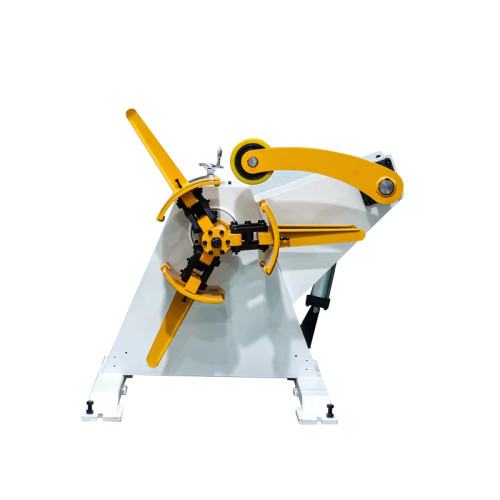
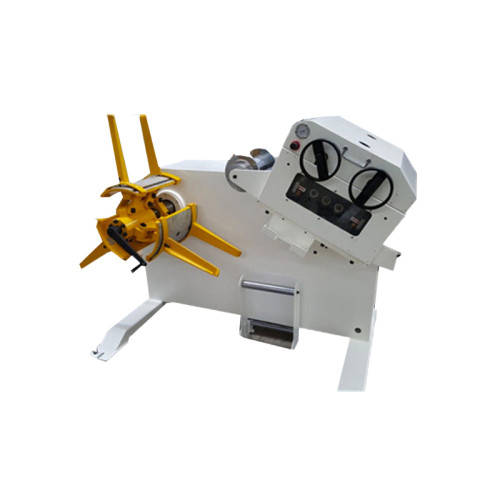
A mandrel is a set of segments that expand outward against the coil bore. The expansion is driven hydraulically or pneumatically, and the range is bounded at both ends.
The lower bound is the collapsed diameter. The mandrel must retract far enough to slide into the smallest coil you intend to load. If your collapsed diameter is 470 mm, you cannot load a 450 mm coil, no matter how much pressure you apply.
The upper bound is set by the expanded diameter at working pressure, and it is not the same as the mechanical limit. A mandrel that reaches 530 mm at 120 bar may technically reach 540 mm at 150 bar, but the segment contact area drops and the pressure per square millimetre on the coil bore rises. You get a grip that marks the bore and still slips under load.
Three-point contact is what you want. When a mandrel grips on three segments at roughly 120 degree spacing, the coil is centred and driven. When it grips on one segment, the coil orbits, the strip tension pulses, and the NC servo feeder downstream sees a tension variation it cannot compensate for.
Segment, Wedge and Adapter Sleeve Mandrels Compared
Three designs cover nearly every mixed-ID situation. Each trades range against grip quality and changeover time.
| Mandrel type | Typical expansion range | Grip quality | Changeover |
|---|---|---|---|
| Hydraulic segment | 480–530 mm | Excellent, full-face contact | None, adjusts in seconds |
| Wedge / mechanical | 470–560 mm | Good, slight taper contact | None, but slower to set |
| Adapter sleeve | Any, by sleeve size | Very good if sleeve is correct | 2–5 minutes per change |
| Fixed mandrel | Nominal only, ±3 mm | Excellent within range | Not applicable |
An adapter sleeve is the standard answer when the ID spread is wider than one mandrel can cover — for example, a plant running both 508 mm and 610 mm coil on the same line. The sleeve takes up the difference, and you accept a few minutes of changeover.

What a Mismatch Actually Damages
Running a coil that is too large for the mandrel is the dangerous case, and the damage shows up in a predictable order.
First, bore marking. Segment corners press into the coil bore and leave indents. On the first few wraps, those indents transfer to the strip surface and appear as periodic marks on finished parts. On exposed automotive panels this is a reject.
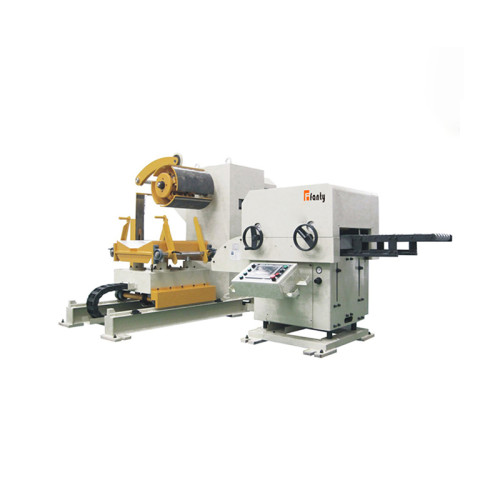
Second, slip under tension. With reduced contact area, the mandrel loses friction grip. The coil slips, strip tension drops, and the loop between the decoiler and the straightener starts to surge. The 3-in-1 decoiler straightener feeder then fights a moving target, and feed length repeatability degrades before anything visible goes wrong.
Third, structural damage. Continued slip under load hammers the segment pivots and the expansion linkage. This is the expensive stage. A worn linkage turns a one-hour mandrel service into a multi-day parts order.
Running a coil that is too small is less dramatic. The mandrel simply cannot expand enough to touch the bore, and the coil never gets driven at all. The symptom is obvious immediately, which is why it is rarely a long-term problem.
There is a fourth failure mode worth naming, because it is the one that costs the most in practice. A coil that is only slightly out of range will run. It grips on three segments, it drives under light load, and it slips only when the strip tension peaks — which happens during the first acceleration after a coil change. That produces an intermittent feed error that shows up on one part in fifty, and it takes weeks to trace because everything looks correct at the moment anyone inspects it.
The measurement that settles it is mandrel slip, not mandrel pressure. Mark the coil bore and the mandrel segment with a paint line, run a full coil, and check whether the marks still line up. A drift of a few millimetres per coil tells you the grip is marginal, and marginal grip always fails eventually under production load.
Running Mixed IDs on One NC Straightener Feeder
Mixed IDs on a single line are workable. Four practices make the difference.
- Buy the widest expansion range you can justify. A 480–560 mm hydraulic segment mandrel costs little more than a fixed 508 mm unit and removes the problem permanently.
- Measure the coil, not the label. Check bore diameter with a tape on the first coil of each new shipment. A 4 mm surprise is common.
- Group coil by ID in the storage bay. Sequence jobs so changeover happens once per shift rather than once per coil.
- Recheck mandrel pressure after every changeover. Segments that have expanded and collapsed a thousand times need a pressure check, not an assumption.
FANTY builds on a 45,000 m² site with a workforce of 370, and a good part of that floor is dedicated to coil handling equipment. The practical lesson from that production experience is simple: mandrel range is a specification line item that gets overlooked at quotation stage and dominates the conversation two years later.
Questions From the Coil Storage Bay
Can one mandrel cover both 508 mm and 610 mm coil?
No. The spread is 102 mm, and no single hydraulic mandrel covers that with reliable contact. Use an adapter sleeve, or specify a two-range mandrel if the volume justifies the cost.
How much coil ID variation is acceptable without an adapter?
Roughly ±15 mm around the nominal, provided the mandrel reaches full contact pressure across that band. Beyond that you are relying on segment corners rather than faces, and bore marking follows.
Does an out-of-round coil cause the same damage as a wrong ID?
The mechanism is similar but milder. An oval coil grips on two segments instead of three, so it orbits slightly. Tension pulses and feed accuracy suffers, but segment wear is slower than with a genuine size mismatch.
What mandrel pressure should I set?
Follow the machine builder's figure, typically 100 to 130 bar, and verify by checking for slip at full coil weight rather than by reading the gauge alone. A gauge reading at no load tells you very little.
Can I run a smaller-ID coil with a sleeve that makes it bigger?
Sleeves normally increase the effective bore to fit a larger mandrel. Reducing a bore is not practical, so a coil smaller than your collapsed diameter is simply out of range.
Not Sure Your Coil IDs Match the Mandrel?
Send us your coil bore range, weight and strip dimensions. We will confirm whether one mandrel covers it or whether you need an adapter sleeve, and quote both options.
Check Your Coil ID Range