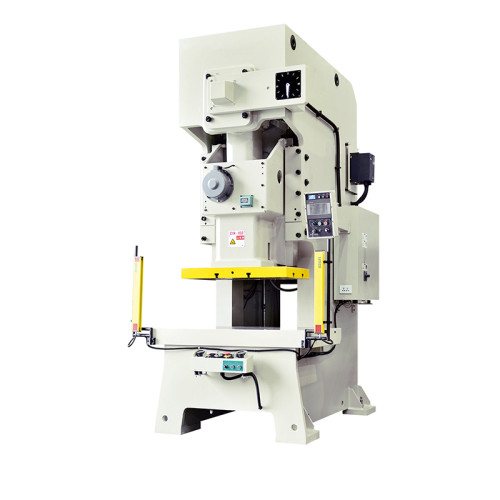
Can an NC Servo Feeder Keep Up With a 400 SPM Press?
A 400 SPM press running a progressive die gives you 150 milliseconds per stroke, and roughly a third of that is available for feeding. That is the number that decides whether an NC servo feeder can sit in front of it or whether you need to rethink the line. Feed length, strip mass, roll pressure and acceleration profile all have to fit inside a window that leaves no room for slack — so the honest answer depends far less on the press rating than on the material you are running.
What 400 SPM demands of the feed system
High-speed stamping is a timing problem before it is a force problem. At 400 strokes per minute the crankshaft completes a revolution in 150 ms, and the die is closed and open in that same window. The feeder must complete its full motion — accelerate, travel, decelerate, settle, and be stationary while the pilot pins engage — inside the fraction of the cycle the press maker allocates to feeding.
Typical allocations run 25 to 40 percent of the cycle. At 400 SPM that is 37 to 60 ms of usable feed time. Inside that window the strip must travel the feed pitch, stop without oscillation, and hold position while the die closes. Missing the settle time does not produce a visible fault on the first stroke; it produces a progressive drift in hole position that shows up as scrap a thousand parts later.
The machines that hold this reliably are built by teams who have tested them at speed rather than calculated them on paper. FANTY's 80+ R&D staff run exactly this kind of verification, and the machines in the field come from more than 200 production lines' worth of accumulated cycle data.
Do the feed-time arithmetic first
Before comparing any machine, work out what your own application needs. The calculation is straightforward:
- Cycle time = 60,000 / SPM, in milliseconds. At 400 SPM that is 150 ms.
- Usable feed window = cycle time × the share your press allows, typically 0.30. That gives 45 ms.
- Subtract settle time — allow 8 to 12 ms for the strip to stop cleanly. You now have roughly 35 ms of actual travel.
- Divide pitch by travel time to get the required average velocity. A 25 mm pitch in 35 ms needs 0.71 m/s average, with peaks well above that.
That peak velocity is the figure that matters. A servo feed does not move at constant speed; it accelerates, runs, and decelerates. For a 25 mm pitch completed in 35 ms, peak strip velocity commonly reaches 1.3 to 1.6 m/s. Any feeder quoted for your line must be able to reach that with the strip mass attached and still settle inside the window.
Torque, inertia and the strip you are pulling
A servo feeder's ability to hit peak velocity is limited by torque and by the inertia it has to accelerate. Two identical machines behave differently on 0.5 mm aluminium and on 3 mm cold-rolled steel, because the moving mass changes by a factor of more than ten.
Strip mass is easy to underestimate. A 300 mm wide, 2 mm thick steel strip weighs about 4.7 kg per metre. On a 25 mm pitch the feeder moves 4.7 kg of strip plus the moving frame of the feed rolls in 35 ms, dozens of times per second. The motor has to accelerate and decelerate that mass with enough authority that the strip does not overshoot the pitch.
This is why feed accuracy specifications must be read with the test conditions attached. A machine quoted at ±0.03 mm is likely being measured on light gauge at moderate speed. The same machine on heavy gauge at 400 SPM may drift to ±0.08 mm or worse. Ask for the accuracy figure at your thickness and your pitch — a supplier who can supply that number has actually tested it.
| Feeder type | Realistic top speed | Best fit | Limitation at 400 SPM |
|---|---|---|---|
| Pneumatic roll feed | 150-200 SPM | Simple, low-pitch work | Cannot settle fast enough; pitch drifts |
| Mechanical cam feed | 250-400 SPM | Fixed pitch, long runs | Pitch change needs a cam change; inflexible |
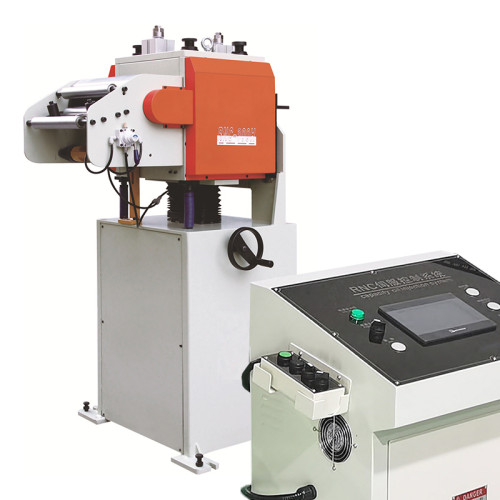
| NC servo feeder (standard) | 250-350 SPM | Mixed pitches, medium gauge | Torque-limited on heavy strip at short pitch |
| NC servo feeder (high-response) | 400-500 SPM | High-speed progressive dies | Needs low-inertia rolls and rigid mounting |
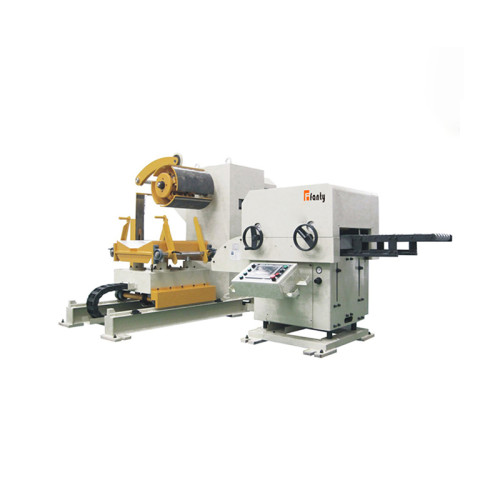
| Servo feeder with straightener | 300-400 SPM | Coil line, flatness-critical parts | Straightener adds mass; pass line must be rigid |
Roll pressure and surface marking at speed
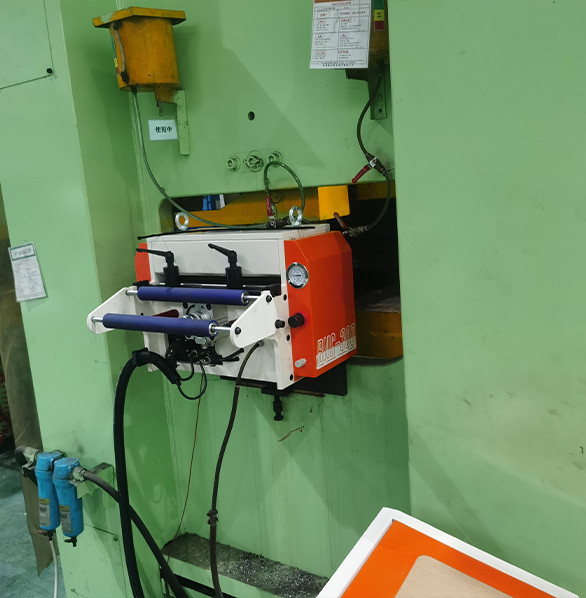
Every extra newton of roll pressure buys grip and costs you surface finish. At high speed the trade-off tightens because the strip is accelerating hard under the rolls, and slip shows up not as a slow drift but as an intermittent miss.
Two things help. First, roll surface hardness and finish: hardened, ground rolls with a controlled surface profile grip without marking, whereas soft rolls need more pressure to hold the same strip. Second, roll diameter relative to pitch: larger rolls last longer and mark less, but they add inertia that works against fast settling. High-response machines usually sit at a deliberate compromise — enough diameter for grip and life, low enough inertia to settle inside 10 ms.
On coated or pre-painted strip this becomes a quality issue rather than a maintenance one. Reducing pressure and instead increasing the number of grip points — more rolls, wider contact — is the usual fix, and it is worth confirming with the supplier that the machine can be configured that way.
What actually breaks at 400 SPM
In field service, the failures on high-speed lines cluster in predictable places. Feed roll bearings are the most common, because they see the reversing load of every acceleration cycle. Couplings between motor and roll shaft are second, particularly where a rigid coupling was used instead of one that tolerates slight misalignment. Encoder mounting is third — vibration works fasteners loose, and a drifting encoder reads as a feeding error that no amount of tuning will fix.
None of these are exotic. They are all addressed by specifying a machine built for the duty rather than a general-purpose unit pushed beyond its design point. If your press runs at 400 SPM for two shifts a day, the feeder is doing roughly 192,000 feed cycles per shift. That is the number to put in front of a supplier.
Matching the machine to the press, not the brochure
The practical test is a witnessed run. Ask the supplier to feed your material, at your pitch, at your target SPM, and to record position error over a run of at least 5,000 strokes. A machine that holds ±0.05 mm across 5,000 strokes at 400 SPM is a machine that will hold it in your plant. A machine that only holds it for the first 500 strokes has a thermal or settling problem that will surface after installation.
Also confirm the press interface. At 400 SPM the feeder and press must exchange signals within a few milliseconds, and a slow PLC scan or a relay-based interface will introduce a lag that no servo tuning can remove. Specify the interface type explicitly — high-speed digital I/O, not a general-purpose relay board.
One more mass consideration applies if you are specifying an NC Straightener Feeder rather than a standalone unit. The straightening roll stack sits in the same strip path, and on a combined machine the strip has to pass through both assemblies on every index. That is a benefit for flatness and a cost for response time, so the SPM figure you accept should be quoted for the combined configuration, not for the feeder alone.
What is the highest SPM a standard NC servo feeder can handle?
Most general-purpose units run comfortably to 300-350 SPM on light and medium gauge. Above that, torque and settling time become limiting, and you need a high-response machine with low-inertia feed rolls and a rigid mounting arrangement.
Does feed pitch length affect the maximum speed?
Significantly. A shorter pitch can be completed in less time, so the same machine runs faster on a 12 mm pitch than on a 40 mm pitch. Always quote the pitch when discussing speed — an SPM figure without a pitch is not a specification.
Can I increase line speed by reducing roll pressure?
You can, but only to the point where grip fails. Below the minimum pressure for your strip, the rolls slip during acceleration and the pitch becomes inconsistent. Slip at high speed is intermittent and hard to detect visually, so the failure usually shows up as unexplained scrap.
Is a servo feeder with an integrated straightener slower than a standalone feeder?
Usually slightly slower, because the straightener adds moving mass to the strip path. In practice the difference is small — typically 30 to 60 SPM — and it is often worth accepting for the flatness control a 3-in-1 decoiler straightener feeder provides.
What feed accuracy should I demand at 400 SPM?
For most progressive dies, ±0.05 mm over a 5,000-stroke run is a reasonable acceptance criterion. For fine blanking or tight-tolerance parts, tighten to ±0.03 mm and require the supplier to demonstrate it on your material rather than on test strip.
Running your press flat out and still losing position?
Tell us your pitch, strip thickness, material grade and target SPM. FANTY will confirm whether an NC servo feeder can hold your tolerance at speed — and if it cannot, we will say so.
Discuss Your Line SpeedFanty · NC Straightener Feeder
Pitch, Pass Line and Roll Pressure, Sorted Before You Order
Tell us your press stroke rate and feed length. Our engineers match servo feed power, straightener roll geometry and loop control to your actual cycle time.
Get a Free QuoteFANTY Machinery · 13 years on stamping automation · 2,000+ coil lines installed · engineers reply within 24 hours