Can a Coil Line Run Hot-Rolled Pickled Coil Cleanly?
An appliance bracket plant moved 60 percent of its volume from cold-rolled to hot-rolled pickled and oiled coil to take a 12 percent material saving.
The first coil ran on a Tuesday morning and produced 340 parts before the operator stopped the press.
Blank length had drifted 0.4 mm, the strip carried roll marks on the top face, and the die had started to burr.
What follows is the six weeks it took to make that switch work, including the two things the material certificate did not mention.
The Switch Started as a Material Saving
Cold-rolled coil for a 3.0 mm bracket was quoted at a premium the buyer could no longer defend. Hot-rolled pickled and oiled came in 12 percent lower per tonne on the same width.
On paper the swap looked like a purchasing decision. In practice it changed the mechanical behaviour of everything between the uncoiler and the die.
The plant ran a nine-roll straightening head with 1,200 mm capacity, a 5-tonne coil capacity and a line speed of 180 SPM. Nothing on that specification had to change.
What had to change was the setup, and the assumptions behind it.
What the First Coil Showed on the Line
Three symptoms appeared inside the first hour, and each one pointed at a different cause.
Blank length drift. Measured over 40 consecutive strokes, blank length ran from 299.7 to 300.4 mm against a 300.0 mm nominal and a ±0.15 mm tolerance.
Surface marking. Two parallel lines ran the full length of the strip on the top face, spaced exactly at the straightening roll pitch.
Burr growth. Burr height on the pierce edges went from 0.04 mm to 0.09 mm in 6,000 strokes, roughly four times the normal rate for this die.
The operator's first instinct was to slow the line. That made the drift worse for ten minutes before it made anything better, which is usually the sign of a grip problem rather than a timing problem.
Three Differences That Actually Matter
Hot-rolled pickled is not cold-rolled with a different finish. Three material properties change the way a coil line behaves.
Thickness tolerance. A 3.0 mm HRPO coil to ASTM A1011 typically holds ±0.13 mm through the body and rather less at the ends. Cold-rolled sheet at the same gauge holds about ±0.05 mm.
Crown. Hot-rolled strip carries a crown of up to 0.08 mm across 1,200 mm. That is a 0.08 mm variation in roll gap across the width, and it shows up as a flatness complaint on one edge.
Surface. Pickling leaves a rougher, oilier surface with residual scale pockets. Ra commonly lands between 1.5 and 2.5 µm against 0.8 to 1.2 µm on cold-rolled.
The mill certificate lists the thickness band and the mechanical properties. Read it before the coil is loaded, not after the first scrap report.
Each of those three numbers is small. Together they explain every symptom on that Tuesday morning.

Tuning the Line for Pickled Stock
Six adjustments brought the line back inside tolerance. None of them required a new machine, and two of them cost nothing but time.
| Line setting | What changes on the strip | What it costs you |
|---|---|---|
| Feed roll pressure raised 15 percent | Grip recovers on the oilier surface, drift falls to ±0.1 mm | Marking risk rises, so roll finish has to be right first |
| Wiper and pinch rolls added ahead of the head | Loose scale and excess oil stop reaching the rolls | One more wear item, and 200 mm of extra line length |
| Straightener penetration reduced by one setting | Roll marking disappears on the top face | Flatness on the crowned edge needs watching |
| Die clearance opened 0.03 mm per side | Burr growth returns to normal on 3.0 mm pickled stock | Slightly larger hole edge, unacceptable on a bearing seat |
| Pilot release advanced 8 degrees | Strip settles before the pilots enter | Narrower timing window at higher speed |
The pressure change and the wiper came first because they attack the same problem from two directions: oil on the roll face and scale under it.
Raising pressure alone would have traded a drift problem for a marking problem. The wiper is what makes the higher pressure safe.
Scrap Went Up Before It Came Down
For the first three weeks the scrap rate sat at 4.1 percent, against 2.2 percent on cold-rolled. That is the part of a material switch nobody puts in the business case.
The die also needed two shims under the pierce station, because the pickled stock sat differently in the strip guide than the cold-rolled coil it replaced.
Week four, after the wiper and the pressure change, it fell to 1.6 percent. Week six, with the die clearance corrected, it settled at 1.2 percent.
The 12 percent material saving was real, but it only survived because the process was brought back inside tolerance within a month.
A plant that runs the same switch and accepts 4 percent scrap for a quarter has given the saving back twice over.
When Pickled Coil Stops Being the Cheap Option
Pickled coil is the right material for a large share of brackets, chassis parts and structural stampings. It is the wrong material in four situations.
Exposed cosmetic faces. The surface cannot be brought to cold-rolled appearance by any line setting. If the part is painted and seen, the saving is not available.
Lines without a wiper. Scale reaching the rolls marks the strip and wears the roll faces. Without a wiper, a plant is trading material cost for roll maintenance.
Tolerances tighter than ±0.1 mm on thickness. No line can correct a coil that varies 0.13 mm through its length. The variation goes straight into the die.
Very thin gauges. Below about 1.2 mm the crown and tolerance band of hot-rolled stock consume most of the process window, and cold-rolled becomes cheaper once scrap is counted.
Note also that the tolerance figures above are typical rather than guaranteed. Ask for the actual mill certificate on the coil you are buying, because the band varies by mill and by width.
What to Check Before the Second Coil
Run the first coil at 70 percent of production speed. The symptoms appear in a predictable order, and a slower line makes each one easier to attribute.
Four checks, all of them cheap, decide whether a material switch will hold on your line.
- Measure the first coil at three points along its length. A 0.1 mm spread changes the die clearance decision.
- Check the strip surface with a white cloth after wiping. Grey residue means scale is still reaching the rolls.
- Run 40 strokes and measure blank length, not five. Drift from oil film is intermittent and hides in small samples.
- Record burr height at stroke 1,000 and 5,000. A fourfold rise means the die clearance is wrong for the new gauge.
Our engineers have supported this kind of material conversion on more than 200 installed lines across 60-plus countries, and the pattern is consistent.
The line rarely needs new hardware; it needs its grip, its wiping and its die clearance re-tuned for a rougher surface.
For the flatness side of that tuning, the roll geometry has more influence than any control setting, and our coil line knowledge base sets out how roll count, pitch and penetration interact on crowned strip.
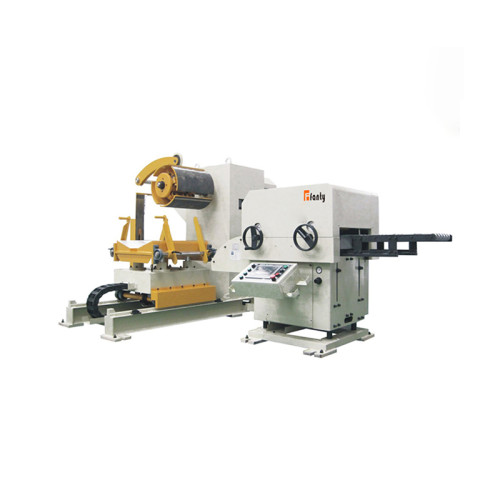
Line specifications for the machines in this case are listed on the coil line product index.
Can a coil line absorb 0.1 mm of thickness variation before scrap rises?
About ±0.08 mm on a 3.0 mm part with a ±0.15 mm blank tolerance. Beyond that, feed roll grip and die clearance both start fighting the material, and scrap moves by a percentage point or more.
Does a 9-roll head flatten crowned hot-rolled strip?
It removes coil set and most longitudinal bow. It cannot remove cross-width crown, because crown is a thickness variation rather than a bend. Expect 0.05 mm of residual crown on 1,200 mm strip.
How long does a 60 percent material switch take to stabilise?
Three to six weeks in our experience, with the first week spent measuring rather than adjusting. Plants that skip the measurement phase usually spend the time on scrap instead.
Is pickled coil harder on dies than cold-rolled?
Yes, on two counts. The rougher surface carries more abrasive scale, and the wider thickness band means the die sees a moving clearance. Tool life on a pierce die can drop 20 to 30 percent.
What does a wiper add to line length and cost?
Roughly 200 to 300 mm of line length and a wear item that needs replacing every 3 to 6 months. It is the cheapest insurance in the whole conversion.
Where to go next
Material changes fail on tolerance and surface long before they fail on tonnage. The cluster's specification pillar works through the same three variables — gauge, crown and surface — from the buying side.
Read the flatness specification guide